Engineers at Senceive have developed a rockfall detection system for sites considered vulnerable to blockage or damage caused by falling rocks and debris.
While the UK rail network does not generally face the same degree of risk from rockfall as some European routes, for example those in the Alps and Pyrenees, a significant number of rockfall events each year cause delay, disruption, and danger.
It is 20 years since the Milton Keynes-based remote monitoring specialist pioneered wireless monitoring applications for the rail sector and 10 years since its first successful application of the now widely adopted InfraGuard™ slope monitoring technology at Barnehurst in South London.
The rockfall solution uses intelligent slope monitoring features built into InfraGuard to address the unique challenges posed by rockfall hazards, providing near real-time detection of sudden events, rapid alerts, and high-quality photo verification for quick, actionable insights.

Robust & reliable
Rock slopes, unlike soil slopes, are characterised by the unpredictable movement of individual boulders or localised debris, which can be missed by a typical wireless slope monitoring system because material can fall in between tilt sensor locations. This poses a significant threat to railways, and a bespoke solution was needed. Enter Senceive’s latest development, created in close collaboration with Network Rail, the world’s largest user of wireless slope monitoring technology.
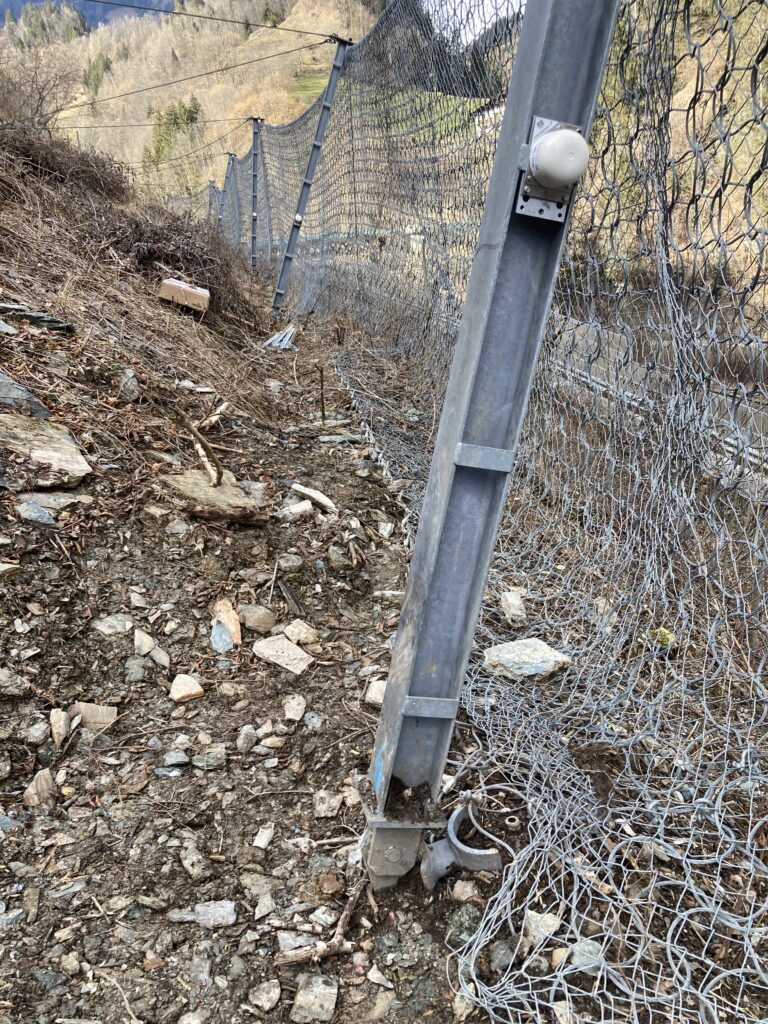
In early 2024, Network Rail commissioned trials at a test site in Switzerland, which allowed Senceive to demonstrate an innovative wireless detection system specifically tailored for rocky slopes. The system revolves around monitoring the effects of rockfall debris impacting fences and barriers and provides a robust, reliable solution with a high detection rate and a minimal incidence of false alarms.
Events can be detected in three ways:
- Rockfall detected by draw wire sensors. This method is based on sensors detecting the extension of draw wires fixed to the fence as a result of loading by rockfall debris. It is particularly sensitive to the gradual accumulation of material over an extended period.
- Impact on catchfence detected by tilt sensors. This approach is based on impact sensors in the Senceive NanoMacro tilt nodes mounted on catchfence stakes detecting a sudden acceleration or shock. It is ideal for detecting instantaneous events such as a small-to-medium sized boulder hitting the fence.
- Rotation of catchfence stakes detected by tilt sensors. This approach is based on the detection of rotational movement by the highly sensitive tilt sensors in the same NanoMacro nodes described above. Because it requires movement of the catchfence stakes, it is the most reliable way of detecting a large-scale rockfall event that hits the fence with significant force.
An event detected by any of these three methods will trigger the system to accelerate reporting and send high-resolution site images. Equipped with cameras capable of detecting football-sized objects from 50 metres in any lighting conditions, this system enables rapid decision-making, helping to significantly reduce the risk of infrastructure disruption, accidents, and derailments.
Resilient infrastructure
Built for the most rugged and remote locations, the wireless monitoring solution operates independently, requiring no external power or fixed communications infrastructure. This makes it an ideal choice for deployment in challenging, inaccessible areas where rockfall presents a serious risk to rail infrastructure. It is a modular system and can be fitted to virtually any fence.
A recent deployment in the north of England was achieved within a few hours using plastic mesh fence supported by steel stakes. Tilt nodes were fixed to the stakes, a wireless cellular gateway was added, and the system was reporting data before the team left site.
By integrating these detection capabilities with proven technology, Senceive’s rockfall monitoring system allows operators and engineers to respond quickly and effectively to rockfall hazards, ensuring safer, more resilient infrastructure.
Image credit: Senceive