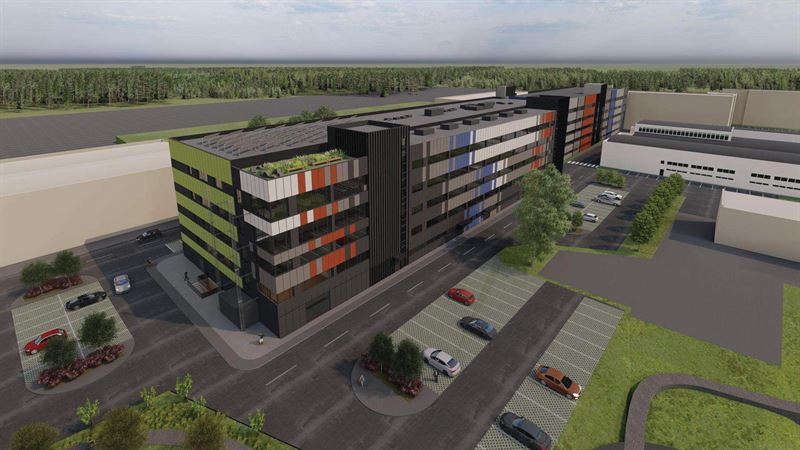
YIT Lietuva has signed a contract to build a new production facility in Vilnius for laser technology manufacturer Light Conversion, adding substantial new manufacturing space to Lithuania’s photonics sector. Construction is scheduled for completion within 16 months of contract signing.
The development will be delivered in two phases. The first comprises a five-storey production building with a basement and more than 13,400 square metres of floor area. Once the second phase is complete, the complex is expected to approach 19,000 square metres and accommodate around 500 employees.
The project includes approximately 200 parking spaces and improvements to the surrounding area, while part of the basement will serve as an employee shelter. YIT says the building will meet A++ energy-efficiency requirements and incorporate a rooftop photovoltaic installation.
Light Conversion is using the development to increase production capacity and improve operational efficiency. For a laser manufacturer, however, additional floor area only becomes useful once the building can maintain the environmental and infrastructure conditions required by precision optical and electronic manufacturing.
Ultrafast laser systems combine optics, crystals, precision mechanics, electronics, control software, cooling, and high-accuracy assembly. Production and test operations can be sensitive to temperature variation, contamination, vibration, humidity, alignment, and electrical quality, making building-services design part of the manufacturing system rather than an entirely separate construction discipline.
The factory will therefore need to coordinate ventilation, cooling, electrical distribution, laboratory areas, clean production spaces, compressed services where required, material flows, test equipment, security, offices, and logistics around equipment whose performance depends on a stable operating environment.
Ultrafast lasers produce extremely short pulses that can concentrate energy with limited thermal effect on the surrounding material. Industrial applications include precision micromachining and processing of materials used in electronics, semiconductors, medical devices, and other high-value manufacturing where conventional cutting or thermal processes can introduce too much heat or mechanical damage.
Lithuania has developed a concentrated laser and photonics sector around Vilnius through decades of collaboration between universities, research institutes, component manufacturers, and commercial laser companies. Light Conversion is one of the larger businesses in that ecosystem, making a facility designed for around 500 employees a substantial addition to the local industrial base.
The supporting supply chain extends beyond complete laser systems. Photonics manufacturing draws on optical coatings, nonlinear crystals, specialist glass, precision machining, electronics, power supplies, sensors, motion systems, software, metrology, and clean assembly. Expanding one large manufacturer can therefore pull additional work through several engineering disciplines if production volumes rise as planned.
For YIT, the contract brings conventional construction delivery into a technically demanding industrial environment. Structure and programme remain important, but so do vibration control, environmental systems, electrical resilience, commissioning, and the sequence in which production equipment is installed after building completion.
The 16-month construction timetable covers the route to a completed facility rather than fully ramped manufacturing. Once construction finishes, Light Conversion will still need to commission laboratories and production areas, install or transfer equipment, verify environmental conditions, validate test systems, and qualify production processes before the added space contributes fully to output.
That gap between building completion and useful manufacturing capacity is easy to overlook in high-technology factory announcements. Precision production rarely moves into a new building like office staff moving desks. Equipment has to be levelled, connected, calibrated, tested, and integrated with material handling and quality systems before customer products can move through the line reliably.
The building’s energy-performance target introduces another design constraint. Photonics production can carry substantial cooling and ventilation loads, and laboratories often need tighter environmental control than conventional industrial spaces. Designing those systems for efficiency at the outset is considerably easier than trying to reduce their consumption after production equipment has been installed around them.
The first construction phase alone will create more than 13,400 square metres of new space. By the end of the second, Light Conversion expects a complex approaching 19,000 square metres, giving it room for a much larger concentration of people, equipment, laboratories, and production activity.
The industrial result will not be measured by square metres. It will be measured by how quickly the completed facility can become a stable manufacturing environment for equipment whose entire purpose is precision. YIT has 16 months to provide the building; Light Conversion then has to make the tolerances inside it considerably tighter.