The University of Liverpool has secured €4.4 million of Horizon Europe funding for a five-year doctoral training programme combining advanced materials research with processing technology, automation, robotics, artificial intelligence, and data science. The programme will be based at the university’s Materials Innovation Factory and involve industrial partners alongside academic researchers.
The International Doctoral Training Centre bridging Advanced Materials Discovery and Advanced Processing Technologies to develop the Materials Innovators of the Future, shortened to iDTC-MIF, will recruit two cohorts of international postgraduate researchers. Participants will come from physical science, computer science, materials engineering, and related disciplines.
The programme is designed around an increasingly awkward problem in advanced manufacturing research: materials development rarely fits neatly inside one technical discipline. Chemistry, process conditions, data handling, automation, robotics, and manufacturing constraints all influence whether a promising laboratory material can be reproduced reliably and processed at useful scale.
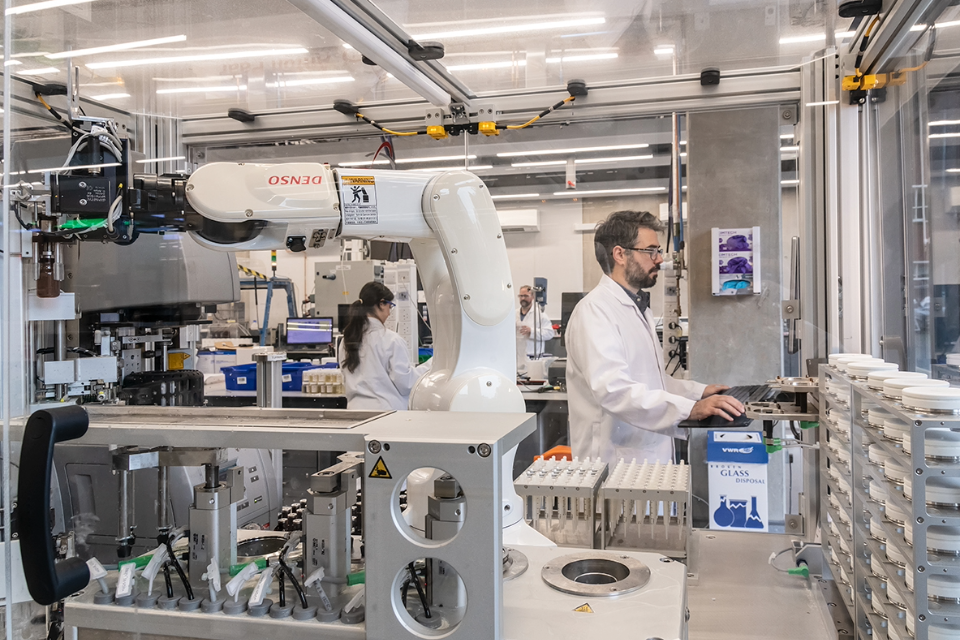
The Materials Innovation Factory gives the doctoral centre an established automated research environment rather than a conventional laboratory base. Created through collaboration between the University of Liverpool and Unilever, the facility combines materials chemistry with robotic equipment, computational tools, and high-throughput experimentation for academic and industrial users.
Automated laboratories can increase experimental throughput, but their industrial value depends on the quality and structure of the data generated. Repeating an experiment hundreds of times more quickly is of limited use if sample histories, operating conditions, measurement results, and equipment states cannot be compared consistently.
Liverpool’s work has increasingly linked robotics with computer-aided materials science, allowing experimental workflows to be planned and executed with greater automation. The new training programme will place doctoral researchers inside that environment while adding formal development in AI, data science, processing technology, and industrial collaboration.
Closed-loop experimentation is one direction for such systems. Software selects an experimental condition, automated equipment performs the work, instruments capture the result, and the data influence the next experiment. The approach can reduce the amount of routine laboratory work performed manually while allowing researchers to explore larger combinations of composition and processing conditions.
Automation does not remove the underlying materials science. Decisions still depend on whether measurements are meaningful, whether process variables have been controlled, and whether the resulting material can be manufactured outside a highly instrumented research environment. Training researchers across both domains should make it easier to identify those limits before a project reaches industrial scale-up.
The processing element is especially relevant because material properties can change substantially between laboratory preparation and industrial production. Mixing, heating, cooling, pressure, residence time, contamination, raw-material variability, forming, and finishing processes can alter structure and performance even where the chemical composition remains nominally unchanged.
Industrial partners will give the two doctoral cohorts exposure to those practical constraints. Equipment selection, maintenance, quality control, process windows, data traceability, and cost become more prominent as research moves closer to production, and each can determine whether a material leaves the laboratory or remains an interesting paper.
The programme also reflects a wider change in technical skills. Automation specialists working in laboratories need enough domain knowledge to understand the physical processes they are controlling, while materials scientists increasingly need enough digital knowledge to design experiments that produce structured, machine-readable information.
Building those capabilities together during doctoral training avoids treating automation as a separate service added after the scientific work has already been designed. It also exposes researchers to the compromises that appear when theoretical experimental freedom meets the less generous limits of industrial equipment, production schedules, and budgets.
The €4.4 million award builds on an existing facility rather than creating the automation infrastructure from scratch. Liverpool previously developed the Materials Innovation Factory as a major research environment with laboratory and office space for university researchers and industrial scientists, supported by a concentration of robotic and analytical equipment.
The five-year programme will be judged less by the number of experiments its robots can perform than by the researchers emerging from it. Advanced manufacturing already produces plenty of promising materials data; the persistent shortage is people able to connect discovery, processing, automation, and production without assuming that one discipline will tidy up the problems left by another.