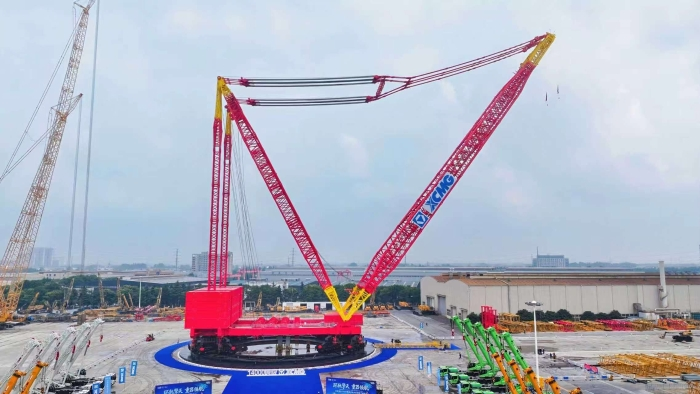
XCMG has completed final assembly of the first main unit of a ring crane designed for a combined maximum lifting capacity of 14,000 tonnes, moving an unusually large piece of construction equipment from development into physical production.
The crane has been jointly developed by XCMG and Sinopec Heavy Lifting & Transportation and uses a modular architecture built around two main units working in tandem. The first unit has now rolled off the production line and can also operate independently while its partner unit is completed and the overall system moves towards integration.
Once both units are combined, XCMG gives the crane a maximum lifting moment of 700,000 tonne-metres alongside its 14,000-tonne rated capacity. Those figures place the machine firmly in the category of project equipment intended for exceptionally heavy prefabricated modules, towers, vessels, and generating equipment rather than conventional construction lifts.
Ring cranes achieve that scale by rotating their superstructure around a large circular track rather than relying on the more familiar undercarriage used by crawler and mobile cranes. The arrangement distributes high loads over a prepared foundation and allows the crane to slew around a fixed working area while maintaining the structural geometry needed for very large lifts.
The machine is being developed principally around energy infrastructure. XCMG identifies nuclear power, conventional energy, and wind projects among the target applications, all sectors where the increasing size of individual modules has pushed lifting requirements beyond the capacity of many established machines.
In conventional energy and process construction, larger cranes can allow towers and vessels to be fabricated in fewer sections before installation. Moving more welding, assembly, inspection, and testing into controlled fabrication environments can reduce some work at height and shorten parts of the site programme, although transport and lifting constraints determine how far that approach can be taken.
Nuclear projects present an even stronger case for extreme lift capacity because modular construction increasingly relies on large preassembled structures being installed as complete units. XCMG says its ring crane will be able to handle major equipment for two nuclear islands from one crane position and with a single boom configuration.
If demonstrated in live project conditions, that could reduce the dismantling, repositioning, and re-rigging required between major lifts. The actual programme benefit will still depend on ground preparation, site geometry, module sequence, weather conditions, rigging arrangements, and the time required to configure the crane safely around each load.
Wind power is creating another class of heavy-lift problem. Turbine ratings, tower heights, nacelle mass, and blade dimensions have increased steadily, forcing lifting and installation equipment into capacity ranges that would have appeared unusual only a few generations of turbines ago.
XCMG says the ring crane’s height and lifting capacity can support larger wind installations, although the current announcement does not set out a specific project or turbine rating for its first deployment. Its initial value is therefore the demonstrated manufacture of the equipment rather than a completed customer lift.
The drive arrangement is also unusual. XCMG has adopted an electric direct-drive system that converts electrical power directly into motion, replacing some of the conventional fuel-powered drivetrain used in extremely heavy lifting equipment.
The manufacturer claims the design can reduce energy consumption by more than 30% while improving operating efficiency by 20%. Those remain XCMG performance claims rather than independently verified operating results and will depend on duty cycle, project conditions, and the baseline machine used for comparison.
Electrifying machinery at this scale creates more than an energy-efficiency exercise. Hoisting, slewing, braking, control, redundancy, and emergency systems all have to handle enormous loads predictably, while electrical distribution and power electronics must accommodate high transient demands without compromising safe operation.
The consequence of a control or structural problem is rather different when thousands of tonnes are suspended from the machine. Monitoring, load measurement, braking, structural health, control-system redundancy, and disciplined operating procedures therefore matter at least as much as peak lifting capacity.
The modular design also reflects the logistical problem created by the crane itself. Equipment capable of lifting extremely large industrial modules cannot normally travel between projects as a complete machine, so its own structures, drives, ropes, controls, and track system have to be designed around transport, site assembly, inspection, commissioning, and eventual relocation.
XCMG and Sinopec signed the development contract in October 2025 after work that XCMG says stretches back to 2015. The first completed main unit therefore represents a production milestone in a programme that has already spent years moving through engineering and manufacturing development.
The full system still has to be completed and demonstrated. A second main unit must be manufactured, the two sections integrated, and the complete crane taken through commissioning and increasingly demanding load tests before an operator can use the published maximum ratings on a live project.
The first unit nevertheless turns the project from a design programme into physical heavy equipment. For a machine designed around a 14,000-tonne headline figure, the next phase will be markedly less concerned with records and rather more concerned with repeatable control, structural behaviour, and whether project engineers are prepared to put something extremely expensive on the hook.