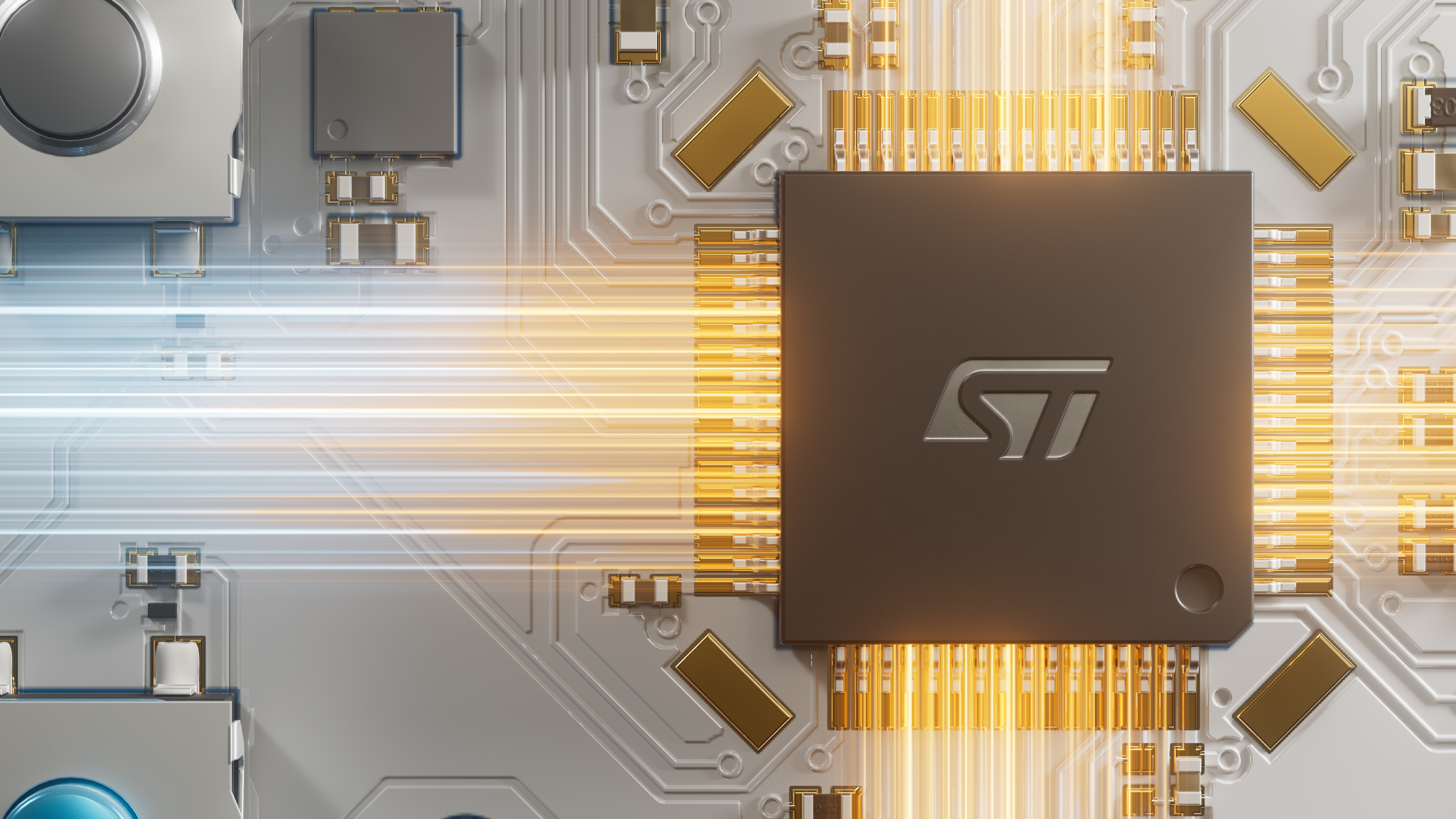
STMicroelectronics has introduced a unified STM32 microcontroller platform spanning industrial, automotive and robotics applications, with three new STM32A product series intended to support greater software reuse across systems with different safety and performance requirements.
The strategy was unveiled at STM32 Summit 2026 on 4 November. It combines existing STM32 technologies, common development tools and a new family of microcontrollers aimed at applications requiring dependable real-time control and functional safety.
STMicroelectronics has begun supplying samples of its first three STM32A series to customers, with broader availability planned during 2027. The initial products are STM32A4, STM32A5 and STM32A9, each addressing different control and system integration requirements.
The announcement concerns a common development architecture rather than a single microcontroller intended to serve every industrial or automotive application. Individual devices will continue to require selection and qualification according to the intended equipment and operating conditions.
STM32A4 targets entry-level automotive control nodes and local safety functions. The series is intended for applications requiring embedded processing close to sensors, actuators and other vehicle components.
STM32A5 addresses mid-range safety-critical systems, including industrial automation, robotics, energy equipment and automotive applications.
STM32A9 is designed for more demanding multi-domain control, where real-time processing, low latency, Ethernet connectivity and deterministic communication become important system requirements.
STMicroelectronics is seeking to reduce differences between development environments used in markets that increasingly share technologies for sensing, embedded control, connectivity and security.
Industrial machines, vehicles and robots all use microcontrollers to collect information from sensors and execute software that influences the operation of physical equipment. The underlying functions can be similar even where the application-specific requirements differ substantially.
A microcontroller integrates processing, memory and interfaces for communicating with other electronic components. It may operate independently within a small device or form part of a distributed system containing several controllers.
In industrial motion control, a microcontroller can process measurements relating to motor current, speed or position and use the resulting information to calculate control commands.
The software must respond within time limits determined by the behaviour of the machine. A delay that is acceptable in a monitoring application may be unsuitable for a control loop requiring rapid and consistent responses.
Robotic systems introduce similar timing requirements across motors, sensors and control equipment. Individual controllers may regulate local functions while communicating with systems responsible for coordinating more complex movement.
Automotive applications also depend on distributed control, but their hardware and software are subject to additional qualification, reliability and safety requirements associated with the vehicle environment.
The unified STM32 approach is intended to give developers a common foundation while allowing devices to be selected for these different requirements.
Remi El-Ouazzane, president of the Microcontrollers, Digital ICs and RF Products Group at STMicroelectronics, said the strategy was intended to reduce fragmentation in embedded development.
He said: “Embedded innovation should not require developers to start again with every new product.”
The platform builds on Arm Cortex-M processor technology, which provides a common architectural foundation across different STM32 microcontroller families.
Using familiar processor architecture and development methods can allow engineering teams to retain established knowledge and portions of their software when moving between devices.
Reuse still depends on the hardware and software requirements of the new application. Differences in available memory, peripheral interfaces, security functions and operating conditions may require changes to the software and its subsequent testing.
STMicroelectronics is also maintaining STM32Cube as a common development environment, supported by the wider Arm software ecosystem.
These tools provide resources for configuring microcontrollers, developing embedded software and integrating functions into an application. A consistent environment can reduce the amount of work associated with learning an entirely different platform when a product design changes.
Development tools do not remove the need for application-specific validation. Software controlling machinery or vehicle equipment must still be assessed against the behaviour of the completed system.
Functional safety is particularly important where an electronic or software fault could create a hazardous condition. Safety engineering involves identifying possible failures, assessing their consequences and establishing appropriate measures to reduce risk.
Depending on the application, those measures may include hardware diagnostics, monitoring, redundancy or controlled responses when abnormal operation is detected.
The STM32A portfolio is intended to provide capabilities and supporting resources for such applications. The finished machine or vehicle system must nevertheless be developed and assessed against the safety requirements relevant to its use.
The company also identifies physical artificial intelligence as an emerging area in which embedded control and more advanced processing systems are becoming increasingly connected.
Physical AI involves computing systems interpreting information about their surroundings and influencing the operation of equipment such as robots or automated machinery.
Some decisions may involve machine learning, while the underlying physical system continues to require predictable sensor processing, communication and actuator control.
Microcontrollers can provide local processing and control close to the equipment. More demanding AI workloads may require separate processors or additional computing resources.
The unified STM32 platform is intended to support the interaction between these functions, including the movement of information between local controllers and other parts of the system.
STMicroelectronics is continuing its technical collaboration with Arm, particularly around future Cortex-M technology and its use in embedded systems.
Drew Henry, executive vice-president of Physical AI at Arm, identified intelligence operating close to physical equipment as an important direction for processor development.
The company is also aligning its semiconductor manufacturing roadmap around several process technologies. Its stated foundation includes 40nm embedded Flash, 18nm fully depleted silicon-on-insulator technology with embedded phase-change memory, and embedded non-volatile memory technologies associated with TSMC.
These technologies provide different options for manufacturing microcontrollers with the processing, memory and peripheral characteristics required by their intended applications.
Non-volatile memory is important because microcontrollers commonly need to retain programme instructions and configuration information when power is removed.
Memory capacity, endurance, access characteristics and operating conditions can influence device selection. Manufacturing technology must therefore be considered alongside the processing architecture and requirements of the finished product.
The common STM32 strategy does not mean that every device will use the same fabrication process or contain identical hardware. STMicroelectronics intends to provide continuity across a range of products while retaining the ability to develop devices for different markets.
The first STM32A devices are now available for customer evaluation. Broader commercial availability is expected to begin with STM32A9 in the first half of 2027, followed by further development across the portfolio.
Customer qualification will establish how the devices perform within particular industrial, automotive and robotic systems. The company’s immediate commitment is a common architectural and software direction, with the initial hardware entering the evaluation stage ahead of wider availability.