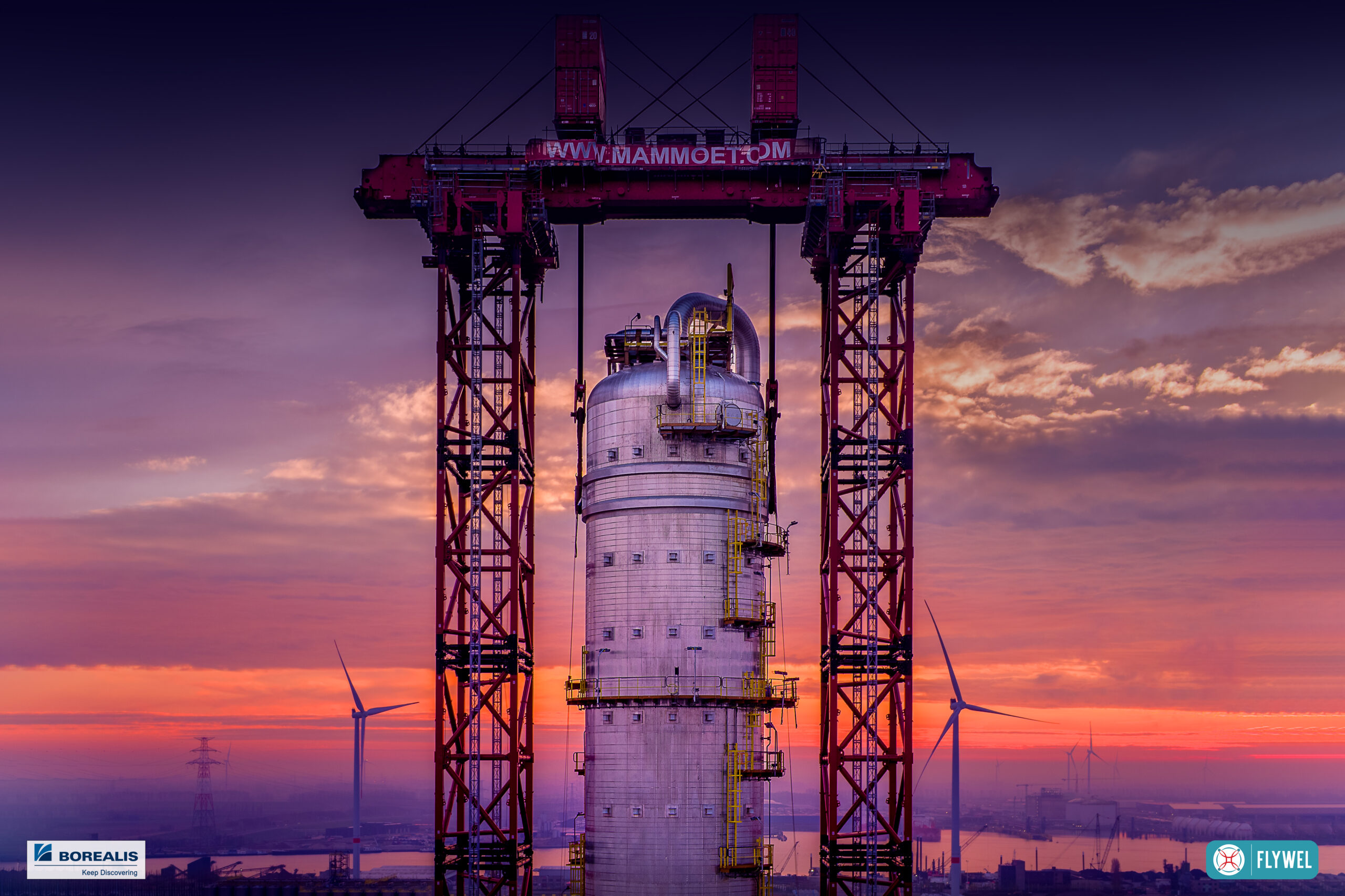
Borouge International has reached mechanical completion of its second propane dehydrogenation plant in Kallo, Belgium, advancing a wider manufacturing expansion programme spanning European polymer facilities and ethylene production projects in the United Arab Emirates.
The Kallo PDH2 facility has a designed annual capacity of approximately 750,000 tonnes of propylene, with start-up expected during the first half of 2027. Its physical construction milestone was confirmed on 4 November as the group outlined plans to reach 13.8 million tonnes of annual production capacity by 2030.
Mechanical completion confirms that the installation has progressed to the stage at which commissioning can be undertaken. The announcement does not establish that the new plant is producing propylene commercially or has demonstrated operation at its designed output.
The Belgian project forms part of an investment programme that includes new polypropylene manufacturing capacity in Germany, upgraded compounding operations in Austria and proposals to increase ethylene production at Ruwais in the UAE.
At Kallo, the new plant will manufacture propylene through propane dehydrogenation, a chemical process that removes hydrogen from propane. The resulting propylene is an important feedstock for polypropylene production and several other industrial chemical processes.
Propane dehydrogenation requires controlled reaction conditions and substantial thermal energy. The operating system must manage feedstock preparation, the reaction process, separation of the resulting product streams and the treatment or use of associated by-products.
The performance of an industrial dehydrogenation plant depends on factors including conversion, product selectivity, catalyst behaviour, energy consumption and the availability of supporting utilities. Establishing reliable operation requires these systems to function together under the conditions anticipated in the plant’s design.
Construction completion is followed by checks and commissioning activities involving equipment integrity, instrumentation, control systems and safety arrangements. Utilities and process systems must be prepared before feedstocks are introduced through a controlled start-up sequence.
Initial production then provides an opportunity to establish whether the installation can manufacture material meeting the required specifications while maintaining stable operation. Output may increase progressively during a ramp-up period as operating conditions are adjusted and performance is verified.
Borouge has scheduled the start-up of Kallo PDH2 for the first half of 2027. The timetable remains dependent on the successful completion of commissioning and does not represent a confirmed date for full commercial capacity.
The plant adds to the company’s established activities in the Antwerp industrial region, where chemical manufacturing benefits from connections to feedstock supply, processing infrastructure and industrial logistics networks.
Propylene production is closely linked to polypropylene manufacturing, although the two processes require different equipment. Polypropylene is made through polymerisation, during which propylene molecules are combined into longer polymer chains.
The characteristics of the finished material depend on the polymerisation technology, process conditions and product formulation. Different grades can be developed for applications including packaging, automotive parts, industrial components and manufactured consumer products.
In Germany, Borouge International is expanding its Borstar Nextension polypropylene programme at Burghausen. Construction began in September 2026 on a facility intended to increase production of differentiated polypropylene materials.
The German project remains under construction. Borouge has not confirmed its completed capacity or a commissioning date in the 4 November project update, so the announcement should not be interpreted as additional polymer output already entering the market.
The company has also inaugurated an upgraded speciality polypropylene compounding plant at Schwechat in Austria, following an investment of approximately €100 million.
Compounding takes polymer material and combines it with selected additives or other ingredients to produce formulations with defined processing and performance characteristics. This downstream activity differs from manufacturing the underlying polypropylene resin.
Depending on the application, compounding can be used to modify properties such as stiffness, impact behaviour, processability or resistance to particular operating conditions. The quality of the finished product depends on consistent ingredient measurement, mixing, temperature control and processing.
The Schwechat development has reached a different stage from the investments in Belgium and Germany. Its upgraded facilities have been inaugurated, while Kallo is approaching commissioning and the Burghausen project remains under construction.
Borouge International is also progressing work on two ethane cracker units in the UAE. At Ruwais, it has commenced early engineering services with Linde Engineering for an expansion of Ethylene Unit 2, known as EU2.
The proposal is intended to add approximately 230,000 tonnes of annual ethylene production capacity. Linde licensed the original plant and is undertaking engineering work ahead of the next contracting stages.
Ethane cracking uses high temperatures to convert ethane into ethylene and other products. The resulting material must be separated and purified before it can be supplied to downstream chemical processes.
Ethylene is widely used to manufacture polyethylene, alongside other chemical products. Increasing ethylene production can support further polymer manufacturing, provided the wider complex has sufficient downstream processing capacity and supporting infrastructure.
The EU2 expansion is still progressing through engineering development. Borouge has not announced that the additional 230,000 tonnes of production capacity has been installed or commissioned.
Linde Engineering has separately received a letter of award for pre-front-end engineering and design work on Ethylene Unit 3, or EU3. Additional ethylene from the proposed upgrade is intended for sale into the base chemicals market.
Pre-front-end engineering provides the technical basis for evaluating process options and defining requirements before later engineering and investment stages. It does not itself represent approval of a completed construction programme.
The company is also progressing Borouge 4 at Ruwais. The project, owned by ADNOC and OMV and operated by Borouge Plc, is expected to provide an additional 1.4 million tonnes of polyethylene capacity once fully ramped up.
This capacity remains a future contribution rather than current output. Its delivery will depend on completion, commissioning and successful production ramp-up across the relevant manufacturing systems.
Dr Hasan Karam, chief operating officer of Borouge International, said: “We are unlocking new capacity through our strategic growth and expansion projects”.
The company’s expansion programme covers several linked stages of chemicals manufacturing, from olefin production to polymer manufacture and the compounding of specialist materials. Coordinating these activities can affect the availability of feedstocks and the range of products supplied to industrial customers.
Investment in additional chemical production also creates requirements for energy, utilities, process equipment, storage and transportation. The performance of each new installation depends on its integration with the other operations and infrastructure serving the manufacturing site.
Borouge International was formed in 2026 through the combination of Borouge Plc, Borealis and NOVA Chemicals. Headquartered in Vienna, the group is backed by XRG, the international investment arm of ADNOC, and OMV.
The company describes a global manufacturing network comprising 30 sites and has set a target of 13.8 million tonnes of annual capacity by 2030. That target combines existing operations with planned developments and is not a statement of current production.
The next significant milestone is the commissioning and start-up of Kallo PDH2 in the first half of 2027. The progress of construction in Germany and engineering work in the UAE will determine when further announced capacity can enter commercial production.