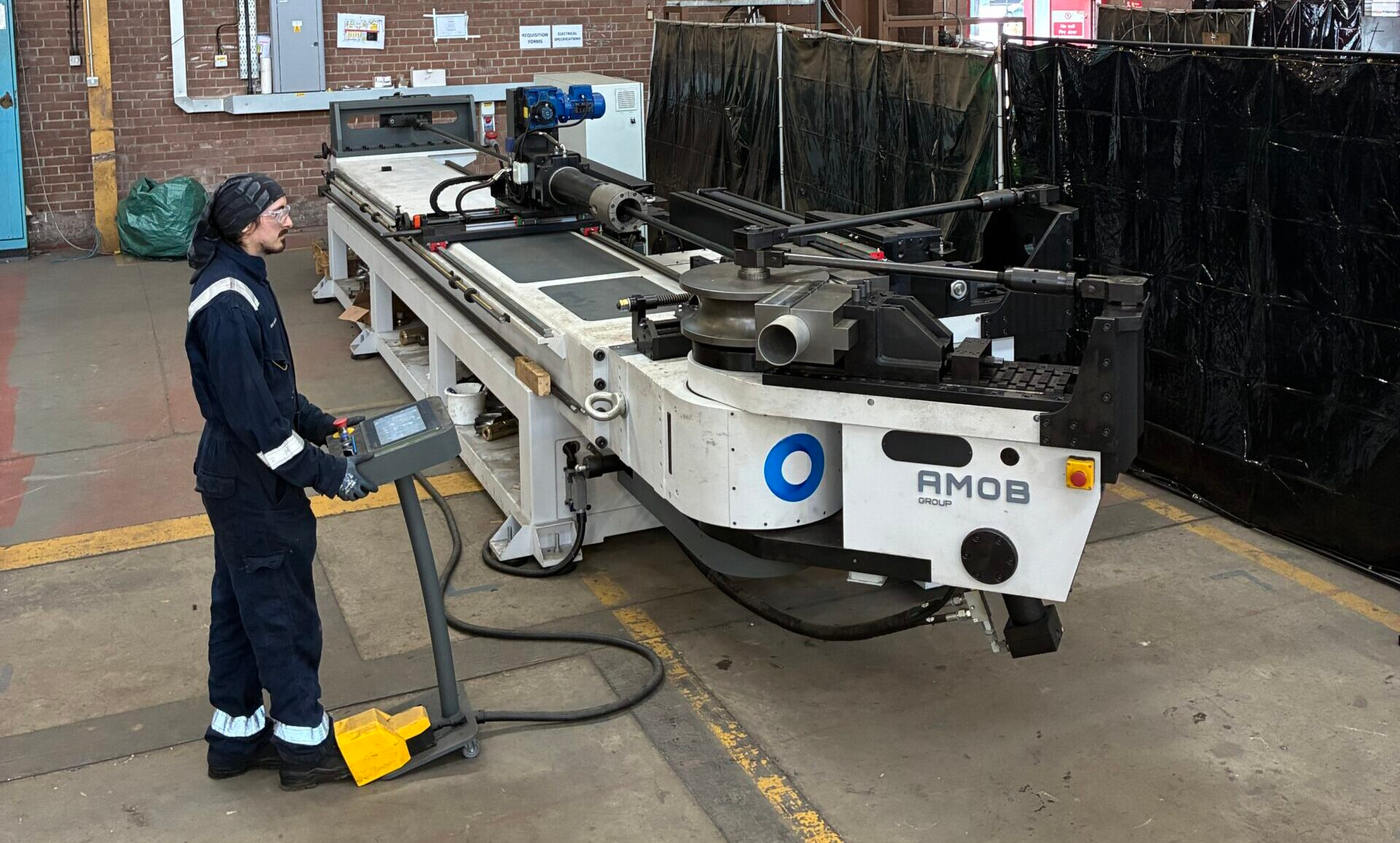
Star Refrigeration has opened its CNC pipe-bending capability at its Westway manufacturing facility near Glasgow to external industrial customers. The Scottish company, best known for refrigeration and large heat-pump systems, is offering one-off components, prototypes, subcontracted overflow work and production batches. The equipment can form specified carbon-steel and stainless-steel pipework, giving fabrication companies another option where a formed bend can replace a cut-and-weld assembly.
The company says the machine can bend carbon steel and stainless-steel pipe up to 100NB, corresponding to 114.3mm outside diameter, including four-inch Schedule 40 material. The equipment is described as one of a small number of installations in Scotland capable of handling industrial pipework at that size. Trade reporting identifies the newly installed bender as an AMOB CNC machine, although Star has not published a complete tooling specification, maximum bend angle or minimum qualified bend radius in its service announcement.
The machine uses computer-controlled positioning and forming tools to bend pipe to the geometry set out in a job programme. A formed bend can replace a joint made by cutting straight pipe sections and welding a fitting into place, reducing the number of separate components and potential inspection points in a suitable assembly. It does not automatically remove the need for welded joints elsewhere in the system. The outcome depends on bend radius, space available for forming, the route of the pipework and the final installation specification.
The material envelope matters because different pipe grades and wall thicknesses behave differently during bending. A pipe can ovalise, thin on the outside of the curve or wrinkle on the inside if the tooling and bend parameters are unsuitable. Springback after forming can also affect the final angle. These are engineering constraints rather than defects that CNC control alone automatically removes. Star has not released bend qualification data for every offered material, and customers will still need to agree applicable dimensional tolerances and acceptance criteria.
Removing welded joints may simplify fabrication in applications where each joint would otherwise require preparation, welding, inspection and cleaning. The number of operations saved depends on the layout and whether a bend can replace a particular fabricated assembly without interfering with installation clearances. Some geometries cannot be formed from one length of pipe, while other designs require fittings or welds for maintenance, alignment or access. Star’s service is therefore another fabrication option, not a universal substitute for welding.
Star argues that using bends in place of fabricated elbow assemblies can reduce welding, associated hot work, energy consumption and production cost. The statement is an unquantified supplier claim: no comparative test, measured kilowatt-hours, percentage cost reduction or documented factory cycle time has been released. Welding may still be required at connections or on assemblies that cannot be made from one length of pipe. Actual savings also depend on material prices, the reject rate, tooling changes and the inspection standards set by the customer.
Star’s background in industrial refrigeration is relevant to the service. Refrigeration and heat pump installations use networks of pipework to convey fluids under defined pressure and temperature conditions, and fabricated assemblies must be compatible with those duties. A controlled bend can alter the number and location of welded connections, but it also changes local geometry and must be considered in the calculation of pipe stresses and pressure losses. The service announcement does not amount to a certification of every bend for any particular pressure system or refrigerant.
External customers will need to specify outside diameter, wall thickness, material grade, minimum bend radius, straight leg lengths, orientation and the inspection documentation required for the finished item. Springback, ovality, wall thinning and local wrinkling can affect formed pipe, particularly when the ratio of bend radius to diameter is small. A prototype can establish whether tooling and programme settings produce the required geometry before series work starts. Star has not provided a full bend-radius envelope, quantified hourly throughput or quoted delivery lead times.
The Westway installation builds on Star’s more than 55 years of designing and manufacturing industrial refrigeration and heat pump equipment. Its opening to the wider market effectively offers spare or additional specialist capability as a contracted manufacturing service. Star has not specified whether the new work will occupy previously unused capacity or require changes to the production schedule for its own equipment. Nor has it disclosed a separate investment value associated with the external service.
Outsourced bending could reduce the capital expenditure required by smaller fabricators when projects involve pipe sizes or bend forms outside their existing machinery range. It also transfers part of the process control to a specialist supplier, leaving customers responsible for specifying the finished component and confirming its suitability for the end system. Traceability and inspection requirements may differ significantly between ordinary process pipework, regulated pressure systems and high-integrity installations.
The Westway service is being offered to UK fabricators and engineering contractors now, but Star has not disclosed machine utilisation, available external capacity, contract volumes or price comparisons with welded construction. The disclosed capability reaches 100NB pipework, equivalent to 114.3mm outside diameter for the stated four-inch pipe size, subject to the equipment and tooling limits for the chosen material. The decision to outsource will depend on dimensional acceptance, repeatability, transport and the number of fabrication operations that a formed bend actually removes.