Siemens has opened a €115 million rail technology manufacturing and research centre in Chippenham, Wiltshire, bringing signalling production, engineering and testing into a new facility at SouthPoint Business Park.
The investment replaces the company’s historic neighbouring operation and retains approximately 800 local jobs. Siemens Mobility has transferred the workforce to the new site without interrupting production, maintaining the continuity of an established manufacturing operation while introducing updated industrial facilities.
Opened on 6 November, the centre will develop, test and manufacture signalling and control systems for railway infrastructure in Britain and overseas. Siemens says approximately 40% of the products manufactured in Chippenham are exported, giving the operation a substantial role within its international rail technology business.
The investment is equivalent to approximately £100 million, the figure Siemens used when the project was announced in 2024. The opening represents the completion of that previously committed development rather than a new investment decision or an announcement of 800 additional positions.
Production at the site includes equipment for computer-based interlocking systems and the European Train Control System (ETCS), technologies used to manage railway movements and provide protection against unsafe train operation.
Interlocking equipment controls the relationship between signals, points and the routes available to trains. Before a movement can be authorised, the system must establish that the relevant route is safe and that conflicting movements have been prevented. Computer-based systems carry out these functions through safety-related control logic and interfaces to railway equipment.
ETCS provides a standardised framework for supervising train movements and enforcing permitted operating limits. Depending on the level and configuration of the installation, information passes between trackside and onboard systems to support the monitoring of movement authorities and train speed.
The two technologies perform related but distinct functions. Interlocking protects the configuration of routes through railway infrastructure, while train control and protection equipment monitors whether train movements remain within the permitted conditions. Their integration requires defined communications, system interfaces and verification procedures.
Manufacturing equipment for these applications demands consistent production methods and traceability. Individual electronic assemblies and control devices must satisfy technical specifications, while the completed systems require appropriate testing before they are installed as part of operational railway infrastructure.
The new Chippenham centre brings those manufacturing activities into a facility designed for research and engineering development as well as production. Siemens has not published a breakdown of the €115 million investment between construction, machinery, laboratories and other project costs.
Combining technical functions at one site can simplify coordination between product design, manufacturing and verification teams. Engineers developing a revised component or control system must account for production feasibility, compatibility with related equipment and the evidence needed to demonstrate that a change meets the applicable requirements.
Safety-related railway systems also have long operating lives. Equipment introduced into existing infrastructure must be compatible with the wider installation, while software and hardware changes are subject to control because alterations can affect functions beyond the component being modified.
These requirements distinguish railway technology manufacturing from production in which a component can be replaced solely on the basis of its physical dimensions or basic electrical performance. System configuration, documented testing and the relationship between connected devices are part of the engineering process.
Chippenham’s rail engineering history dates to 1897, when an operation established by Evans O’Donnell began developing the business that later became associated with Westinghouse Brake & Signalling. The town subsequently became an important centre for railway control technology.
Equipment developed through the Chippenham operation has supported projects including London’s Elizabeth, Victoria and Central lines. The new facility preserves that local engineering presence while providing production and development space for current digital signalling programmes.
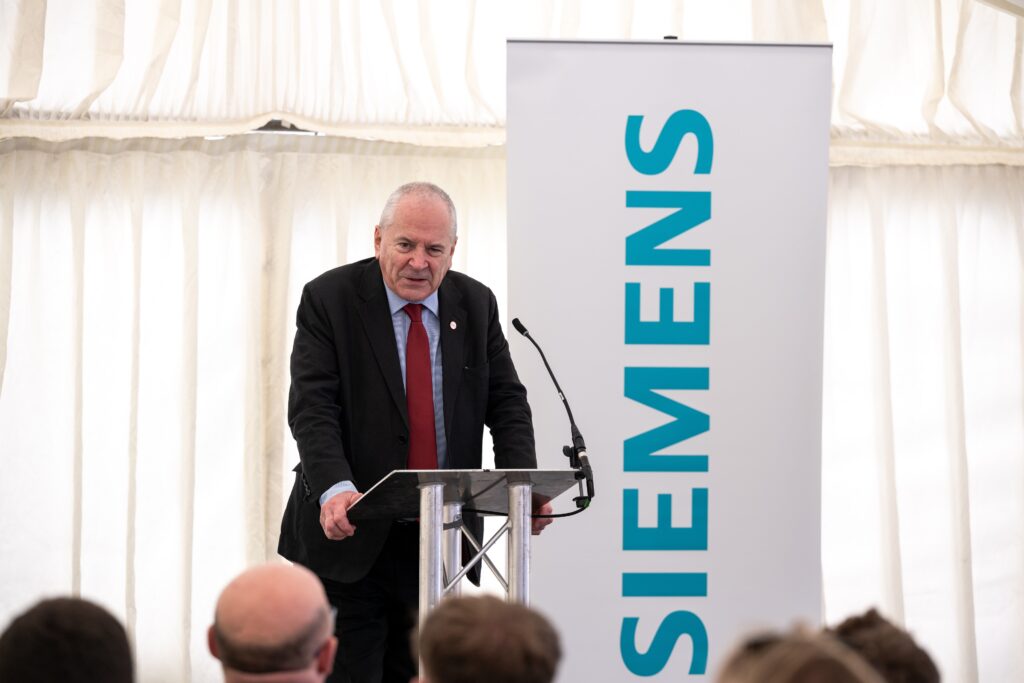
Michael Peter, president of Siemens Mobility, said the investment reflected the company’s long-term commitment to the UK and the engineering expertise established in the town.
“For over a century, this town has been a powerhouse of rail engineering,” Peter said.
The building has achieved the BREEAM Excellent standard, with energy-efficient office and manufacturing areas incorporated into its design. Siemens also reports a 10% net increase in biodiversity through landscaping and native planting associated with the development.
Those building measures are separate from the performance of the railway systems manufactured at the site. The environmental characteristics of individual products and infrastructure projects will depend on their design, manufacture, installation and operating conditions.
The opening also extends Siemens Mobility’s investment in its British industrial operations. A separate €230 million rail manufacturing village is being developed at Goole in East Yorkshire, alongside the company’s existing rail maintenance and engineering facilities.
Siemens Mobility employs approximately 5,000 people across the UK, with activities spanning rolling stock, signalling, electrification, maintenance, software and integrated transport systems. The Chippenham investment is focused on railway infrastructure technology rather than the manufacture of complete trains.
The company is also maintaining engineering skills programmes linked to its UK operations. During the previous year, Siemens UK and Ireland welcomed 326 apprentices, graduates and interns, while the National Training Academy for Rail has trained more than 28,000 people.
An engineering education event accompanied the opening, with local schoolchildren attending a practical STEM session that was broadcast to more than 1,000 pupils nationally. The programme formed part of Siemens’ wider work with schools and technical training organisations.
Production is now operating from SouthPoint Business Park following the completed workforce transfer. The facility will support future digital signalling and control system programmes, with its manufacturing, research and testing activities established in the new Chippenham centre.