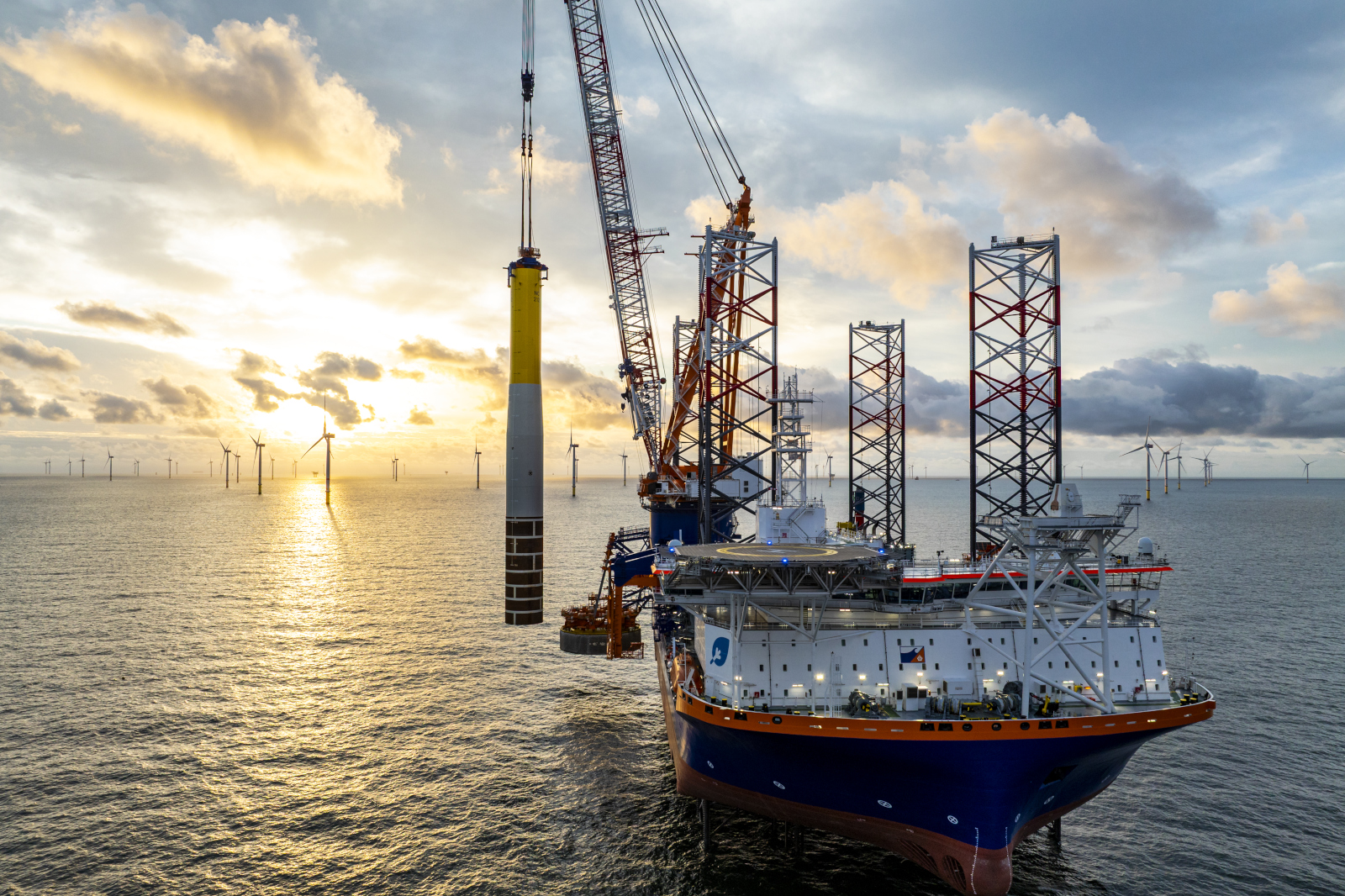
RWE has received the first ten monopile foundations for Nordseecluster B at the port of Eemshaven in the Netherlands, beginning deliveries of the heavy steel structures required for the second phase of its German offshore wind development.
The foundations have been unloaded at the Buss Ports heavy-lift terminal, where a total of 60 monopiles will be handled during 2026 and 2027. Each structure measures approximately 81 metres in length and weighs around 1,350 tonnes, requiring specialised facilities for unloading, temporary storage and subsequent transport to the offshore construction site.
Dajin Heavy Industry is manufacturing and supplying the foundations. Installation offshore is scheduled to begin in 2027, followed by turbine installation during 2028 and commercial operation of the 900MW second phase at the beginning of 2029.
Nordseecluster B forms part of a two-stage development located approximately 50 kilometres north of the German island of Juist. The first phase, Nordseecluster A, has a capacity of 660MW and is expected to complete commissioning in early 2027.
The combined project has a nominal capacity of 1,560MW, generally described as approximately 1.6GW. It is owned by RWE, with a 51% stake, and Norges Bank Investment Management, which holds the remaining 49%. RWE is responsible for construction and subsequent operation.
Monopile foundations are large cylindrical steel structures that transfer the loads from offshore wind turbines into the seabed. Their dimensions are determined by factors including water depth, seabed conditions, turbine size and the forces expected during the project’s operating life.
Wind turbines impose substantial loads on their supporting structures. Forces acting on the rotor and tower create bending moments that must be transferred through the foundation into the surrounding ground, while waves and currents introduce additional loading.
The foundation must accommodate both extreme operating conditions and the cumulative effects of repeated loading. Fatigue performance is an important engineering consideration because the structure will experience many loading cycles over its intended service life.
Manufacturing a monopile of this scale requires large steel sections to be formed and joined to the specified dimensions. Welding, inspection and dimensional control must support the structural requirements of the finished component, with the manufacturing process designed around the substantial mass and size of the assembly.
Transport introduces a different set of constraints. Each foundation must be supported in a way that prevents unwanted movement or damage, while lifting operations must account for its weight, geometry and the distribution of loads along the structure.
Port facilities capable of handling such components require sufficient quay capacity, suitable lifting equipment and storage areas that can accommodate large structures while allowing other construction activities to continue. The arrival of ten monopiles therefore marks progress in the supply chain as well as the beginning of a substantial logistics operation.
Buss Terminal Eemshaven provides the heavy-lift handling and storage capability used for the latest delivery. The port is also involved in other offshore wind construction programmes, allowing specialist facilities and experience to be used across several projects.
Handling monopiles at a port does not mean they have been installed offshore. The structures must still be loaded for marine transport, moved to the construction area and installed using vessels and equipment suitable for the foundation design and seabed conditions.
Offshore installation programmes are sensitive to vessel availability and weather. Wind, wave conditions and other marine operating limits can affect when heavy components can be transported or installed, even after the structures have reached the assembly port.
The sequence of deliveries and installation work must therefore be coordinated to avoid excessive storage requirements or interruptions to offshore construction. Manufacturing and port operations may proceed at different rates from installation, creating a need to manage component inventories and transport schedules.
Nordseecluster B will ultimately use 60 offshore wind turbines supplied by Vestas, each with a nominal capacity of 15MW. The turbine installation programme is scheduled for 2028, after the foundation installation campaign begins.
Each turbine will require a suitable support structure and electrical connection before it can contribute generation to the wider wind farm. Foundations form an essential part of the physical infrastructure, but their completion does not establish that the generating equipment or associated electrical systems are ready for operation.
Offshore wind construction also requires inter-array cables, substations and connections linking the turbines to the transmission network. The electrical systems must be tested and commissioned alongside the generating equipment before commercial operation can begin.
Nordseecluster A is further advanced. RWE reported first electricity generation from that phase in July 2026, although the wider commissioning programme was still progressing. The arrival of foundations for Nordseecluster B illustrates the overlap between the two construction stages.
The company expects the completed cluster to generate approximately 6.5TWh of electricity annually. That is a projected annual output rather than generation already achieved, with actual production depending on wind conditions, equipment availability and electrical losses.
RWE intends to use electricity from the project to serve industrial and commercial customers through long-term supply arrangements. Earlier in 2026, the company signed a power purchase agreement with Amazon covering 110MW of capacity from Nordseecluster B.
Such agreements can connect large electricity consumers with new generating capacity, although the contractual capacity should not be confused with a guarantee of continuous electrical output. Wind generation varies with weather conditions, while the commercial supply arrangement determines how that generation is allocated.
The current milestone concerns the physical delivery of the first foundation batch. Further structures are scheduled to pass through Eemshaven during the remainder of 2026 and 2027, ahead of installation offshore and the turbine construction programme leading towards the planned 2029 commercial start.