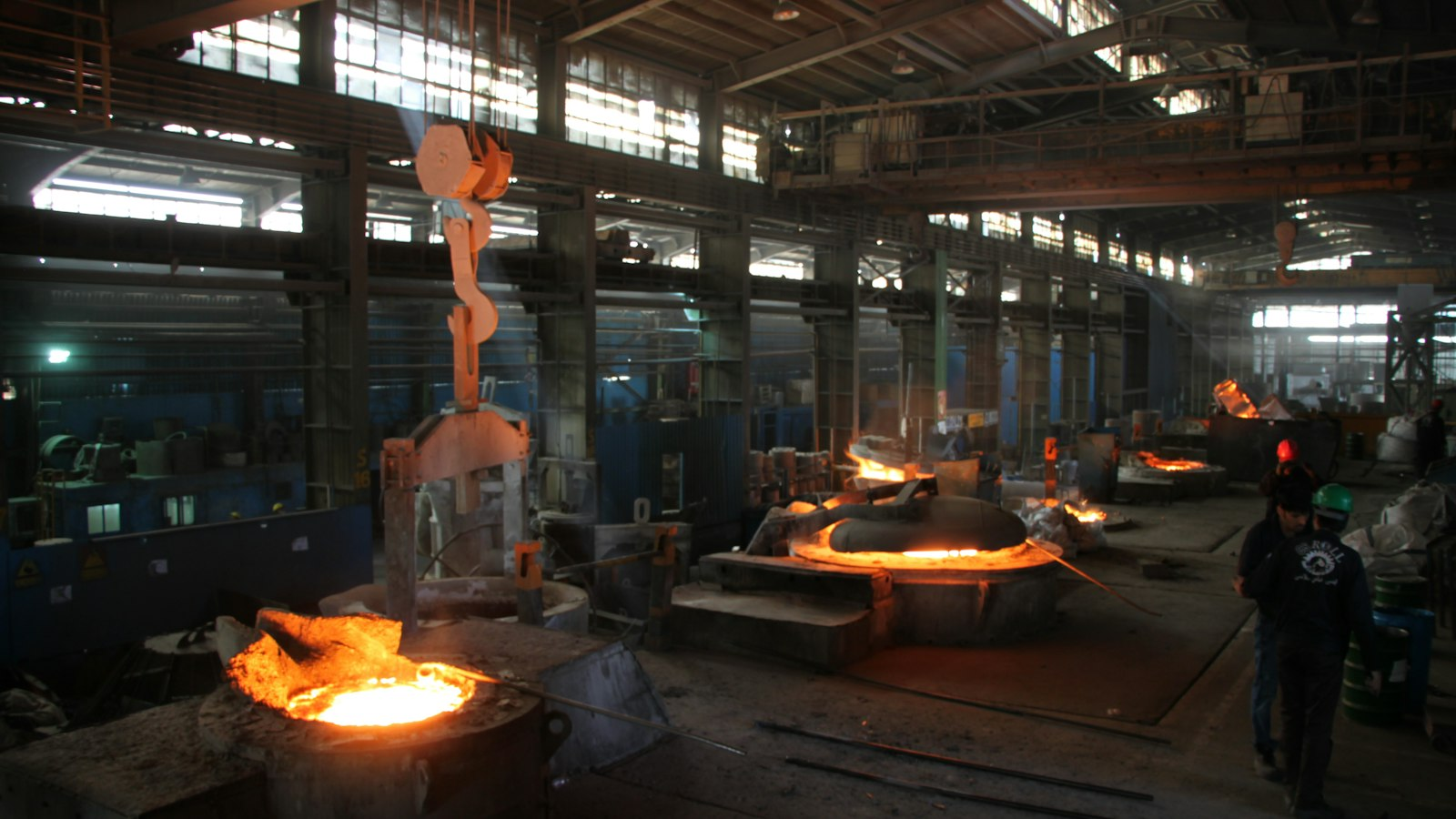
Rio Tinto and Shougang Group have commissioned an industrial scale carbon capture trial at the Chinese steelmaker’s Jingtang operations, targeting carbon dioxide contained in blast furnace gas produced during ironmaking.
The facility can process up to 3,000 cubic metres of blast furnace gas per hour and is designed to capture as much as 10,000 tonnes of carbon dioxide annually. It follows a smaller system commissioned in 2024 and represents the next stage of a technology programme the companies began under a memorandum of understanding signed in 2022.
The installation has been integrated into Shougang’s ironmaking production system and is intended to operate over the long term for trial and research. That is important because performance on an operating steelworks depends on changing gas composition, production rates, maintenance schedules, heat availability, and other conditions that cannot be reproduced completely in a laboratory system.
Blast furnaces are likely to remain part of global steel production even as producers invest in electric furnaces, direct reduced iron, hydrogen, renewable electricity, alternative reductants, and other lower-carbon routes. Replacing an integrated steelworks requires large amounts of capital, while electricity supply, scrap availability, ore quality, plant age, and regional economics differ substantially between producers.
Carbon capture is therefore being assessed as one possible route for reducing emissions from existing assets expected to remain in service. It does not remove the need for changes elsewhere in steelmaking, but it could reduce emissions from conventional blast furnace operations where replacement with a different production route is not immediately practical.
Blast furnace gas already forms part of an integrated site’s energy system. The gas contains carbon monoxide, carbon dioxide, nitrogen, and other constituents and can be recovered for use as a fuel elsewhere in the works, so adding carbon capture has to be integrated with an existing network of gas handling, power, heat, and process operations rather than treated as an isolated exhaust treatment system.
Rio Tinto says waste heat from current operations could be used to reduce the cost of carbon capture. That matters because separation processes consume energy, and an excessive energy penalty can weaken the economic case even where the underlying capture chemistry performs well. Using heat that would otherwise be rejected can improve the overall balance without creating the same additional fuel requirement.
The companies have not yet published complete operating data covering capture efficiency, energy consumption, uptime, or cost per tonne of carbon dioxide. The 10,000-tonne annual figure should therefore be read as designed trial capacity rather than evidence that the process is ready for immediate replication across an entire integrated steelworks.
Scaling the technology will require sustained operation under real blast furnace conditions. The system has to tolerate changes in gas composition and contaminants, maintain separation performance, integrate with production and maintenance schedules, and avoid creating reliability problems elsewhere in the ironmaking process.
What happens to the captured carbon also affects the wider industrial case. Rio Tinto and Shougang are exploring utilisation routes, including conversion of captured carbon dioxide into syngas that could be fed back into steelmaking. A route that reuses carbon within the process has different infrastructure requirements from one based on compression, transport, and permanent geological storage.
The trial forms part of a wider collaboration between the companies covering low-carbon sintering, optimisation of blast furnace and basic oxygen furnace operations, and carbon capture and utilisation. That breadth reflects the number of processes contributing to emissions at an integrated steel plant, where raw material preparation, ironmaking, steelmaking, fuels, and utilities are tightly linked.
Rio Tinto also has an interest in how decarbonisation changes demand for its iron ore. Ore chemistry, physical properties, beneficiation, and preparation affect how material performs in blast furnaces, direct reduction plants, and other production routes, giving mining companies a commercial reason to participate in downstream process development rather than leaving technology change entirely to steelmakers.
Shougang, meanwhile, gains operating data from an installation connected directly to industrial ironmaking. Reliability, heat integration, capture performance, maintenance, and carbon utilisation can now be studied at a scale substantially larger than the 2024 predecessor system.
Capturing 10,000 tonnes of carbon dioxide annually remains small compared with the emissions of a large integrated steelworks, so the immediate value of Jingtang rests in what it establishes about scale-up. If the plant operates reliably and the energy requirement remains manageable, the next engineering question will be how far capacity can increase before equipment size, integration complexity, and operating cost begin to offset the additional emissions reduction.