Ore Energy has raised $43 million in Series A funding to establish its first manufacturing facility and prepare its iron-air battery technology for gigawatt-hour-scale production in 2028. Plural and HV led the round, with existing investor Positron Ventures participating, taking the Dutch company’s total funding above $61 million.
The proposed factory is intended to validate manufacturing at scale rather than add another laboratory line. Ore Energy plans to expand its manufacturing, commercial, and operational teams as it moves from grid-connected demonstrations towards repeatable production and a contracted commercial deployment.
The company’s batteries store and release electricity through the reversible oxidation of iron electrodes. During discharge, metallic iron reacts with oxygen and water to form iron oxide; charging reverses that process. Ore Energy uses iron, water, and air instead of lithium or cobalt and is developing modular systems capable of storing energy for up to 100 hours.
That duration places the technology in a different operating category from most lithium-ion installations. Short-duration batteries are widely used for frequency response, intraday balancing, and shifting solar generation by several hours, while iron-air systems are intended to cover longer periods of weak wind or restricted renewable output.
Ore Energy claims its system can provide long-duration capacity at one tenth of the cost per unit of energy capacity of lithium-ion technology. The figure remains a company projection until factory yields, installation costs, operating performance, and degradation are demonstrated across commercial projects, but the design deliberately prioritises abundant materials and energy capacity over compactness.
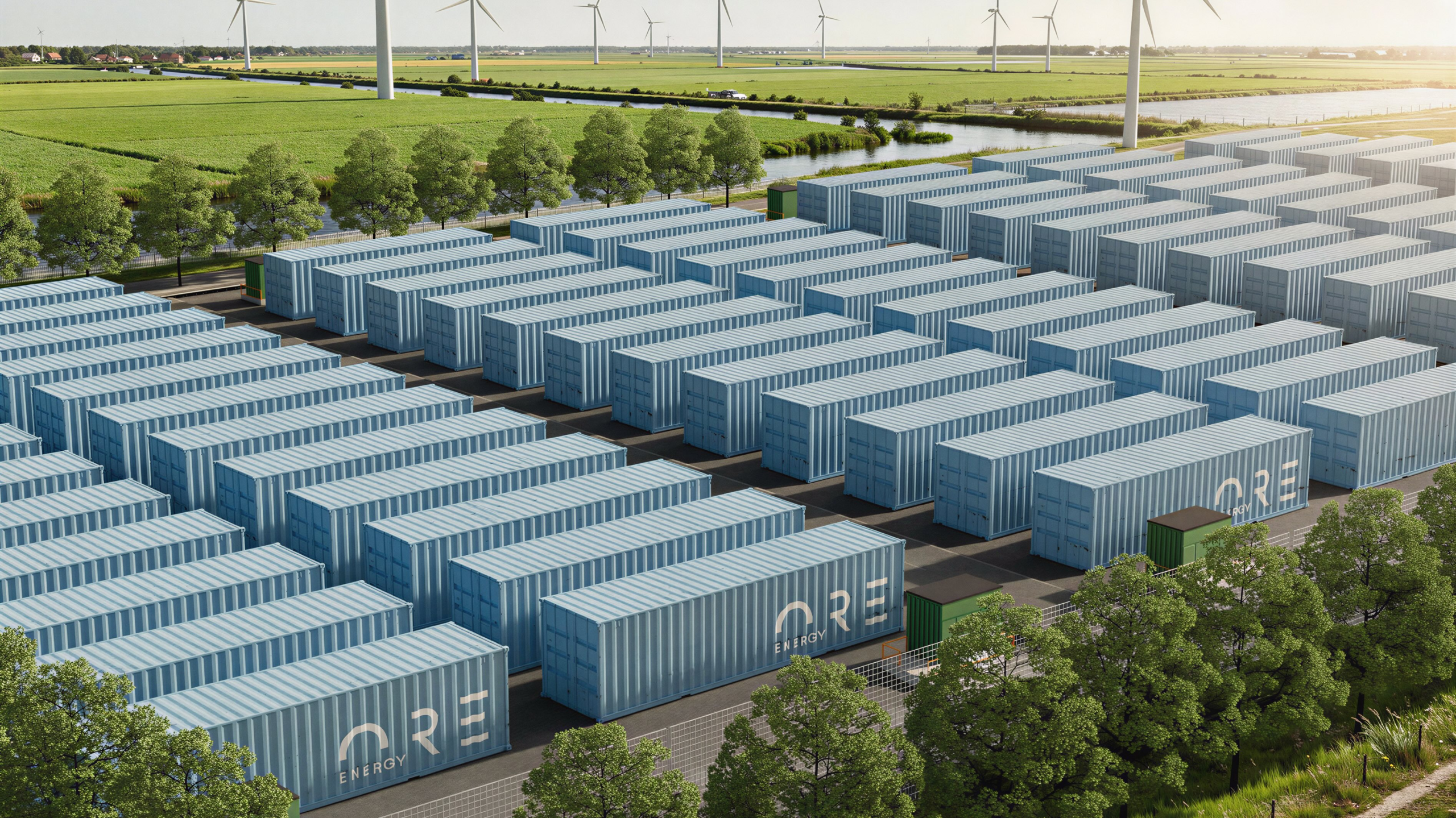
The new capital follows a 1 GWh agreement with Dutch energy supplier Budget Thuis. The programme begins with a committed 400 MWh first phase planned for delivery in 2028, using a 40-foot containerised architecture that can be configured for storage durations from 24 to 100 hours.
That order gives the manufacturing programme a defined commercial destination. It also creates a deadline against which factory equipment, supplier qualification, process control, product testing, and site delivery must mature together, rather than allowing production development to advance without a committed project.
Ore Energy has already completed grid-connected demonstrations in Delft and at EDF’s research laboratories in France. The EDF pilot operated under the European Union’s StoRIES programme and tested storage and discharge over periods of up to roughly four days under real-world utility conditions.
Pilot operation reduces technical uncertainty, but commercial production introduces a different set of problems. Electrode consistency, sealing, corrosion control, electrolyte management, assembly tolerances, factory acceptance testing, and traceability all have to be repeated at volume. Inexpensive raw materials do not produce an inexpensive battery if throughput is poor or rework is high.
Iron-air systems are also physically larger than lithium-ion equipment for a comparable power rating. Their economics depend on low-cost energy capacity, making land, foundations, container handling, ventilation, electrical balance-of-plant, and installation methods important parts of the finished product rather than secondary site details.
Standard interfaces will be needed between the battery modules and the power-conversion, protection, control, and grid-connection equipment used on each project. Without that standardisation, the gains from modular factory production can be lost in bespoke civil and electrical engineering at the deployment site.
The European supply-chain claim carries a similar qualification. Iron, steel, water systems, containers, and conventional industrial components are widely available, but the factory will still need dependable sources of process equipment, controls, power electronics, and qualified materials. Local availability is useful only when suppliers can meet specification and schedule at commercial volume.
Ore Energy’s funding announcement ties the first factory to a 2028 gigawatt-hour production target, while the Budget Thuis agreement places the same year against the initial 400 MWh delivery. The alignment gives investors and customers a clear sequence of manufacturing milestones, but it leaves little room for delays in equipment procurement, qualification, or commissioning.
Capital equipment selection will be an early indicator of that readiness. The company must decide which operations can use conventional manufacturing machinery, which require purpose-built tools, and how inspection data will be connected to each module. Those choices will shape the factory’s ramp rate before the first commercial containers leave the line.
The factory will decide whether reversible rust can be made into repeatable industrial hardware rather than a technically attractive pilot. Gigawatt-hour ambitions are common in battery announcements; sustained yield, first-pass quality, and field performance remain considerably harder to manufacture.