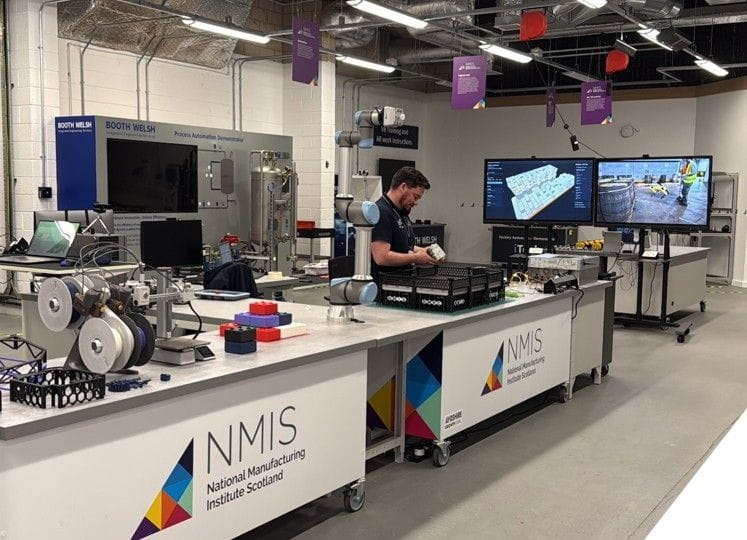
The National Manufacturing Institute Scotland has completed a private 5G trial at its Digital Process Manufacturing Centre in Irvine, using a simulated factory environment to test how dedicated mobile networks could support industrial connectivity.
The project was delivered with Merck, North Ayrshire Council, and Folk Consulting, with partial funding from the Department for Science, Innovation and Technology’s 5G Innovation Programme in Ayrshire. The trial used a controlled plant room environment based on Merck industrial processes, allowing the partners to test network behaviour without exposing live operational data.
Engineers replicated common manufacturing equipment, including pumps, fans, and control systems, before generating industrial data flows through the network. Folk Consulting worked with NMIS on the data generation approach and validation work, while the wider project team assessed network performance under increasing levels of simulated demand.
The private 5G system reached average data throughput of more than 97 Mbps, with peak speeds above 100 Mbps. The project team said the results suggested the system could support hundreds of simulated industrial environments at the same time, giving manufacturers a more concrete basis for assessing dedicated wireless connectivity in production settings.
The trial addresses a persistent problem in factory digitalisation: production sites need evidence under realistic operating conditions before adopting new connectivity infrastructure. Technologies such as mobile robotics, real-time asset monitoring, augmented maintenance, remote diagnostics, digital twins, and temporary instrumentation all depend on dependable data movement, but factories rarely provide clean laboratory conditions.
Private 5G can offer dedicated wireless coverage, controlled access, predictable performance, and stronger separation from public mobile networks. Those characteristics make it attractive in plants where mobile assets, flexible production layouts, or difficult-to-cable equipment create limits for conventional wired infrastructure. The case becomes stronger where connectivity has to support operational technology rather than office traffic.
Factory environments are physically and electrically difficult places to deploy wireless systems. Steel structures, moving equipment, electromagnetic interference, legacy controls, safety zoning, and changing layouts can all degrade performance. Most sites also run mixed communication architectures, combining Ethernet, fieldbus, Wi-Fi, proprietary industrial networks, cloud platforms, and supervisory control systems. Any new wireless layer has to fit into that environment without weakening safety, uptime, or cybersecurity.
The Irvine trial is useful because it was built around an industrial process scenario rather than a generic speed test. By simulating plant equipment and data flows, NMIS and its partners were able to examine private 5G performance in conditions that resemble real operational demands. That type of evaluation gives manufacturers a better route to compare private 5G with Wi-Fi, wired networks, and hybrid architectures before committing to plant-wide deployment.
Merck’s involvement adds further weight because process manufacturing often carries more stringent requirements around data integrity, validation, and operational risk. Information from pumps, fans, environmental systems, process equipment, and control loops can feed maintenance, quality, optimisation, and compliance workflows. In those conditions, network performance is not only a productivity concern; it becomes part of the plant’s operating discipline.
Manufacturing digitalisation is now moving beyond the first wave of data collection. The harder task is getting useful information to the right systems and people at the right time, without creating fragile architectures or unmanaged cyber exposure. Connectivity is becoming production infrastructure, particularly as AI, robotics, analytics, and autonomous equipment take on larger roles in industrial operations.
That convergence is already visible in factory automation, where AI-enabled robotics systems are being connected more closely with perception, control, and physical motion. Private 5G will not replace every industrial network, but it may become part of the communications layer needed for more flexible and mobile production systems.
The Ayrshire project also gives regional manufacturers access to a lower risk testing environment. Demonstration facilities can help companies move beyond supplier claims and assess connectivity against process conditions, security requirements, integration constraints, and business value. That is often the difference between a technology pilot and a deployable production case.
Private 5G still has to justify cost, coverage, latency, reliability, integration effort, and operational benefit on a site-by-site basis. The NMIS trial does not make the technology universal, but it does provide a more disciplined way to evaluate it. In manufacturing, that evidence base is often more valuable than a faster headline speed.