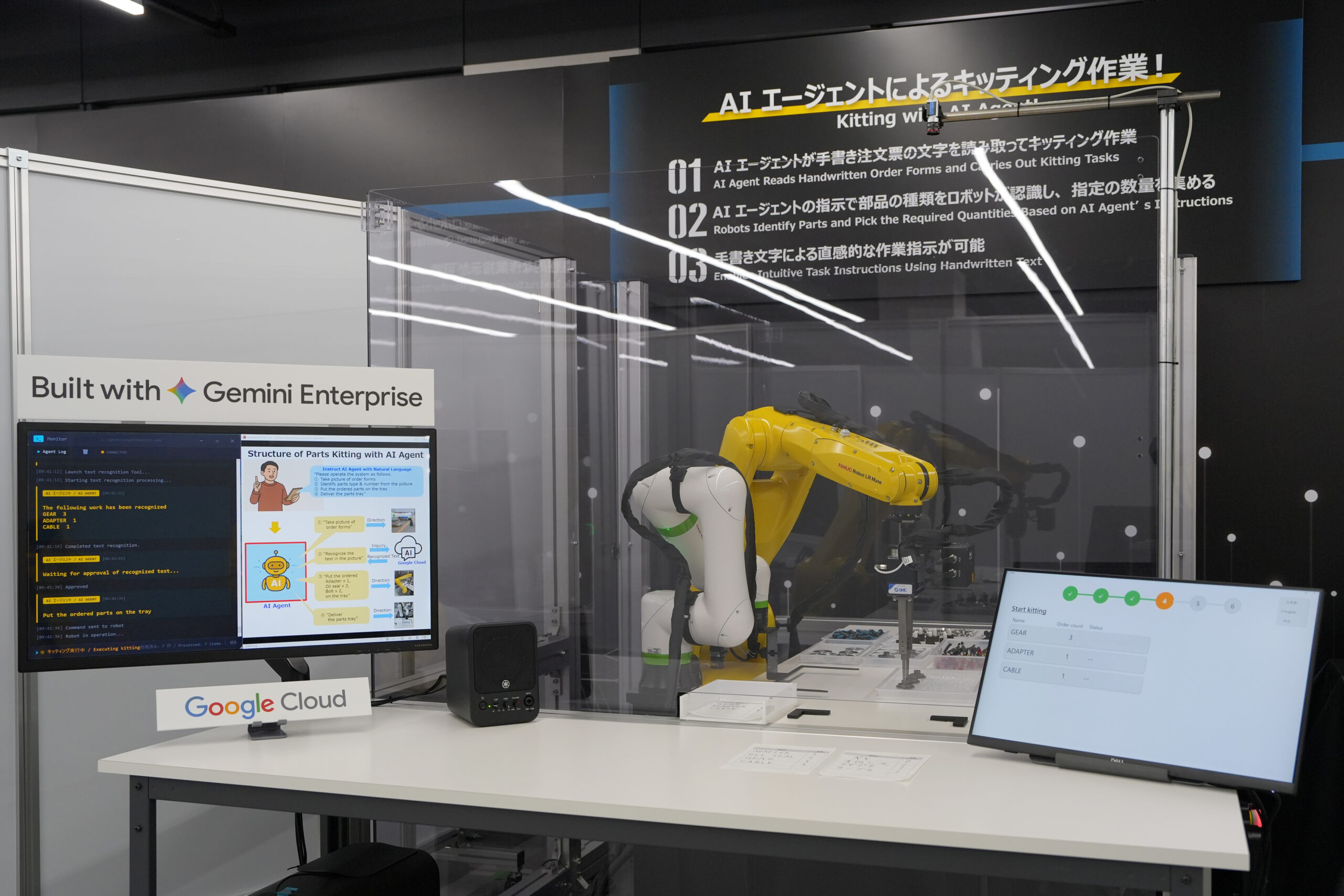
FANUC has expanded its Physical AI Robot System through a collaboration with Google, bringing Gemini Enterprise and Intrinsic’s robotics development environment into industrial robot control.
The system uses generative AI to interpret human instructions, recognise objects, and direct FANUC robots to carry out assigned tasks. FANUC demonstrated the next-generation system at its New Product Open House Show in May, where collaborative and non-collaborative robots operated as a single cell based on natural-language instructions.
Physical AI combines machine perception, decision-making, and motion in physical environments. In a factory cell, that means robots can use sensor input and AI models to adapt their actions to objects, task variation, and surrounding equipment, instead of relying only on fixed paths and manually scripted sequences.
FANUC said demand for Physical AI-related applications has grown since the system was released at the International Robot Exhibition last December, with more than 1,000 robots already shipped for related deployments. The latest collaboration adds Google Cloud technology, including Gemini Enterprise, an enterprise-grade generative AI platform developed with security controls for business use.
The approach builds on FANUC’s existing support for open and widely used development technologies. FANUC robots support ROS, while Google contributes to the robotics software ecosystem through Intrinsic, its robotics AI group. FANUC also supports Python for AI development, high-speed communication interfaces for external robot control, and interfaces that allow robot operation from PLCs.
Intrinsic’s Flowstate environment is also part of the expanded system. The software is interoperable with ROS and is designed to help developers build adaptable robot applications more quickly, while FANUC is providing robot-control compatibility so AI workflows can be connected to its industrial hardware.
The collaboration places established factory robots inside a broader shift in automation, where AI systems are being tested against physical work rather than information tasks alone. Industrial robot cells have long performed well in tightly structured production, but programming effort can still limit deployment where products vary, fixtures change, or multiple robots must coordinate around less predictable tasks.
FANUC is also participating in Google DeepMind’s Gemini Robotics Trusted Tester Program, which is focused on foundational robotics models. As those models mature, the practical test will be whether AI-guided cells can meet industrial requirements for repeatability, safety, uptime, and maintainability across normal production conditions.