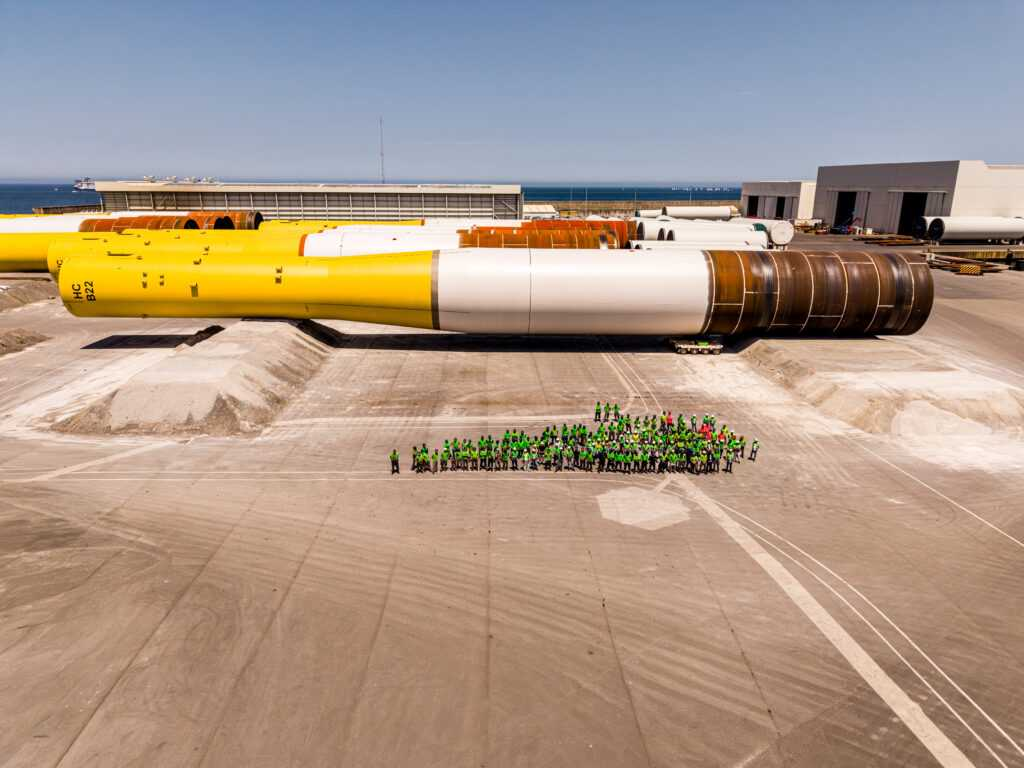
Haizea Wind Group has delivered record-scale monopiles from the Port of Bilbao for Ørsted’s 2.9GW Hornsea 3 offshore wind farm in the North Sea.
The foundation structures measure 11 metres in diameter, exceed 105 metres in length, and weigh approximately 2,300 tonnes each. Haizea describes them as the largest structures manufactured in the Iberian Peninsula and among the largest monopiles produced in Europe.
Hornsea 3 is being built around 120 kilometres from the Norfolk coast and is intended to supply the equivalent of more than 3.3 million UK homes. The project’s scale places equal demands on foundation fabrication, port logistics, installation vessels, and the coordination of several suppliers.
Haizea’s delivery is a manufacturing milestone, but the structures still have to move through load-out, sea transport, handling, installation, and verification before they become foundations. At this scale, logistics cannot be added after production. Factory layout, storage positions, quay strength, transport routes, vessel interfaces, and weather windows influence how components are made and when they can leave the plant.
Grúas Aguado supported transportation and preparation within the Port of Bilbao, while Mammoet moved the monopiles using self-propelled modular transporters. Cadeler handled load-out and load-in activities.
Each handover required the structure’s weight and centre of gravity to be matched with transporter capacity, support arrangements, lifting or skidding plans, and the limitations of the receiving vessel. A movement measured in hundreds of metres can require months of engineering when the load exceeds 2,000 tonnes.
The fabrication challenge is less visible but no smaller. Plate preparation, rolling, longitudinal and circumferential welding, dimensional control, non-destructive examination, coating, flange interfaces, and documentation must remain consistent across sections too large to inspect or rework casually.
Small deviations can become major alignment or handling problems after several cans have been joined into a structure more than 100 metres long. Distortion, ovality, flange tolerance, weld quality, and coating damage all have consequences downstream, where offshore correction is slower and more expensive.
The growth in monopile dimensions follows the move towards larger turbines and more demanding project sites. Greater turbine output can reduce the number of positions needed for a given capacity, but foundations and installation systems must absorb higher loads.
Manufacturers consequently need larger rolling equipment, welding stations, halls, doors, storage areas, and quays, while installation contractors require vessels and tools capable of handling heavier structures. The supply chain becomes more productive at one level and less forgiving at another.
Haizea’s Bilbao facility covers more than 200,000 square metres, with six production halls and storage for towers and monopiles. The plant employs more than 900 people and has been expanded to manufacture foundations for turbines above 15MW.
That capacity is strategically useful for European offshore wind, although it does not remove scheduling risk. Hornsea 3 depends on parallel delivery from foundation manufacturers, cable suppliers, substations, turbine factories, ports, and specialist vessels. A delay in one package can leave completed components occupying valuable storage space or installation assets waiting without productive work.
Earlier Industrial News coverage of the Hornsea 3 foundation supply chain showed how steel and secondary-component work is distributed across several companies and countries. The Bilbao delivery demonstrates the same dependence on continental manufacturing and port infrastructure.
Hornsea 3 will generate electricity for the UK, but its physical supply chain spans steelmaking, heavy fabrication, coatings, specialist transport, vessels, and engineering services across Europe and beyond. Domestic value is created through development, onshore work, operations, and parts of the supply chain, while critical structures continue to arrive through international industrial networks.
Haizea employs more than 1,500 people across its wind-tower, offshore-foundation, and large-castings businesses. It reported 2025 revenue above €400 million and net profit of €20 million, with Bilbao forming the centre of its largest offshore fabrication capability.
The record dimensions attract attention, but repeatability matters more to Hornsea 3. Every monopile must pass through the same controlled sequence without coating damage, missed installation windows, offshore fit-up problems, or documentation gaps that delay acceptance.
The structures leaving Bilbao show that the factory can build at the required scale. The installation campaign will show whether Europe’s enlarged manufacturing and logistics system can deliver that scale as a dependable series rather than an isolated heavy-lift achievement.