The European Space Agency has signed the first three contracts under its European Launcher Challenge, committing €543.6 million to competing launch providers as Europe seeks a broader commercial base for access to orbit.
The European Space Agency (ESA) has awarded €186.9 million to Rocket Factory Augsburg, €158.9 million to PLD Space, and €197.8 million to Isar Aerospace. A fourth award involving MaiaSpace remains in the contracting process.
The agreements release funding against programme milestones rather than providing the entire award in advance. ESA assessed proposals against business case, engineering quality, resources, schedule, and compliance before completing the second stage of the competition.
All three contracted providers must demonstrate orbital launch capability before 2028. That requirement moves the programme beyond business plans and development announcements into propulsion, structures, avionics, launch-site infrastructure, qualification, flight testing, and the rather unforgiving question of whether the vehicle reaches orbit.
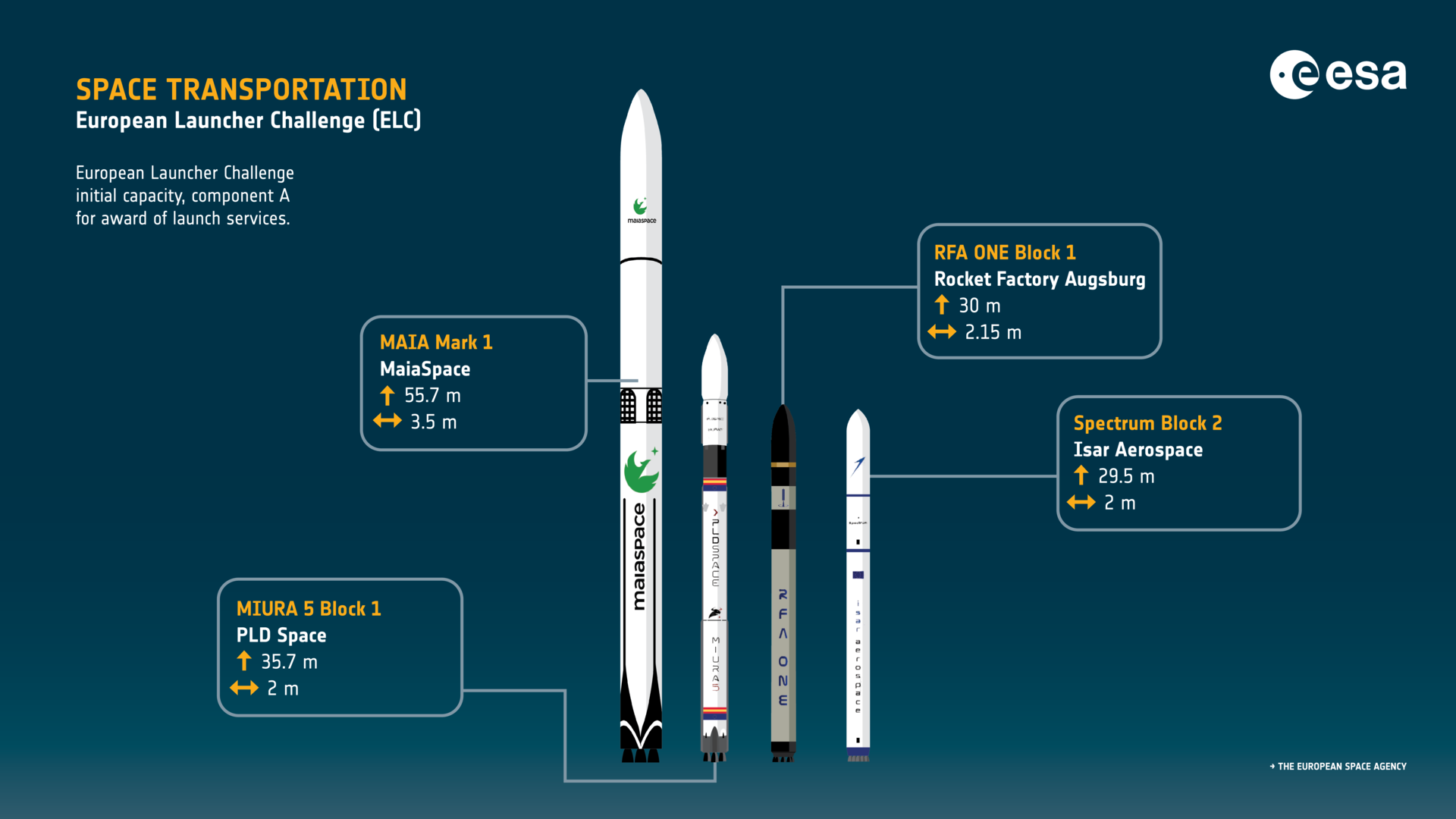
Germany-based Rocket Factory Augsburg is developing RFA One, a three-stage vehicle approximately 30 metres tall and 2.15 metres in diameter. Its current configuration is designed to carry up to 500kg to a 500km sun-synchronous orbit.
RFA plans to launch from SaxaVord Spaceport in Scotland. Its €186.9 million contract is funded mainly by Germany with a contribution from the UK, giving the British launch-site programme a direct connection to ESA’s new commercial competition.
Spain’s PLD Space receives €158.9 million, primarily funded by Spain with a German contribution. Its Miura 5 launcher builds on the Miura 1 technology demonstrator flown from Spain in 2023.
Miura 5 is intended to operate from Europe’s Spaceport in French Guiana and carry payloads of up to 540kg to sun-synchronous orbit. PLD Space plans further capability upgrades for institutional and commercial missions requiring greater payload capacity or orbital reach.
Isar Aerospace receives the largest of the first three awards at €197.8 million. Its two-stage Spectrum vehicle is 28 metres tall and two metres in diameter, with ten engines in its current configuration and a target payload of up to 1,000kg to low Earth orbit.
Spectrum completed its first flight from Andøya Spaceport in Norway in 2025, remaining airborne for around 30 seconds. A second vehicle is being prepared for a qualification flight carrying payloads that the company intends to place into orbit.
The three programmes differ in architecture and launch location, but they share the industrial problem that has ended many private launcher projects before commercial service begins. A company can successfully manufacture engines, tanks, or a complete development vehicle without yet possessing a repeatable launch business.
Propulsion, structures, guidance, avionics, software, separation systems, ground equipment, range operations, logistics, quality systems, and regulatory approvals all have to work together. Once a first orbital launch is achieved, the organisation then has to reproduce that performance with sufficient reliability and cadence to attract paying customers.
The Launcher Challenge is intended to create more competition around that transition. ESA will act as a customer for newly developed European launch services while supporting providers in deploying and improving their systems.
Europe’s existing Ariane and Vega launcher families remain central to institutional access to space. ESA’s objective is not to replace them with one smaller private vehicle, but to establish more choice and resilience as commercial demand becomes increasingly varied.
Small and medium satellite operators can value schedule, orbital destination, dedicated launches, and integration flexibility differently from customers buying capacity on a large institutional mission. A functioning group of commercial launchers could therefore complement rather than replicate Europe’s established heavy and medium launch systems.
The industrial effect extends into a broad supplier base. Launcher programmes consume propulsion components, tanks, composites, precision-machined parts, electronics, valves, test equipment, software, telemetry systems, structures, and launch infrastructure, while repeated flight requires those supply chains to support series production rather than one-off prototypes.
That last transition is usually the more expensive one. A development workshop can accommodate engineering changes and bespoke rework that become unacceptable once vehicles have to move through a factory at predictable intervals.
Multiple funded providers also create a less comfortable question over whether Europe can support several commercial launcher companies simultaneously. Engineering talent, launch opportunities, investment capital, and customer demand are finite, and public funding does not guarantee that every programme will reach sustainable production.
ESA is attempting to impose some commercial discipline by retaining competition and linking funds to milestones. The companies still have to demonstrate orbital performance and then convince institutional and private customers that their vehicles can launch reliably at viable prices.
The programme also connects with a wider expansion of European space infrastructure. IRIS² has moved into full-scale deployment, creating future requirements around satellite manufacturing, secure ground systems, and launch procurement alongside other European institutional missions.
Those programmes can create anchor demand, but a durable launch industry cannot depend indefinitely on development support. Factories need sufficient flight cadence to absorb fixed costs, maintain skilled teams, retain suppliers, and improve hardware through repeated production.
The €543.6 million now contracted gives RFA, PLD Space, and Isar Aerospace substantially greater resources with which to reach that point. It does not make the technical risks disappear, and ESA’s requirement for orbital demonstrations before 2028 gives the three companies relatively little time to turn those resources into flight-proven hardware.
European launcher policy has spent several years discussing resilience and competition. The first contracts move that argument onto the factory floor and launch pad, where progress becomes easier to measure and considerably harder to explain away.