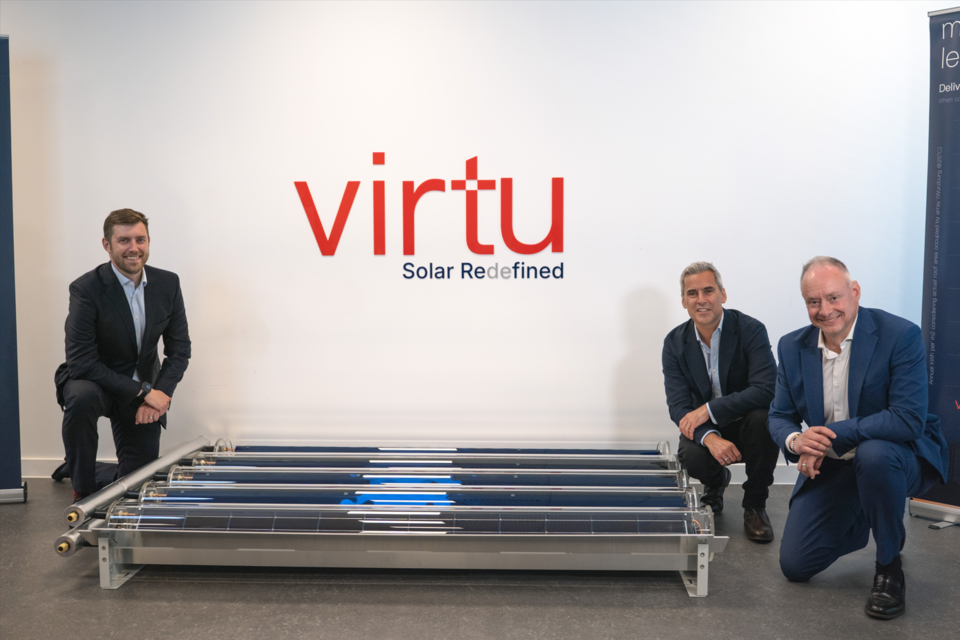
Naked Energy has secured £8.875 million from Great British Energy and Barclays Climate Ventures to establish a UK manufacturing facility for its Virtu solar-thermal technology.
Great British Energy is investing £7.5 million through its Energy Engineered in the UK programme, with Barclays participating as an existing shareholder. The round is intended to bring more production into Britain, lower manufacturing costs, and support expansion in domestic and export markets.
The factory location has not yet been selected. Once operating, it is expected to create up to 40 direct skilled jobs and approximately 100 indirect roles, with a further announcement due after the site decision. Capacity, equipment, commissioning dates, and the proportion of components sourced domestically remain unconfirmed.
Naked Energy’s Virtu range is designed to supply heat on commercial, public-sector, and industrial sites. VirtuHOT is an evacuated-tube solar-thermal collector producing heat at temperatures up to 120°C, while VirtuPVT combines photovoltaic electricity generation with thermal output at temperatures up to 75°C.
Much of the energy consumed by buildings and light industrial processes is required as heat rather than electricity. Hot water, space heating, cleaning, washing, food and drink production, laundries, hospitals, hotels, and leisure facilities often operate within temperature ranges that can be served partly by solar thermal systems.
The collectors can be integrated with boilers, heat pumps, and existing hot-water systems, allowing solar energy to pre-heat water before the main plant raises it to the required delivery temperature. Backup generation, storage, controls, pumps, and hydraulic design remain necessary, but the approach can reduce fuel demand without replacing every part of an established heating system.
Naked Energy says the low-profile collector arrangement allows more than 85% of suitable roof area to be occupied, compared with around 50% for conventional tilted solar arrays that require spacing to prevent self-shading. The company holds more than 20 patents and has installed systems at the British Library and the All England Lawn Tennis Club, alongside projects in Europe and North America.
The new factory must convert those technical claims into repeatable production economics. Collector assemblies require controlled tolerances, durable seals, consistent thermal performance, traceable components, and interfaces that installers can reproduce across different buildings. Raising output without weakening test coverage or field reliability is where unit cost and customer confidence are usually won or lost.
The investment is Great British Energy’s first major solar commitment. Its £1 billion Energy Engineered in the UK programme combines grants and investment intended to establish domestic capability across renewable and low-carbon supply chains, rather than relying solely on the deployment of imported equipment.
That industrial focus is increasingly relevant as electricity infrastructure constrains factory and project decisions. Research covered by Industrial News found that grid connection delays are already affecting UK industrial expansion, including project timing, costs, and potential plant locations.
Solar thermal does not remove every electrical requirement, but direct heat generation can avoid adding the full thermal load to an already constrained connection. The commercial result will still depend on process temperature, operating hours, available roof space, gas and electricity prices, storage, and whether heat demand coincides with solar output.
Manufacturing capacity alone cannot correct weak system design. Naked Energy has therefore developed design, monitoring, maintenance, and heat-as-a-service offerings alongside its collectors, placing the hardware inside a broader delivery model rather than treating it as a standalone roof product.
Barclays Climate Ventures first invested in the company in 2022 and followed with another investment in 2024. Its participation alongside public capital gives the factory a blended financing base, while Great British Energy’s involvement links the project to a wider effort to retain clean-energy intellectual property, production work, and skilled employment in Britain.
Factory selection will also determine the practical shape of the supply chain. Collector tubes, frames, reflectors, seals, controls, and packaging have different production and handling requirements, while final testing must confirm performance before equipment is released to installers.
The unresolved site decision will now shape how much of that value can be clustered around existing engineering capability. Access to fabrication suppliers, test equipment, logistics, installers, technical labour, and suitable premises will influence both launch speed and operating cost.
The funding has secured the next manufacturing step, but it has not yet built the factory. The next announcement will need to provide a location, timetable, and production plan capable of turning British-designed collectors into dependable volume output rather than another well-financed intention.