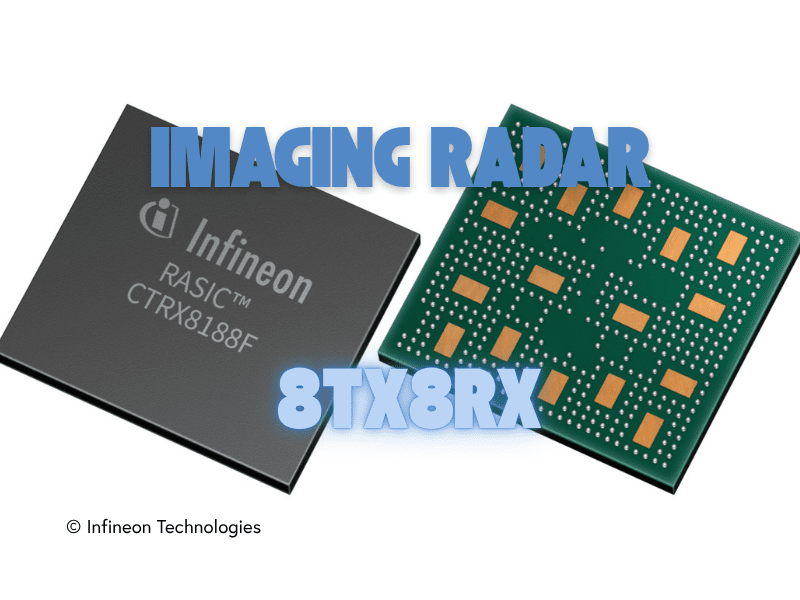
Infineon Technologies has started mass production of its RASIC CTRX8188F radar transceiver, adding a new production-ready 8Tx8Rx imaging radar MMIC for centralised automotive radar architectures.
The device is based on Infineon’s second-generation CMOS radar technology and is designed for 77GHz automotive radar applications, combining eight transmit and eight receive channels in a single monolithic microwave integrated circuit. Infineon is positioning the transceiver for advanced driver assistance systems and future automated-driving platforms.
The CTRX8188F is designed to support 4D and high-definition imaging radar systems with detection ranges of up to 400 metres. It can be used with Infineon’s AURIX TC45 microcontroller family in edge-processing applications, while also supporting centralised processing architectures where raw radar data is sent to a central vehicle computer.
Centralised radar is becoming more important as vehicle electronics move away from isolated electronic control units towards domain and zonal architectures. In older radar systems, processing is handled locally within the sensor. In centralised systems, radar front ends capture data while more intensive processing takes place on a central compute platform, allowing sensor fusion, software updates, and algorithm development to be handled more consistently across the vehicle.
The CTRX8188F supports cascading configurations beyond 32 transmit and 32 receive channels, giving Tier 1 suppliers and vehicle manufacturers a route to scale radar performance across different vehicle segments. The device also includes a configurable CSI-2 interface, supporting integration with SerDes and asymmetric Ethernet communications used in modern vehicle architectures.
Automotive sensing requirements continue to intensify as cameras, radar, ultrasonic sensors, LiDAR, driver monitoring, inertial sensing, and vehicle-to-everything systems become part of safety and automation strategies. Advanced perception pipelines are also drawing in more specialised processing, including DSP IP for 4D LiDAR systems in industrial robotics and automotive applications. Radar sits alongside those technologies as a robust, all-weather sensing layer.
Radar has practical advantages that keep it central to ADAS. It can operate in poor visibility, detect relative speed directly, and support functions such as adaptive cruise control, emergency braking, blind-spot monitoring, lane-change assistance, and highway pilot systems. Imaging radar extends those capabilities by improving angular resolution and object separation, helping vehicles distinguish static structures, moving objects, and vulnerable road users.
Higher channel count is one route to better radar performance. More transmit and receive channels allow finer spatial resolution and richer data for signal processing. That creates benefits in dense traffic, complex junctions, poor weather, and higher-speed driving, but it also raises design challenges around power consumption, thermal behaviour, RF layout, signal integrity, calibration, and data bandwidth.
Moving an 8Tx8Rx device into mass production gives automotive system designers a more stable building block for radar platforms that have to meet safety, cost, manufacturability, and supply requirements. Prototype performance is not enough in automotive electronics; devices have to be qualified, available, and supported through long programme lifecycles.
The device also reflects the continuing shift of vehicle value into semiconductors. Software-defined vehicles depend on compute, memory, sensors, power electronics, connectivity, and secure update architectures. Radar MMICs are part of that strategic semiconductor layer, with OEMs and Tier 1s designing platforms around data flows, compute placement, and future feature upgrades.
Infineon’s second-generation CMOS radar technology is positioned around higher performance at lower cost compared with previous RF semiconductor nodes. That balance is important because ADAS penetration is moving beyond premium vehicles. Automakers need scalable radar architectures that can support entry-level assistance systems, mid-range safety packages, and higher-performance automation without requiring completely separate hardware development for each model line.
Regulation is also pushing more advanced sensing into mainstream vehicles, while consumer assessment programmes continue to reward driver assistance capability. Regional requirements around Level 2 ADAS safety are influencing radar system specification and adoption, particularly where road conditions, traffic density, and market expectations demand higher perception performance.
The start of mass production confirms that centralised radar is moving from architecture discussion into component supply. The next competitive stage will be system integration: combining radar front ends, vehicle networking, central compute, software, calibration, functional safety, and production test into platforms that can be built at scale.