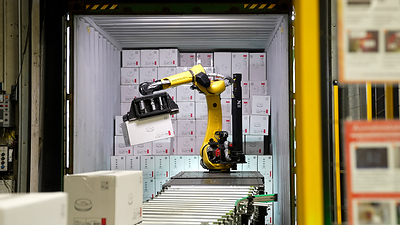
BAUHAUS has deployed mobile manipulation systems from XYZ Robotics at its Krefeld distribution centre in Germany, automating a receiving process that extends from container unloading to sorted mixed-case pallet formation.
The installation uses RockyOne and RockyOne SE robots to remove cartons, identify barcodes, sort goods, and build pallets for onward movement through the operation. Instead of treating unloading and palletising as separate projects, the system connects the stages within a continuous workflow.
Krefeld handles thousands of deliveries and more than 10,000 stock-keeping units. Inbound cartons can vary substantially in size, weight, orientation, packaging condition, surface finish, and labelling, making the task more complex than handling uniform cases from a single production line.
Robotic container unloading requires perception systems capable of identifying boxes inside tightly packed and unstructured loads. The robot must select an accessible item, estimate its dimensions and centre of mass, choose a gripping strategy, and remove it without destabilising surrounding cartons.
After extraction, each item must be presented for barcode capture and assigned to the correct downstream route. Damaged labels, reflective film, multiple barcodes, poor print quality, and irregular orientation can all interrupt a process designed around automated identification.
Mixed-case pallet building adds further constraints because cartons cannot simply be stacked in arrival order. Heavy or rigid packages generally need to form a stable base, while smaller, fragile, or deformable items must be placed without creating an unsafe load.
The software also needs to account for pallet dimensions, destination rules, weight limits, packaging strength, and later transport. A stack that remains stable inside the warehouse may still fail under acceleration, vibration, or braking during road distribution.
Linking the tasks reduces intermediate handling, although a failure at one stage can affect the complete receiving line. Robot recovery, exception management, manual access, and software coordination therefore carry similar importance to headline pick rates.
BAUHAUS has reported round-the-clock operation without routine manual intervention and is assessing the technology for deployment elsewhere in its network. Any wider rollout will depend on whether Krefeld maintains availability across seasonal peaks, supplier changes, and an evolving product range.
Warehouse automation is moving beyond isolated equipment towards connected systems combining robotics, storage, software, and operational data. Dematic’s automation test centre has been developed around the need to examine receiving, storage, picking, pallet handling, and control software as one operational design.
Large mobile robot fleets are also entering production logistics. Toyota’s use of hundreds of autonomous mobile robots for internal material movement shows how warehouse technology is increasingly being applied where delays can interrupt manufacturing rather than merely slow order fulfilment.
Labour availability and working conditions strengthen the case for automating receiving. Container unloading can involve repetitive lifting, confined spaces, heat, awkward posture, and unpredictable loads, while the pace of work is often determined by inbound vehicle schedules.
Automation removes people from much of that exposure but increases demand for supervision, controls support, robot recovery, data analysis, and preventive maintenance. The work changes from repetitive handling towards managing exceptions and sustaining system availability.
Safety engineering must account for mobile bases, robotic arms, conveyors, pallets, forklifts, and people operating within the same facility. Segregation, speed control, scanning, safe-stop functions, access procedures, and restart logic need to reflect the complete installation rather than the certification of an individual robot.
Integration with warehouse management and control software is equally important. The robotic system requires accurate information about expected deliveries, product identities, destination rules, pallet requirements, and inventory status.
A carton moved physically to the correct place but recorded against the wrong item creates a stock error that can persist throughout the operation. Product master data therefore becomes a practical automation constraint rather than an administrative concern.
Dimensions, weight, packaging characteristics, handling restrictions, and barcode standards must be sufficiently accurate for the robot to make reliable decisions. Retail and distribution networks often inherit inconsistent data from thousands of suppliers, requiring cleansing and governance before automation can use it effectively.
Maintenance planning will determine whether round-the-clock operation is sustained. Grippers, cameras, cables, joints, batteries, safety scanners, wheels, and computing hardware all require inspection and replacement, while dust, torn cardboard, loose straps, and damaged packaging can affect equipment that performs well in controlled demonstrations.
BAUHAUS now has a live test of whether mobile manipulation can handle the variability of a major retail distribution operation. Wider deployment will depend on exception frequency, damage rate, pallet stability, software accuracy, maintenance hours, and the proportion of inbound goods that can pass through without manual recovery.