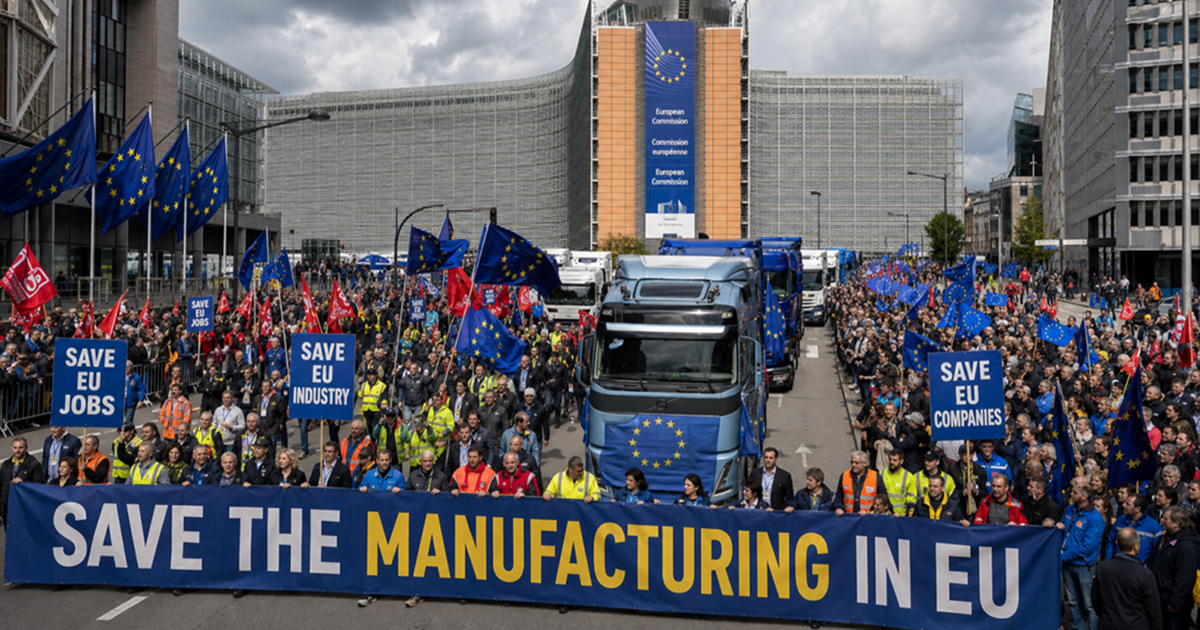
European steel processors, distributors, service centres, manufacturers, smaller businesses, and trade unions are preparing a demonstration in Brussels as concern grows that new trade measures could protect primary steel production while leaving downstream industry exposed.
The event is scheduled for 7 September outside the European Commission’s headquarters and has been promoted through EUROMETAL and related industry networks seeking a broader approach to European manufacturing competitiveness.
Participants want policy to consider the complete steel value chain, including businesses that cut, form, machine, coat, fabricate, distribute, and incorporate steel into finished products. Their concern is that measures applied only to basic steel imports can increase European input costs while allowing lower-priced finished goods to enter from overseas.
The EU introduced a new steel protection regime from 1 July 2026 as global overcapacity continued to place pressure on domestic producers. The measures are intended to restrict damaging import surges and provide greater stability for a sector facing weak demand, high energy costs, and substantial decarbonisation investment.
European crude steel output fell again during 2025 and remains far below levels recorded before the global financial crisis. Producers argue that subsidised or excess overseas capacity will continue to displace European output unless trade controls become stronger and more responsive.
Downstream manufacturers broadly recognise the strategic importance of domestic steelmaking, although the distribution of cost remains contentious. A safeguard that raises the price of coil, plate, bar, or sections may improve the position of a steel producer while reducing the competitiveness of the company converting that material into machinery, structures, vehicles, or exported components.
The imbalance becomes sharper where finished products are not covered by equivalent measures. Imported machinery or fabricated goods may enter Europe carrying steel purchased at a lower world price, allowing an overseas manufacturer to avoid the input cost imposed on its European competitor.
Availability can also become difficult where particular grades, dimensions, coatings, or delivery schedules are not readily supplied inside the EU. Steel users need predictable access to material as well as protection from unfair trade, especially where customer contracts contain fixed prices or penalties for late delivery.
The same tension has appeared in the UK, where manufacturers have warned that tariff changes could increase costs for domestic steel users. Supporting primary production without weakening the businesses consuming its output requires greater precision than a general increase in border protection.
Machinery organisations are raising parallel concerns over imported industrial equipment. The VDMA has called for faster European action against unfairly priced machinery from China, arguing that product-by-product investigations struggle to match the pace at which suppliers and technology categories change.
Steel, machinery, batteries, electric vehicles, solar equipment, and other strategic products are increasingly being assessed through economic security, carbon, and supply resilience alongside conventional price competition. Trade defence is consequently moving deeper into industrial policy.
Protecting every stage of production can raise costs, reduce competition, and provoke retaliation, while protecting only the first stage can transfer the burden to downstream manufacturers. Rules of origin must also distinguish genuine European production from minor processing intended primarily to avoid tariffs.
Carbon policy adds another layer to the debate. European steelmakers are investing in electric arc furnaces, hydrogen-based routes, renewable power, and greater scrap use, all of which require substantial capital and customers willing to recognise the value of lower-emission material.
Downstream manufacturers frequently compete in markets where purchasers remain focused on the price of the finished product. Paying more for lower-carbon steel can weaken competitiveness unless procurement rules, customer requirements, or border mechanisms apply similar standards to imports.
Public purchasing and product standards could create demand for verified lower-carbon material, although measurement must remain consistent. Carbon border measures are intended to stop imports avoiding costs carried by European producers, but administration remains demanding for importers and suppliers.
Steel service centres and distributors sit at the centre of these changes. They hold inventory, process material, manage customer specifications, and absorb the difference between mill production schedules and manufacturing demand.
Volatile tariffs or quotas can alter purchasing decisions months before a measure formally takes effect. Companies may increase stocks before a change, delay orders while rules are clarified, or switch origin in ways that create further instability across the market.
Exports present another difficulty. A European product made from higher-cost protected steel may struggle in a third-country market unless exporters receive some mechanism recognising that difference.
Without such an adjustment, policy could preserve domestic steelmaking while making finished European equipment harder to sell abroad. The higher value generated through fabrication, machining, assembly, and engineering would then remain vulnerable even as the underlying material receives greater protection.
The September campaign will press the Commission to account for those effects across the full manufacturing chain. An effective regime must address demonstrably unfair competition without trapping European processors between expensive inputs and unrestricted finished-product imports.
Brussels is attempting to preserve steelmaking, fund decarbonisation, protect employment, and improve industrial sovereignty simultaneously. Those objectives will remain incomplete if Europe retains the furnace while losing more of the factories that convert its output into higher-value products.