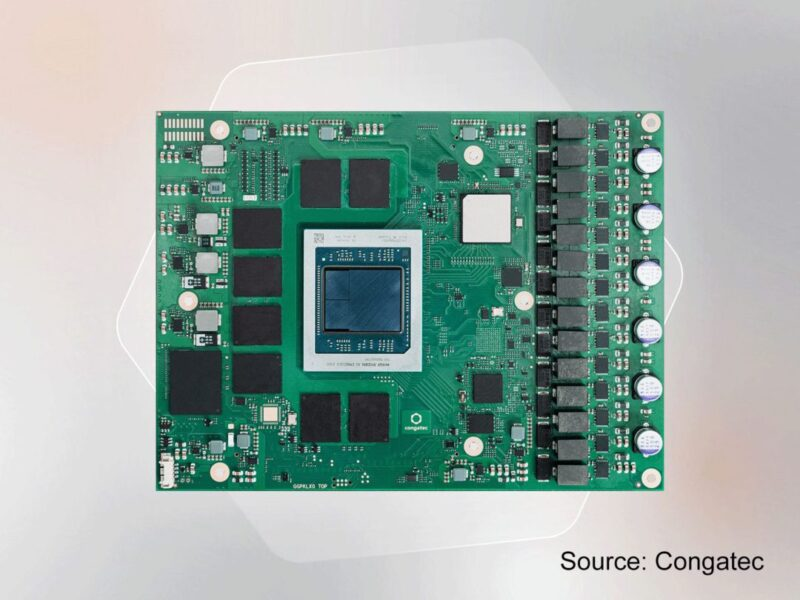
Congatec has introduced a COM-HPC Client Size C module based on AMD Ryzen AI Embedded X100 processors, targeting compute-intensive physical AI systems operating across industrial, medical, robotic, and autonomous vehicle applications.
The conga-HPC/cRX1 combines as many as 16 AMD Zen 5 processor cores with integrated Radeon RDNA 3.5 graphics and an XDNA 2 neural processing unit on a 120mm by 160mm computer-on-module.
Depending on processor selection, the integrated graphics can provide up to 59 TOPS of dense INT8 inference performance and 29.7 TFLOPS of FP32 compute performance. The dedicated neural processing unit adds up to 50 TOPS for sustained AI workloads.
Integrating these functions within one processor package can remove the need for a discrete graphics or AI accelerator card in many systems, reducing enclosure size, connector count, cooling complexity, power distribution, and the number of components requiring lifecycle support.
Processor options span eight, 12, and 16 cores, with commercial and industrial temperature variants. Industrial modules are specified for operation from -40°C to 85°C, while configurable thermal design power extends from 45W to 120W.
Up to 128GB of soldered LPDDR5X memory is supported alongside optional onboard NVMe storage. Soldered memory improves resistance to shock and vibration while allowing the CPU, graphics, and neural processor to share a high-bandwidth memory pool.
The module provides as many as 24 PCIe Gen4 lanes, dual 2.5 Gigabit Ethernet, USB, SATA, GPIO, serial interfaces, and support for four independent 4K displays. Operating system options include Windows 11, Windows 11 IoT Enterprise, and Linux.
Physical AI creates a different workload from cloud-based inference because a robotic or autonomous system may need to combine camera input, sensor fusion, object recognition, path planning, motion control, and safety monitoring within predictable time limits.
Sending those data streams to a remote cloud platform introduces latency, bandwidth cost, connectivity dependence, and data governance concerns. Local processing allows equipment to continue operating when external networks are unavailable and can keep sensitive production or medical information inside the machine.
Concentrating CPU, graphics, and AI acceleration in a compact module increases the thermal burden on the system. Carrier board design, heat spreading, enclosure geometry, airflow, ambient temperature, and application workload all affect whether the processor can sustain its rated performance.
Configurable power allows designers to balance compute output against cooling capacity, although a nominal processor setting does not guarantee continuous throughput. Long-duration AI workloads can expose thermal limits that remain hidden during short benchmark tests.
The launch follows the expansion of edge AI hardware available for industrial design, including platforms for visual inspection, predictive maintenance, autonomous navigation, and process monitoring.
Related work in physical AI edge platforms is bringing a wider range of processor architectures, accelerators, and form factors into robotics and machine vision. Software support and deterministic behaviour now require similar attention to headline TOPS values.
Computer-on-module architectures separate the processor subsystem from the application-specific carrier board. Equipment manufacturers can develop their own I/O, communications, power, safety interfaces, and physical connectors while retaining a route to later processor upgrades.
That modularity is particularly valuable in industrial systems expected to remain in service for a decade or more. Processor generations move faster than machine certification, mechanical design, and customer qualification, allowing a standardised module to reduce the amount of redesign required when silicon changes.
Software continuity remains a significant risk. AI frameworks, operating systems, drivers, security patches, and model toolchains must remain supported throughout the equipment lifecycle, because hardware availability alone cannot preserve a machine when its software environment becomes obsolete.
Congatec developed the module in accordance with IEC 62443-4-1, supporting equipment manufacturers preparing for the EU Cyber Resilience Act. A trusted platform module adds hardware-based security functions.
Cybersecurity becomes especially important where AI output influences physical movement. Model updates, remote maintenance, device identities, network interfaces, and stored data all create attack surfaces capable of affecting production and safety as well as confidentiality.
The conga-HPC/cRX1 provides a dense computing platform for applications that previously required separate processor and accelerator hardware. Industrial adoption will depend on sustained thermal performance, software stability, and predictable machine behaviour after the initial AI demonstration has moved into long-term field operation.