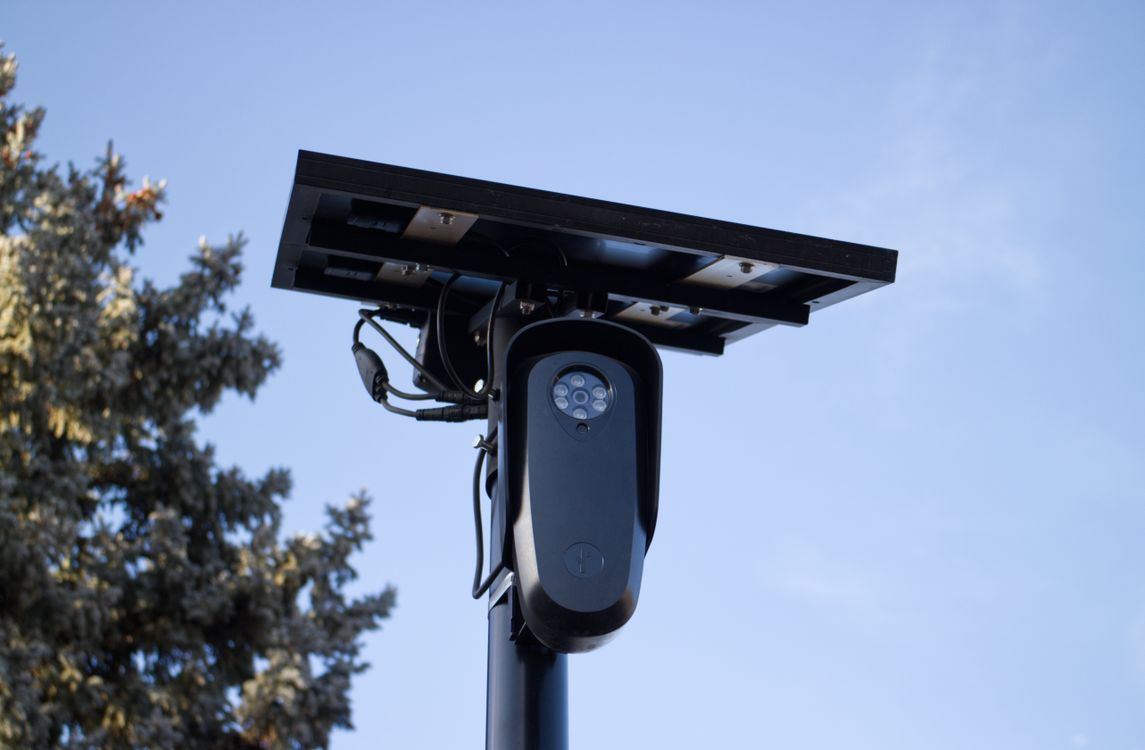
ImageDeep has introduced Houndlight, a solar-powered security alarm camera designed for quarries, plant yards, stockpiles and other industrial sites without mains electricity or a fixed internet connection. The unit combines a battery, solar power, 4G communications and on-device artificial intelligence with a light beacon, siren and voice warning. It is intended for remote compounds and changing work areas where permanent cameras would require additional cabling, network equipment or electrical installation.
Houndlight is built around local detection rather than relying exclusively on streaming every camera frame to a remote server for analysis. ImageDeep says its software can recognise people and vehicles by day or night, distinguish certain irrelevant movement and trigger the on-board deterrent when an event meets the configured conditions. The device can also send an alert to a phone, with optional monitoring by the company’s operators. The launch extends the company’s Scopis AI system into self-contained camera hardware.
Quarries leave mobile plant, stockpiles, fuel storage and temporary compounds distributed across large sites, sometimes well beyond a staffed gatehouse. Extraction and haul-road arrangements change as work advances, so a camera installed for one site layout may need to be moved later. Supplying permanent power and fixed data connections to every location adds trenching, cabling and maintenance work, particularly for areas used only during a defined phase of operations.
Houndlight’s solar panel and battery supply the electronics where mains power is unavailable. The energy used by local image processing, cellular communications, lighting and audible warnings changes with site activity, and solar generation depends on daylight, mounting position and shading. The product is designed to operate for days without grid supply. Installation therefore involves choosing a position that captures the approach route while providing enough exposure to maintain the battery during the intended surveillance schedule.
Its 4G connection carries alerts and management information without a local Wi-Fi network. Site teams still need reliable cellular coverage at the mounting point, particularly where a quarry face or earthworks may obstruct the signal. Image analysis takes place on the camera, allowing the device to activate its warning equipment locally when the configured detection threshold is met. Cellular connectivity then carries the notification to staff or the optional monitoring service.
When the camera detects activity within its configured zone, the light beacon, siren and recorded voice warning can operate before a guard reaches the location. ImageDeep positions this immediate deterrent alongside footage and mobile alerts. Accurate siting is essential: a device facing a shared access road, for instance, needs detection settings and arming periods that distinguish authorised vehicle movements from an intrusion into a closed stockpile or equipment compound.
ImageDeep offers human verification through its monitoring operators, who can assess an alert before it is escalated. The local camera warning and the subsequent response are separate functions. Operators can establish alarm recipients, escalation procedures and site contacts so that a verified intrusion results in an appropriate response, rather than only a record of activity at an unattended location.
Houndlight is intended to be mounted on a pole, wall or temporary post and moved as a quarry or construction compound changes. ImageDeep says its units can be armed or disarmed collectively through Scopis AI, with several cameras grouped into zones. Such grouping can be useful at sites with multiple entrances, equipment parks and isolated storage areas, because a central view of device status reduces the need to inspect each installation separately.
Houndlight ships with a pre-installed SIM and memory card, pan-tilt-zoom operation and mobile application access. Local AI is intended to filter movement from trees, shadows and animals while identifying people and vehicles. Camera positioning and detection-zone settings will determine the practical coverage of a gate, haul route or storage compound, with individual units visible through the Scopis AI management interface.
The same hardware can be deployed at pipelines, compressor stations, wind and solar installations, storage yards and construction compounds. Detection periods and alarm responses can be configured for each operating environment. A quarry may arm an exposed stockpile after a shift ends, while a plant yard with authorised night access will need a different set of active zones and event rules.
ImageDeep is offering Houndlight in the UK, European Union, North America, south-east Asia and Australia while recruiting distribution partners. Quarries can reposition the units as the working area changes, group cameras by operational zone and direct alerts to the people responsible for responding. Solar supply and local AI reduce the need for electrical and data cabling at each temporary monitoring point.