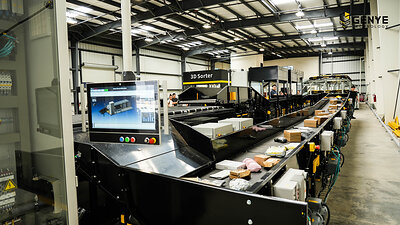
Genye Technology has opened a branch and technology demonstration centre in Fontana, California, establishing local testing, processing, assembly, and engineering capability for its parcel and logistics automation systems in North America.
The Southern California operation is located at 8655 Beech Avenue in the Inland Empire, one of the largest logistics and distribution clusters in the US. Genye says the site combines technology demonstrations, application testing, customer engagement, and local processing and assembly rather than operating solely as a sales office.
The facility formally opened on 18 August, with the company announcing the expansion on 22 August. Customers attending the opening saw live parcel-processing and sorting demonstrations and discussed throughput, system configuration, integration requirements, and deployment with Genye engineers.
Equipment shown at the site included the company’s Mini Loop Cross-Belt Sorter, 3D Sorter, and Singulator with narrow-belt sorting. The demonstrations processed parcels under live conditions rather than relying only on static displays, allowing different machine configurations and handling scenarios to be examined.
Genye designs and manufactures automated systems covering parcel feeding, singulation, sorting, and integrated materials handling. The company says more than 4,000 of its systems have been deployed internationally, supported by more than 100 engineers and a 30,000m² manufacturing operation providing design, production, installation, commissioning, and after-sales support.
Fontana adds a regional layer to that manufacturing structure. Local processing and assembly can shift selected project work closer to North American customers, while the demonstration area gives operators a physical environment in which to test equipment against their own parcel profiles and operational constraints before committing to installation.
Headline throughput figures rarely describe the whole performance of a logistics system. Parcel dimensions, weight, packaging material, label position, induction rate, conveyor interfaces, available floor space, and downstream capacity all influence whether a sorter achieves its rated output once installed inside a working facility.
A demonstration centre is consequently most useful when it behaves like an application laboratory. Testing customer-relevant items and configurations can reveal handling problems before a system reaches site, while engineers can adjust mechanical layouts, control logic, sensor positions, and interfaces without disrupting an operating distribution centre.
The Inland Empire gives Genye access to a dense concentration of warehouses, parcel operations, freight businesses, and fulfilment facilities serving Southern California and the ports of Los Angeles and Long Beach. That concentration reduces the distance between equipment supplier and customer sites where automation is expected to run for long shifts with little tolerance for unplanned stoppage.
Implementation and support have become significant differentiators in warehouse automation. Sortation equipment must integrate with conveyors, scanners, warehouse control software, labelling systems, upstream induction, and downstream chutes or handling cells. A theoretical machine rate offers little value if another interface restricts the complete line.
Local engineering presence can also reduce the operational penalty when equipment requires adjustment or repair. High-throughput distribution centres often depend on a small number of critical conveyors and sorters, meaning one failure can restrict several upstream processes and quickly create a backlog.
Spare parts, software support, commissioning engineers, and technicians therefore sit alongside machine specifications in the practical buying decision. Genye’s California site gives the company a base from which those functions can be provided within the same region as a large number of prospective installations.
The company has not quantified how much manufacturing will move to Fontana, and its larger production operation remains elsewhere. The California centre should therefore be treated as a local assembly, application, and support expansion rather than a replacement manufacturing plant.
Even that narrower role can affect project lead times. Demonstration and application testing can take place near the customer, selected processing or assembly can be completed regionally, and engineering teams can remain involved through installation, commissioning, upgrades, and service without coordinating every stage across international time zones.
Representatives from Rockwell Automation, WINIT Corporation, Thunder International Group, and J&T International attended the opening. Their presence illustrates the logistics and automation ecosystem surrounding the facility, although attendance at an event does not amount to a contract or partnership unless separately announced.
The commercial test will come after the ribbon cutting. A demonstration centre has value only if application work shortens commissioning, local assembly reduces lead times, and service capability improves equipment availability once systems are installed.
Fontana gives Genye a permanent North American base for those activities in a region where parcel and warehouse automation is already heavily deployed. The useful measures will be project conversion, commissioning time, system availability, and support response — rather less photogenic than an opening ceremony, but much closer to what customers actually pay for.