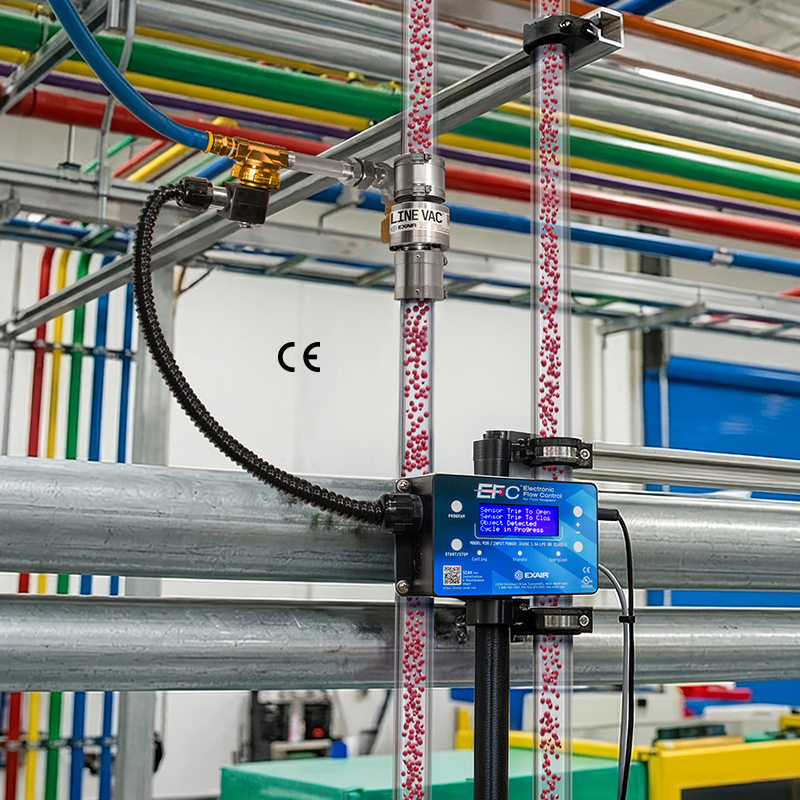
EXAIR has redesigned its Electronic Flow Control for compressed air systems, adding independently adjustable on and off timing and external programming access so automated production equipment can stop airflow more closely around the process that actually requires it.
The EFC combines a photoelectric sensor, timing control and fast acting solenoid valve. When the sensor detects a component entering the working area, the controller can open the compressed air supply for operations including blowoff, drying, cooling, conveying or static elimination before closing the valve when airflow is no longer required.
The latest design adds asynchronous timing, allowing the on and off intervals to be programmed independently rather than tying both parts of the operating cycle together. EXAIR has also moved programming access outside the enclosure so operators can change settings without removing the cover.
Timing determines whether automatic shutoff reduces air demand without compromising the production process. A valve that closes too late continues consuming air after the component has left, while one that closes too early can leave a product wet, hot, contaminated or incompletely transferred.
Independent intervals allow the controller to follow production cycles in which the active process and the gap between components are different lengths. One application may require several seconds of airflow followed by a much longer idle period, while another may need a short pulse repeated around a faster product sequence.
The photoelectric sensor can detect objects up to three feet, or approximately one metre, away. Positioning it upstream gives the controller time to open the valve as a component approaches rather than waiting until the product is already beneath a nozzle, air knife or other device.
Sensor location and conveyor speed therefore determine the delay between detection and arrival at the process. If line speed changes, the same physical sensor position produces a different timing relationship even before the programmed intervals are adjusted.
External programming makes those corrections easier because operators no longer have to open the control enclosure for routine changes. The setting still needs to remain controlled where insufficient airflow could affect quality, so easier access does not remove the need for approved operating parameters.
EXAIR offers EFC models covering compressed air flows from 40 to 350 standard cubic feet per minute. At higher flow rates, even short periods of unnecessary operation can consume substantial volumes, particularly where an air device would otherwise remain open through gaps between products.
Compressed air provides rapid, clean airflow or motive force at the point of use, but the air first has to be generated electrically at the compressor and then pass through treatment equipment, receivers, distribution pipework and valves. Pressure losses and leakage increase the amount of compressor work required before useful air reaches the application.
Stopping flow during idle periods removes demand from the system rather than attempting to produce the same unnecessary air more efficiently. If a blowoff nozzle needs to operate only while a component passes, closing the supply between components reduces the volume the compressor network has to replace.
The available saving depends on the production duty cycle. A continuously occupied conveyor offers little idle time for a sensor controlled valve to remove, while intermittent production or regular gaps can leave air equipment running for long periods without performing useful work.
Valve response also has to suit the frequency of the process. Closely spaced components may leave gaps too short to justify closing and reopening the supply for every item, so the controller can instead keep airflow on across a group and shut it during longer pauses.
Drying illustrates the operating compromise clearly. Additional air generally increases energy use, but too little exposure can leave moisture that interferes with coating, inspection or packaging. Timer values therefore have to be established from the required process result rather than reduced to the shortest possible pulse.
Cooling creates a similar constraint because component temperature may respond more slowly than the sensor event. Air can be triggered by the detected part, but engineers still need to confirm that the chosen duration keeps temperature within limits across different line speeds and incoming thermal loads.
Compressed air conveying depends on the airflow for material movement itself. Closing the valve too early can leave product inside a transfer line, so the programmed interval may need to continue beyond the final detection event long enough to clear the remaining material.
EXAIR places the EFC alongside products including digital flowmeters and ultrasonic leak detectors. Each addresses a different part of compressed air consumption: flowmeters establish how much air a process uses, leak detection finds losses in distribution, and point controls remove deliberate flow during idle periods.
Measurement is particularly useful when deciding where automatic shutoff deserves priority. A high flow application with large gaps between products offers a different saving opportunity from a low flow tool that operates continuously, even when both are supplied by the same compressor plant.
The redesigned EFC does not determine those process requirements automatically. Engineers still have to establish the production cycle, sensor location and acceptable air duration, but independent timing and external programming reduce the effort needed to adjust control around the actual application.
Performance can then be checked at the point of use. If airflow is removed from idle portions of the cycle while drying, cooling, conveying or blowoff results remain unchanged, the factory reduces compressor demand without altering the equipment responsible for the underlying production operation.