
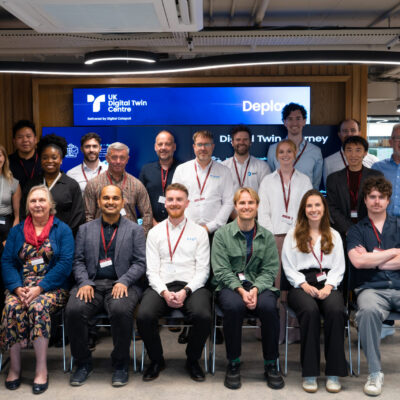
Digital Catapult has concluded its inaugural Digital Twin Adoption Accelerator, bringing forward industrial twin solutions developed by nine UK small and medium-sized enterprises.
The programme focused on deployment in practical industrial settings, with projects covering aerospace, maritime, defence, ports, and infrastructure. It gave technology developers access to defined engineering and operational challenges where digital twins could be tested against asset behaviour, production constraints, and lifecycle requirements.
Digital twins have been a recurring part of industrial strategy for several years, although adoption has often been held back by unclear business cases, fragmented data, immature integration routes, and a gap between simulation capability and daily engineering work. A model that remains separate from decisions offers limited value; a twin that helps predict failure, test design changes, support commissioning, or guide maintenance becomes part of the engineering process.
The strongest applications tend to appear where physical assets are expensive, downtime is costly, and decisions need to be tested before changes are made in the real world. Aerospace production, port operations, maritime systems, defence assets, and infrastructure all fit that pattern. They involve complex systems, long asset lives, and high costs when errors are carried into operation.
Engineering teams using digital twins need more than a visual model. The twin must preserve design intent, reflect operating conditions, connect to trusted data, and support decisions that would otherwise rely on slower manual analysis or direct physical testing. When those elements are missing, digital twin projects can become isolated demonstrations rather than working industrial tools.
The accelerator sits alongside a wider convergence of AI, simulation, automation engineering, and industrial software. At Hannover Messe, the strongest examples of industrial AI were those tied to defined engineering work, including simulation, commissioning, robot training, production optimisation, and factory data analysis. The same pattern was clear in work examining AI deployment across industrial systems, where bounded technical applications offered more credible progress than broad claims about autonomy.
Digital twin deployment still carries several practical barriers. Many industrial sites operate with ageing equipment, inconsistent data structures, limited instrumentation, and engineering knowledge that sits in operator experience rather than formal models. Capturing that context requires time, discipline, and a willingness to treat the twin as an operational asset rather than a project deliverable.
Connected twins also bring cybersecurity and data governance demands. A planning model can be relatively isolated, but a twin drawing from operational technology, maintenance records, production systems, or control environments needs defined access, validation, and change management. The closer a twin gets to operational decisions, the more important it becomes to know what data it uses and whether the model remains reliable.
The involvement of smaller technology companies is also important. Specialist SMEs often hold modelling, sensing, visualisation, analytics, or software capability that larger industrial users cannot easily develop internally. At the same time, those companies need structured access to industrial problems if their tools are to move beyond demonstration. Accelerator programmes can narrow the project scope and force the technology to prove itself against operational constraints.
Skills remain a central part of the adoption challenge. Digital twins require design engineers, software developers, data specialists, automation engineers, operators, and maintenance teams to work from a shared understanding of the asset. Traditional organisational boundaries can slow that work, especially when production and maintenance still rely on undocumented local knowledge.
The UK has a strong base in simulation, systems integration, advanced manufacturing research, and engineering design. Turning that capability into routine industrial deployment has been harder, partly because digital projects often struggle to survive beyond pilot phase. The Digital Twin Adoption Accelerator points to a more practical route, built around defined problems, measurable operational value, and repeatable deployment models.
The measure now is scale. Digital twin projects have to be maintained across multiple sites, changing assets, software updates, and operational teams. If the participating companies can show that their systems keep working beyond demonstration settings, digital twins could become part of normal engineering practice rather than another layer of innovation theatre.
