AI was unavoidable at Hannover Messe 2026, but that alone says very little. The term has become part of the industrial sales grammar, attached to everything from automation platforms and cloud services to robots, maintenance systems, design tools, enterprise software, and almost every version of the factory of the future.
A factory needs shorter commissioning cycles, better engineering throughput, fewer quality escapes, less downtime, usable production data, tighter energy control, and systems that can be trusted when the line is running and the margin for experiment has gone. Hannover’s more convincing AI examples were the ones aimed at those pressures, rather than the ones that treated intelligence as a gloss on existing products.
The clearest applications were narrow, technical, and tied to defined industrial work: engineering agents embedded in automation workflows, digital twins used to accelerate simulation, robot training environments built around physical realism, production data tools aimed at master data, and monitoring systems designed to turn machine information into action.
Where AI had a job to do
Automation engineering was one of the most credible areas of development. Control engineers spend large amounts of time configuring devices, developing PLC logic, building HMI screens, checking project consistency, and adapting standardised automation blocks to specific machines or lines. Much of that work is technically demanding, but also repetitive, particularly where projects are built around familiar architectures.
Siemens used Hannover Messe to launch the Eigen Engineering Agent, an industrial AI system developed for automation engineering. The system is designed to work inside Siemens’ automation environment and carry out engineering tasks using multi-step reasoning, including work around automation code, HMI visualisation, device configuration, and validation. Siemens positioned it as a move from AI assistance towards autonomous execution of defined engineering work.
That places AI closer to the logic and configuration behind automated machinery. The potential gain is reduced time spent on routine configuration and iteration. The harder engineering questions sit around validation, traceability, sign-off, and accountability. Once AI starts assisting with automation code or system configuration, checking the output becomes as important as generating it.
The same pressure is visible across wider engineering software. Industrial projects still lose time in the handoffs between design, simulation, commissioning, production change, and lifecycle support. Each break between those stages creates room for duplicated work, undocumented assumptions, and late correction.
Schneider Electric brought its Microsoft collaboration to Hannover with agentic manufacturing capabilities powered by Azure AI. The work builds around industrial automation, engineering, and lifecycle operations, with an industrial copilot intended to help engineers make and validate production changes faster. Schneider said the system can cut engineering time by up to 50%, with production changes that previously took weeks completed in hours.
The claim is best treated as an upper-end performance figure rather than a standard outcome, but the technical direction is important. AI is being placed across engineering workflows, not simply added as a separate productivity layer. Systems that preserve context from design intent through to deployment could reduce the manual reconciliation that still consumes engineering hours. Systems that cannot be bounded and validated will simply shift effort from doing the work to checking the work.
Rockwell Automation used Hannover to present AI-enabled factory engineering across design, emulation, industrial software, digital twins, embedded intelligence, and secure OT architecture. Its language around autonomy stretches into familiar future-factory territory, but the practical target is clear enough: design, test, emulate, secure, and deploy production systems with less manual friction. Engineering departments already carry ageing control systems, cybersecurity requirements, skills shortages, and retrofit demands. Removing friction from that chain is a legitimate use for AI.
A second group of announcements centred on simulation and commissioning. Digital twins and virtual commissioning are already established industrial tools, but their value depends on how closely the model reflects the physical system. A simulation that ignores lighting, surface conditions, part variation, awkward fixtures, cable routing, vibration, or human movement may still support planning, but it becomes less reliable when a robot cell has to run on a real shop floor.
ABB and NVIDIA addressed that gap through RobotStudio HyperReality, an extension of ABB’s robot simulation environment using NVIDIA Omniverse technology. The system is intended to create more physically realistic virtual training environments for robots, including factors such as lighting, textures, shadows, surfaces, and disturbances that affect robot performance in production. Commercial availability is expected in the second half of 2026.
Robot simulation is not new. The development here is the push towards a less sanitised virtual environment. Industrial robots often perform well in structured cells, but the difference between a clean model and a vibrating, reflective, obstructed, or poorly lit factory cell can be expensive. Richer simulation will not remove commissioning work, but it can reduce the late discovery that a robot behaves differently once the surroundings are less perfect than the CAD model.
Process industries give the same problem a different shape. In high-speed filling, packaging, and material handling, small adjustments to flow, timing, pressure, container geometry, machine settings, and line speed can affect throughput, waste, and product consistency. Simulation is valuable, but slow model runs limit how many scenarios engineers can test before decisions have to be made.
Krones used Hannover Messe to demonstrate AI-powered digital twins for beverage production with Microsoft and technology partners including NVIDIA, SoftServe, Ansys, and CADFEM. The demonstration focused on a filling line, where advanced AI-based fluid simulation was integrated into a digital twin so engineers could model complex behaviour through a multi-agent experience. Microsoft said simulation times had been reduced from four hours to under five minutes, allowing engineers to optimise machine parameters virtually and shorten commissioning time.
The application is narrow enough to be credible. A filling line is a tightly coupled system in which fluid behaviour, container handling, machine timing, and line balance interact continuously. Faster simulation gives engineers more room to test operating conditions, customer-specific layouts, and performance settings before a production change is committed physically. The value sits in the shorter loop between model, machine, and production outcome.
The more persuasive industrial AI work at Hannover tended to have that character. Faster fluid simulation, cleaner engineering workflows, better line tuning, more realistic robot training, and less manual data maintenance do not carry the drama of full factory autonomy. They sit closer to the places where time, cost, and engineering capacity are lost.
The factory test is still unforgiving
Enterprise systems brought another layer to Hannover’s AI discussion. AI agents are increasingly being aimed at the connective tissue of manufacturing: production master data, routing, planning, procurement, maintenance, asset management, logistics, and compliance. These areas are less visible than robots, but operational discipline often depends on them.
SAP used Hannover Messe to present agentic AI capabilities for manufacturing and supply chain operations, including a Production Master Data Agent. The agent is intended to help create and maintain production master data by using bills of materials to generate routings, operations, work centres, and component assignments. SAP also connected its Hannover work to logistics, asset management, field service, manufacturing execution, and Digital Product Passport readiness.
Production master data is one of the less glamorous foundations of manufacturing. Errors in routings, work centres, component relationships, and process instructions can create delays, rework, inconsistent execution, and poor planning. An AI agent that helps generate and maintain that structure has a clearer industrial purpose than a dashboard that describes problems after they have accumulated.
AI does not make poor data reliable. It can accelerate useful work when the underlying structures are coherent, but weak master data, inconsistent process definitions, and fragmented systems create the conditions for confident errors at speed. The stronger examples at Hannover connected AI to trusted operational data and bounded workflows, rather than presenting the model as the whole answer.
Bosch’s Manufacturing Co-Intelligence sits in that category. Bosch presented the concept at Hannover as a way of combining industrial data, AI, and IT infrastructure to support production efficiency, with demonstrations around human-machine collaboration and intelligent production systems. Its work with Microsoft and Capgemini placed the emphasis on the data and integration layer beneath the AI application.
Factory data is rarely clean or self-explanatory. A temperature reading, alarm, work order, batch record, machine state, or maintenance note only becomes useful when the system understands what it refers to, how it relates to the wider process, and whether it can be trusted. In production, the model is rarely the whole product. The hard work is contextualising machine data, process information, maintenance history, and production rules so that an AI system has something coherent to act on.
Lenovo presented AI through its own manufacturing operations and customer deployments. At Hannover, the company highlighted production-scale AI applications across quality inspection, intralogistics, monitoring, issue investigation, and logistics performance. It attached operational figures to that work, including an 85% reduction in lead time, 42% lower logistics costs, and a 58% productivity improvement at its largest North American site.
Those figures are company performance claims rather than universal benchmarks, but they are claims about live operations. Quality inspection, materials movement, monitoring, and issue investigation are measurable areas. They give AI something concrete to prove: fewer defects, faster investigations, better flow, and less avoidable manual effort.
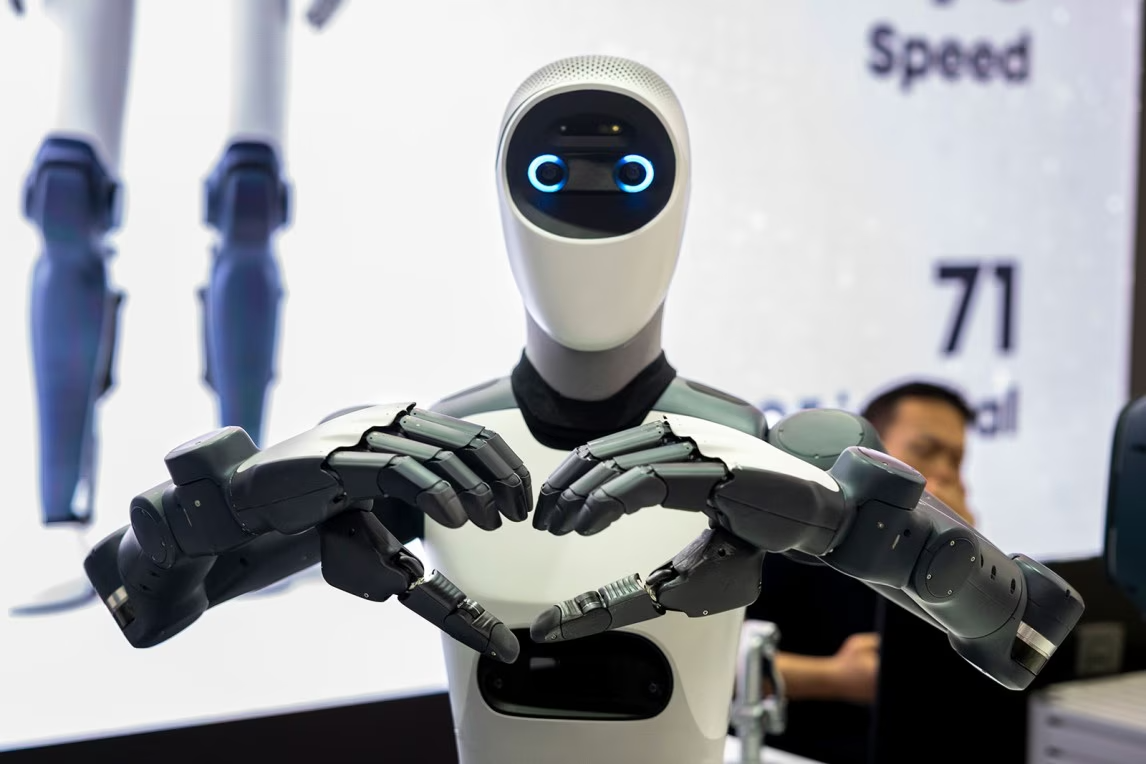
Robotics gave Hannover Messe its most visible AI imagery. Humanoid robots and physical AI have become prominent as machine vision, reinforcement learning, foundation models, sensor fusion, and lower-cost computing move from software into mobile systems. The attraction is clear: a mobile robot with a human-like form could, in principle, operate in spaces designed for people rather than in cells designed around machines.
Hannover’s programme and exhibition floors reflected that interest. Humanoid systems, AI-enabled robots, autonomous inspection tools, and physical AI demonstrations showed how machine intelligence might move from dashboards into the physical environment. The most credible version of that idea is not the human shape. It is the ability of mobile, sensor-rich systems to inspect, detect, report, and trigger workflows where fixed automation is too rigid or expensive.
A humanoid robot walking around a stand is spectacle. A mobile inspection system that identifies a safety risk, records it correctly, and triggers a maintenance process is an industrial tool. The same distinction applies to autonomous mobile robots, collaborative robots, inspection systems, and AI-enabled machine vision. Hardware gains value when it is connected to a production task, a quality requirement, a maintenance routine, or a safety workflow.
That distinction ran through the event. Hannover Messe 2026 did not need to prove that AI has arrived in industrial marketing. The useful separation was between AI as a label and AI as a working component in engineering, simulation, commissioning, production, logistics, quality, and maintenance.
The unresolved problems remain stubborn. Brownfield integration is slow. OT cybersecurity is unforgiving. Human oversight is still necessary. Validation is non-negotiable. Data quality remains uneven. Energy demand is rising. Skills shortages will not be solved by a software layer. Vendor lock-in will become sharper as AI moves deeper into engineering environments and operational systems.
The AI applications worth attention were bounded, technical, and measurable. Tools that reduce commissioning time, improve simulation fidelity, maintain production data, accelerate engineering work, or support quality and logistics have a route into factory use. Everything else will need more than better stand graphics.
The factory test for AI is not whether it can attract a crowd in Hannover. It is whether it still looks useful when production is late, the line is unstable, the data is messy, and the engineer responsible for signing it off has to make the call.