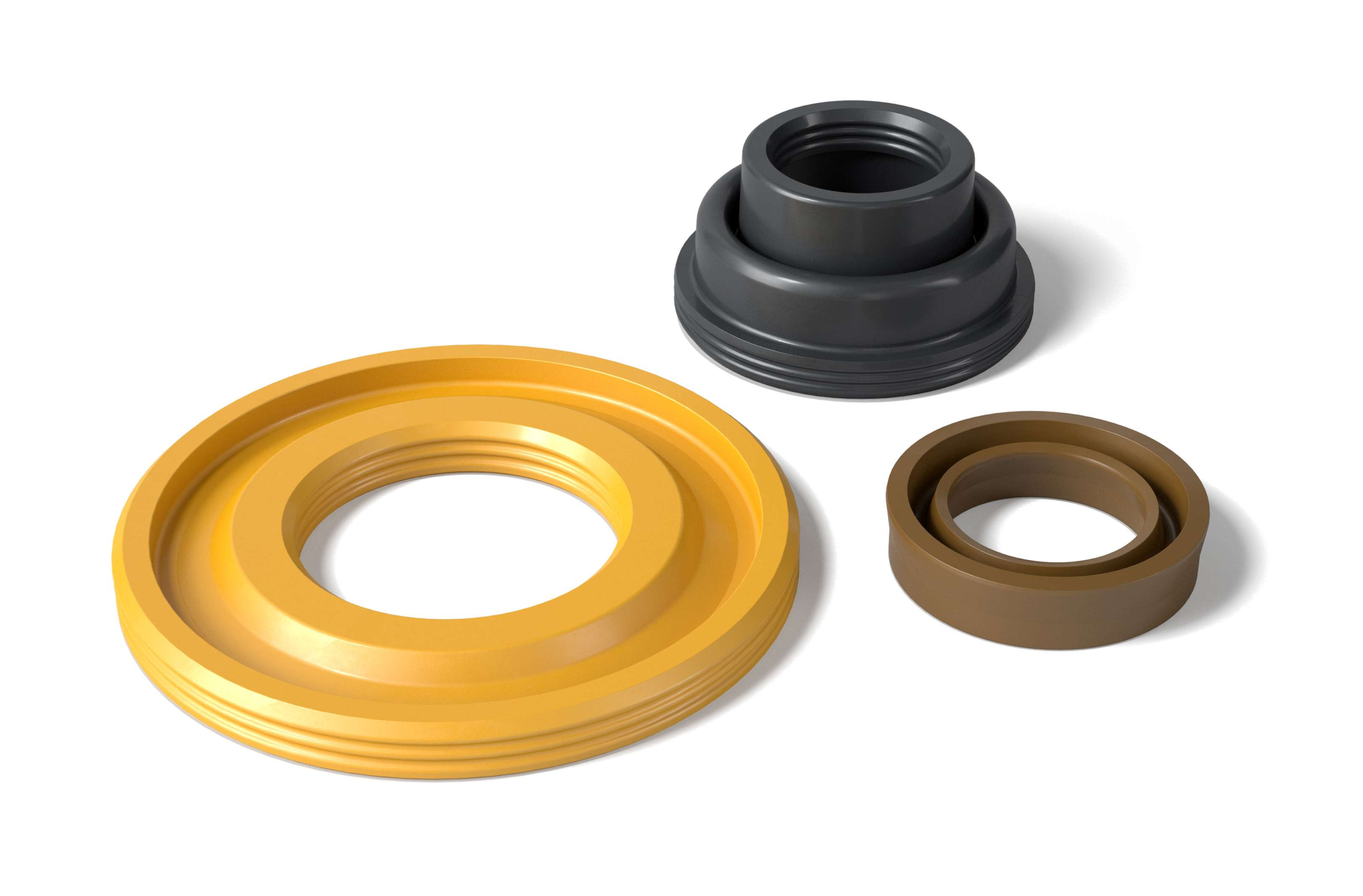
Parker Prädifa has developed an adaptive Warp Seal product family for applications where large component tolerance chains make conventional static sealing difficult to specify, assemble, or validate.
The Prädifa Technology Division of Parker Hannifin has developed the seals to compensate for axial, radial, and angular tolerances in ports, feedthroughs, plug connections, housing openings, and related assembly spaces. The product family addresses designs where the available sealing envelope is shaped by production variation rather than idealised component geometry.
Many modern housings and connector interfaces are produced using high-pressure die-casting, plastic injection moulding, sheet metal forming, and similar high-volume manufacturing methods. These processes deliver efficient production economics, but the tolerances achievable at acceptable cost are often wider than those assumed by traditional static sealing arrangements.
When tolerance chains exceed the working range of a standard seal, manufacturers can face tighter component specifications, additional machining, rework, more complex installation procedures, or higher warranty risk. Parker’s Warp Seal approach places more of the compensation function into the sealing element itself, allowing the seal to adapt within the real assembly space.
The design maintains sealing performance where mating components present misalignment or dimensional variation. Parker says adapted materials give the seals resistance to a wide range of media and environmental influences, while the geometry supports easier assembly across different component layouts without requiring major design or functional restrictions.
The product family is available in several variants for different assembly spaces and tolerance compensation requirements. Depending on the specific design, Warp Seals can also function as pressure relief valves, adding controlled pressure management alongside sealing.
Potential applications include automotive, aerospace and defence, HVAC, industrial manufacturing equipment, mechanical engineering, off-road machinery, hydrogen and fuel cell engineering, and electrification. These sectors often share the same sealing constraints: compact design, high tightness requirements, production variation, and limited space for oversized sealing strategies.
Tolerance management is increasingly being designed into components rather than corrected at the end of production. Compact assemblies, mixed-material housings, automated production, and electrified architectures leave little room for seals that require ideal mating conditions. Failures around feedthroughs and connector interfaces can also be difficult to diagnose once the assembly is in service.
Parker says Warp Seals can reduce assembly effort and cost by avoiding unnecessary tightening of component tolerances. More information is available through Parker’s Warp Seals tolerance management white paper.