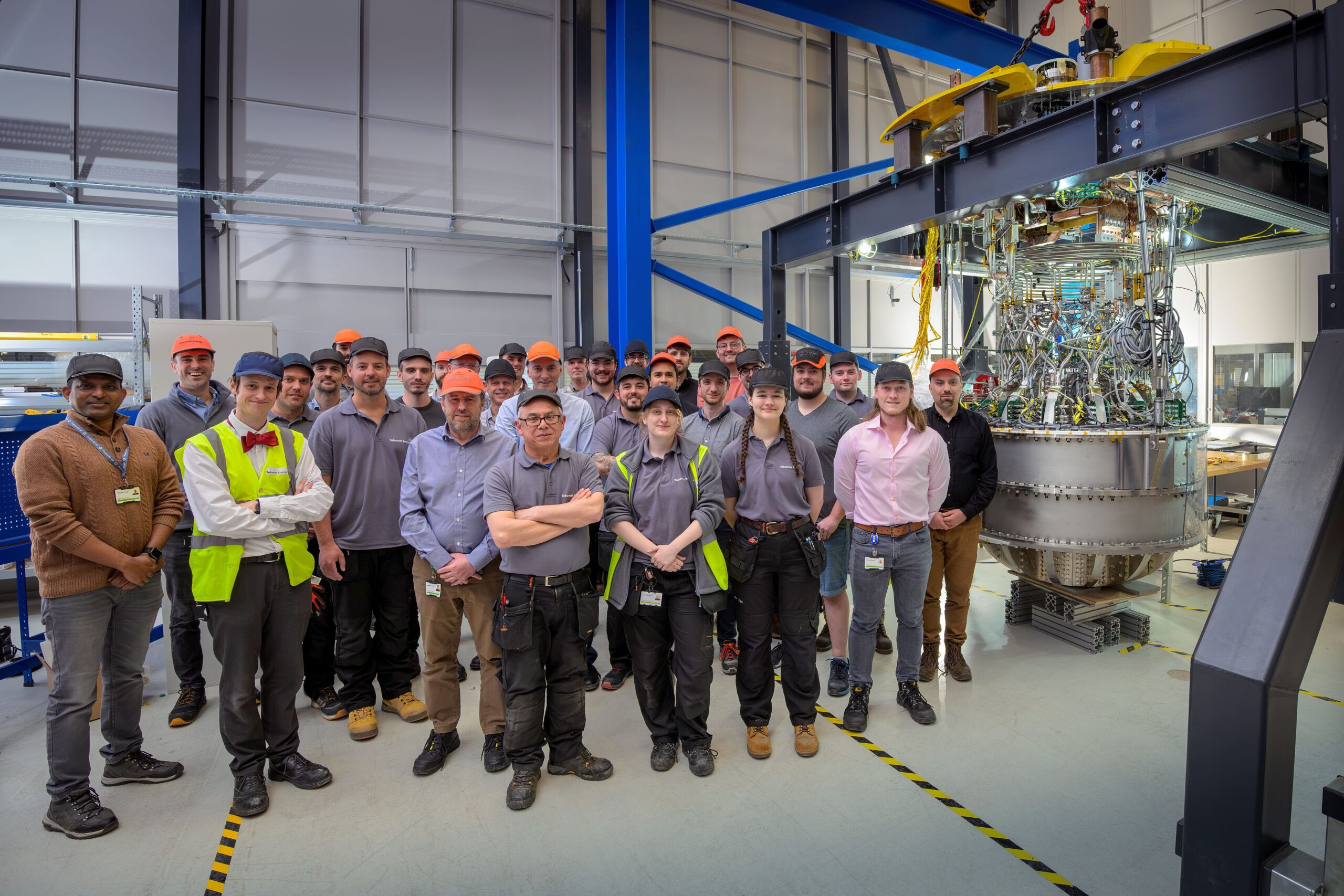
Tokamak Energy has completed a 14-month test campaign on its Demo4 high-temperature superconducting magnet system, generating operating data that will feed into the UK STEP fusion programme and the company’s wider commercial HTS development.
Engineers pushed Demo4 to a peak magnetic field of 13.7 tesla, operated toroidal field coils at 5,600 amps, and cycled the system from 77 kelvin down to 17 K. The equipment also withstood transverse mechanical stress of 150 MPa.
The integrated magnet system accumulated roughly 10,000 hours in different states of energisation, including extended operation at high field. Testing included forced discharges at up to 12.5 T and high current to examine resilience under fault conditions.
Tokamak Energy reported no hotspots or degradation during the forced-discharge testing. More than 90 HTS joints were also assessed, with joint resistance and current transfer behaving in line with the company’s expectations.
Demo4 brings together more than the superconducting coils themselves. The system comprises 44 HTS coils in a spherical tokamak configuration, alongside cryogenics, energisation equipment, instrumentation, controls, current leads, and quench-protection systems.
Fourteen toroidal field limbs each contain two partially insulated HTS coils, while two poloidal field coils each contain eight fully insulated coils. A pressurised helium cooling system operates at up to 20 bar, and more than 600 sensors track voltage, magnetic field, temperature, and mechanical stress.
That level of integration is central to the value of the test campaign. High magnetic field strength is useful, but a power-plant magnet also has to manage thermal cycles, structural loads, electrical connections, cooling, protection, and control repeatedly rather than achieve a single laboratory result.
The company is using the experimental data to improve internal models and control software, allowing predicted behaviour to be compared with the response of a complete physical system. That becomes increasingly important as magnet geometries, stored energy, coil dimensions, structural requirements, and cooling loads grow.
Learning from Demo4 is now being applied to Tokamak Energy’s work as Magnet Systems Partner for STEP, the UK programme developing a prototype fusion power plant. The company holds a £70 million contract with UK Fusion Energy running to March 2029.
Industrial News covered that STEP magnet systems appointment when the contract was announced. Demo4 supplies a different piece of the engineering programme: accumulated evidence about how an integrated HTS system behaves across high field, high current, cryogenic operation, mechanical loading, and controlled fault events.
STEP will impose a broader set of constraints than a dedicated magnet test installation. Magnet performance has to fit around shielding, plant structure, maintainability, power conversion, remote handling, cooling infrastructure, controls, assembly sequence, and the long-term operating requirements of a nuclear facility.
High-temperature superconductors offer advantages because they can support high magnetic fields while operating at temperatures above those required by conventional low-temperature superconducting materials. “High temperature” remains a relative term, however: the system still operates under cryogenic conditions and demands tightly controlled thermal engineering.
Mechanical loading presents another constraint. Strong magnetic fields generate substantial forces within coils and their supporting structures, so conductor behaviour, insulation, winding packs, joints, and structural interfaces have to remain aligned under repeated loading.
Demo4’s 150 MPa transverse stress testing provides engineering evidence for that part of the system. It also gives designers information about how manufacturing tolerances and jointing methods influence behaviour under conditions closer to those expected in larger magnets.
Manufacturing becomes progressively more important as HTS systems scale. Coil winding, conductor handling, insulation, joints, sensors, cooling connections, structural support, and electrical interfaces all have to be produced consistently enough that completed assemblies match the models used to design them.
A development magnet can tolerate a level of specialist intervention that commercial equipment cannot. Repeatable production requires defined processes, inspection standards, acceptance testing, repair procedures, and a supply chain capable of producing technically consistent components at larger volumes.
Tokamak Energy says the Demo4 campaign is already influencing manufacturing and jointing methods, instrumentation, operating margins, and its next generation of magnet systems. The data is also intended to support applications beyond fusion where compact, high-field HTS systems could have commercial value.
Fusion power still depends on solving many engineering problems outside the magnet system, and a successful Demo4 campaign does not shorten those automatically. It does, however, replace part of the theoretical design space with 14 months of operating evidence from magnets, cryogenics, power, controls, protection, and instrumentation working as one system.