Colas Rail UK is rolling engine carbon cleaning across its 31-machine tamper fleet after trials at Rugby recorded fuel and carbon dioxide equivalent savings of more than 13%.
The rail infrastructure contractor has moved the treatment from a two-machine trial into its planned maintenance strategy and has become the first business to adopt Engine Carbon Clean’s subscription model, giving Colas its own generators so engineering teams can perform the work around the country and on demand.
That move from trial to routine maintenance is the more significant part of the programme. Rail fleets regularly provide opportunities to test fuel-saving technologies on one or two assets; considerably fewer interventions are adopted widely enough to become part of the servicing regime.
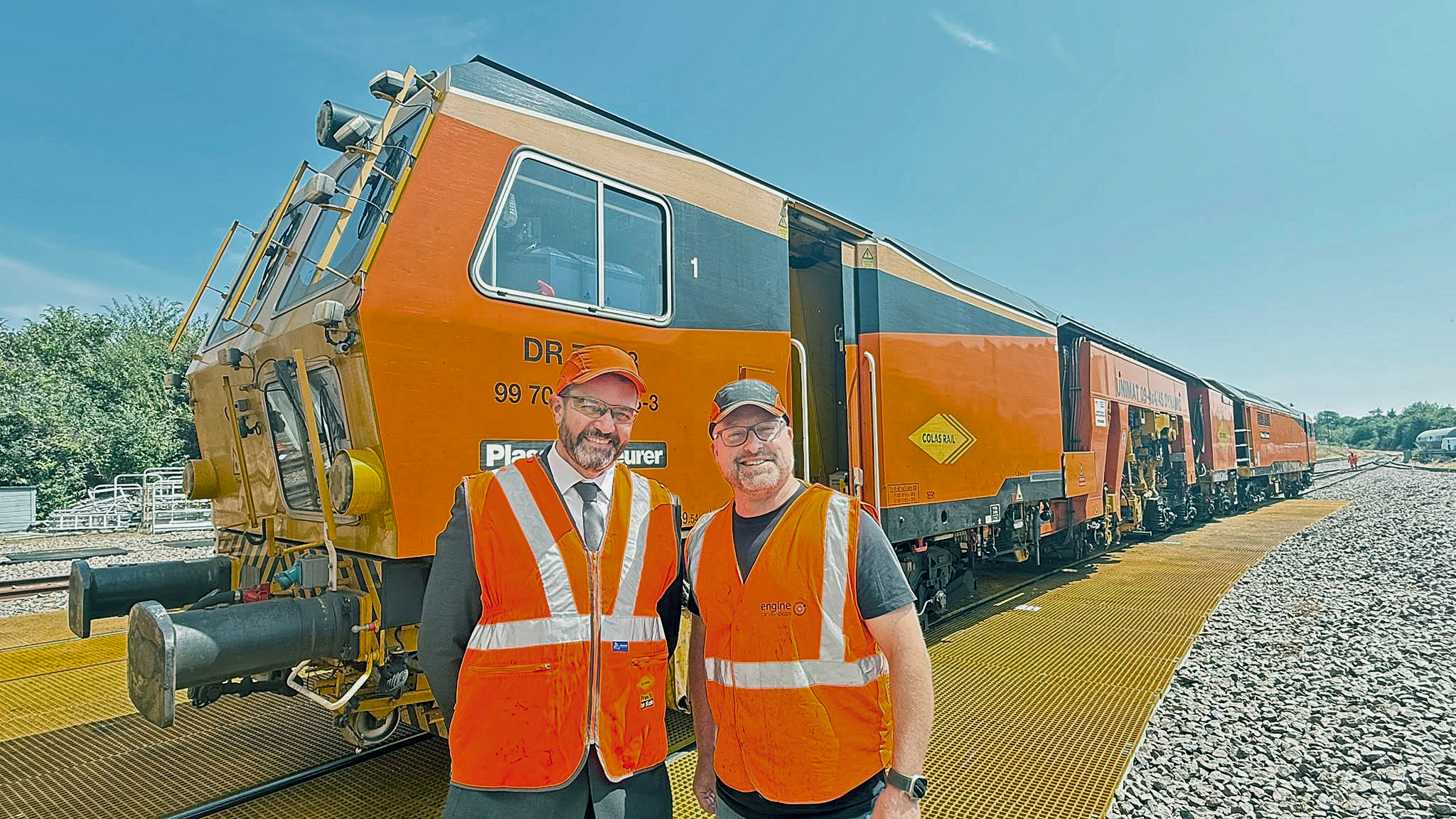
The initial work involved two tampers at Colas Rail’s Rugby depot. Each engine received four three-hour cleaning treatments, with the engineering team measuring operating performance through the programme.
Following the treatments, Colas says fuel consumption and CO2e fell by more than 13%. The engineering team was also able to reduce engine speed while carrying out the same work.
In maximum working mode, the required engine speed fell from 1,995rpm to 1,520rpm while maintaining the same task output.
Engine Carbon Clean, developed by Advanced Hydrogen Technology Group, uses an on-demand generator to produce oxyhydrogen gas. The gas is drawn through the engine air intake while the engine operates, with the developer saying it helps remove internal carbon deposits.
The hydrogen is generated as required rather than stored under pressure. The process does not rely on chemical cleaning additives or forcing stored hydrogen into the engine.
Those descriptions of the cleaning mechanism come from the technology developer. The operational evidence driving Colas’ decision is the measured performance from its own tamper programme.
Paul Conway, Head of Engineering & Compliance for Colas Rail Services, said: “Over 13% CO2e and fuel savings represents a strong and attractive business case.”
Across all 31 tamper assets, Colas forecasts annual savings of more than 550 tonnes of CO2e once the yearly cleaning programme has been applied throughout the fleet.
That remains a projection rather than a completed fleet-wide annual result. The actual saving will depend on engine condition, operating hours, duty cycle, baseline carbon accumulation, and whether the performance recorded on the two trial machines is reproduced across the broader fleet.
The video follows the Colas Rail UK Engine Carbon Clean programme and the engineering work behind the tamper trials.
Tampers are a useful proving ground because they are specialist pieces of on-track machinery rather than conventional road vehicles. Their engines support both movement and demanding working functions, while maintenance has to fit around possession schedules and the availability of individual machines for infrastructure work.
That operating environment also explains the attraction of bringing the equipment in-house. A relatively short maintenance process becomes less useful if each machine has to travel to one dedicated treatment location or wait for an external contractor to become available.
Under the subscription arrangement, Colas holds its own ECC generators and can incorporate the cleaning process into normal servicing schedules around the network.
That should make the fleet rollout easier to standardise and gives the engineering team an opportunity to build a larger body of operating data. Results can be compared between machines, engine types, operating hours, and cleaning intervals rather than relying permanently on the original two-asset sample.
Daniel Ditri, Head of Energy & Carbon at Colas Rail UK, said the work forms part of a data-led decarbonisation strategy tied to a 46.5% reduction target for Scope 1 and 2 emissions by 2030.
“Replacing assets too early is not sustainable, so we are focused on maximising the performance of what we already have,” he said.
That is the wider engineering argument behind the programme. New electric or alternative-fuel equipment can remove substantially more direct emissions than an engine-maintenance intervention, but specialist rail plant has long asset lives and cannot be replaced across an entire fleet at once.
Fuel-efficiency improvements can therefore operate alongside the longer transition rather than competing with it.
Colas has already been applying other measures to its existing fleet. Its current carbon-reduction plan includes greater use of alternative fuels and technologies intended to improve the fuel efficiency of diesel equipment.
The carbon-cleaning programme adds another maintenance-based intervention whose value can be measured against fuel use rather than relying solely on an assumed sustainability benefit.
Advanced Hydrogen Technology Group says ECC can be applied to engines running diesel, petrol, HVO, CNG, LNG, and other biofuels, giving the modular system potential application beyond the tamper fleet.
Colas Freight is consequently moving towards trials on two Class 37 locomotives. Based on the percentage savings recorded on the tampers, the businesses estimate that wider locomotive deployment could eventually avoid more than 2,800 tonnes of CO2 annually.
That is again a projection. A Class 37 locomotive operates under a different load profile and at a different scale from a tamper, making the locomotive trial important before the percentage improvement is extrapolated across another fleet.
The Colas relationship with Engine Carbon Clean began in 2025 when the technology was selected for an ESG-related grant through the company’s internal Innoboost competition.
Since then, the programme has moved through a recognisable industrial sequence: test the process on real equipment, measure the result, decide whether the economics justify wider use, and then bring the capability into routine maintenance.
That progression is more useful than the 13% figure on its own. Decarbonisation projects often struggle at the point where a successful demonstration has to become an everyday operating procedure.
The subscription model gives Colas control over that final step. If the trial result remains broadly reproducible across 31 machines, the technology becomes a maintenance tool delivering a measurable fuel benefit rather than an isolated sustainability demonstration.
The next evidence will come from that fleet-scale operating data and from the Class 37 programme. Two tampers established a case for proceeding; a full maintenance cycle across the fleet will show how much of the initial saving survives contact with the variation of real engines, workloads, and operating conditions.