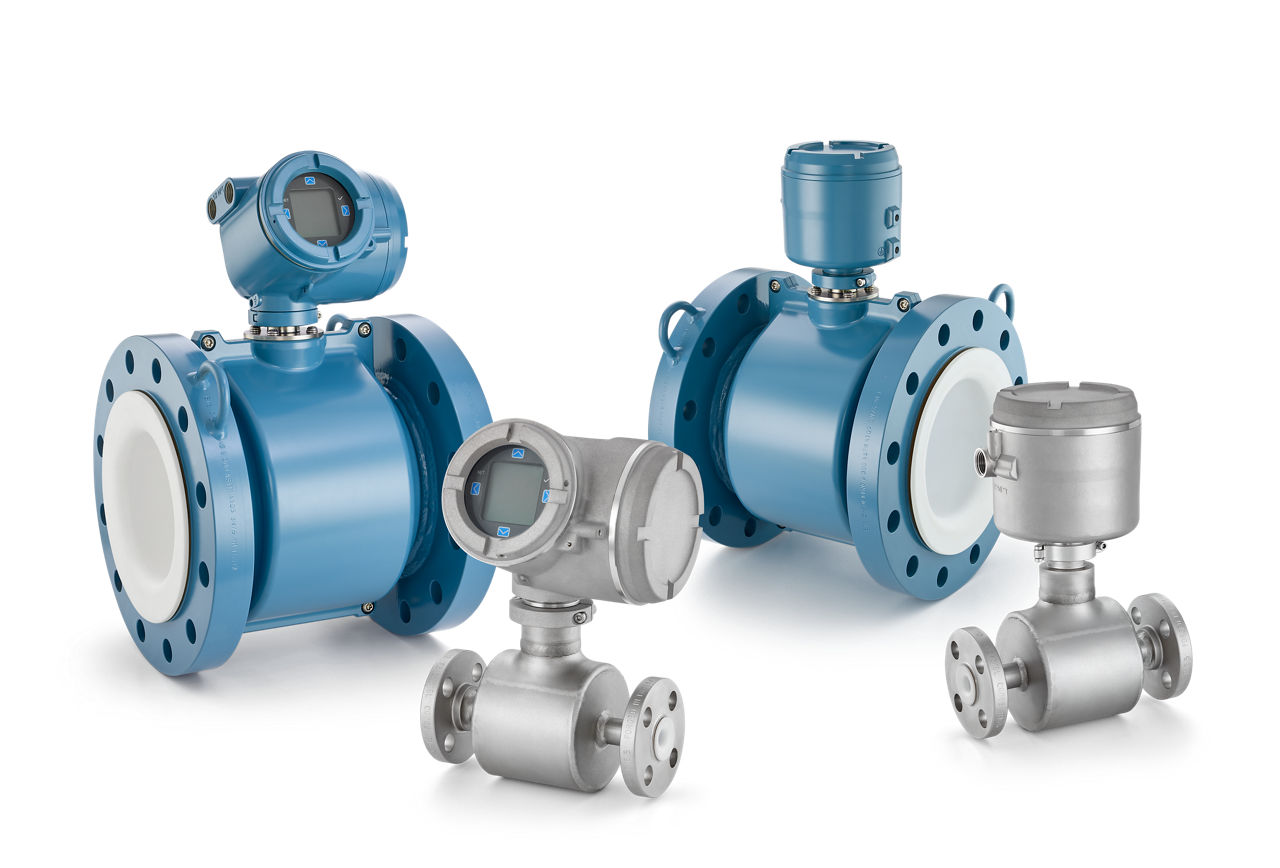
Emerson has launched the Rosemount 9000 Series magnetic flow meter platform, introducing a new transmitter and sensor architecture with expanded process diagnostics, built-in meter verification, redesigned sensing hardware, and simplified electrical integration.
The range initially comprises the Rosemount 9732 Magnetic Flow Transmitter and Rosemount 9205 Magnetic Flow Sensor. It is intended for conductive-liquid measurement across process industries including chemicals, refining, oil and gas, mining, food and beverage, power, water and wastewater, life sciences, and semiconductor manufacturing.
Magnetic flow meters measure conductive liquids without placing a mechanical obstruction in the flow path. A magnetic field is established across the pipe, with electrodes detecting the voltage generated as conductive fluid moves through that field.
The absence of moving parts removes one obvious wear mechanism, but it does not make the instrument immune to process or installation problems. Electrode coating, electrical noise, partially filled pipework, poor grounding, wiring faults, and changing fluid properties can all affect the quality of the measurement.
Emerson has consequently placed diagnostics near the centre of the new platform rather than treating them as an ancillary transmitter function.
The Rosemount 9732 includes coated-electrode detection, tunable empty-pipe detection, process diagnostics, and event logging intended to help users distinguish a genuine change in process flow from a developing instrument or installation problem.
Electrode coating is a good example. Deposits forming on the measurement electrodes can gradually alter signal behaviour, potentially creating a reading that appears credible while becoming less representative of the actual process.
Detecting that condition earlier gives maintenance teams an opportunity to inspect or clean the meter deliberately rather than beginning a broader process investigation because the reported flow has started to drift.
Empty-pipe detection addresses another common problem. Magnetic flow measurement depends on the electrodes remaining correctly exposed to conductive process fluid; a partially empty sensor tube can therefore generate an unreliable value while the transmitter itself continues to function normally.
The Rosemount system allows that detection to be tuned around the application rather than applying one fixed threshold to every fluid and installation.
Built-in Smart Meter Verification extends the diagnostic approach into the instrument hardware. The standard Basic function can verify meter health and measurement performance, with Emerson offering a Pro version providing additional diagnostic depth and historical information.
The practical attraction is the ability to carry out verification without removing the sensor from the pipeline or automatically assuming that a process shutdown is required merely to establish whether the meter remains healthy.
In-situ verification does not remove every calibration requirement, particularly where formal metrology or regulatory procedures specify physical calibration. It can, however, provide documented evidence between those interventions and help maintenance teams decide when further work is actually justified.
Bob Halgren, vice president products with Emerson’s measurement instrumentation business, said: “Customers are looking for technologies that help them do more with fewer resources while maintaining confidence in their operations.”
The sensing hardware has also been redesigned. Emerson says optimised magnetics and digital signal processing provide up to four times better out-of-the-box performance, while the sensor’s power requirement has been reduced by 50%.
Those are manufacturer performance figures and will depend on the installation and comparison baseline, but the design changes point to the same overall objective as the diagnostics: producing a more stable signal before additional troubleshooting or compensation is required.
The Rosemount 9205 also uses intrinsically safe remote sensor wiring. Emerson describes it as the first intrinsically safe magnetic flow sensor delivering full four-wire performance, allowing remote installations in hazardous areas without some of the wiring complexity associated with conventional arrangements.
That can matter in chemical, refining, and other classified environments where installation work is shaped as much by electrical protection requirements as by the measurement task itself.
The 9732 transmitter includes flexible I/O and configuration options, while the platform supports a universal power arrangement intended to accommodate AC and DC requirements without requiring different transmitter hardware for every site standard.
A universal supply is not particularly glamorous instrumentation engineering, but it has a straightforward maintenance value. Plants operating across several electrical standards are less likely to order or stock the wrong power variant when a unit is being installed or replaced.
Configurable analogue, digital, and pulse outputs provide similar flexibility on the control-system side. The same platform can be adapted to a range of installed systems without requiring every application to use the same communications or signal architecture.
Emerson is also adding Bluetooth configuration and a Universal Service Port, extending the number of ways technicians can access setup and diagnostic information locally.
The new platform is not backwards-compatible with existing Rosemount 8700 Series transmitter and sensor combinations. The 9732 is engineered for use with the 9205 sensor and future 9000 Series products, rather than as a direct replacement transmitter for an installed 8705 sensor.
That makes the launch an expansion of the Rosemount magnetic-flow portfolio rather than an immediate replacement programme. Emerson says the 8700 Series remains available and fully supported.
At launch, the 9205 sensor is available in line sizes from ½in to 8in, excluding 2.5in and 5in sizes, with additional sizes planned through future 9000 Series products.
The platform also includes a short-run installation capability intended to maintain measurement performance where long lengths of straight pipe are unavailable. That is particularly relevant around compact process skids and retrofit installations where elbows, valves, or other disturbances may sit close to the meter location.
The practical question for users will be how much of the richer diagnostic information translates into changed maintenance behaviour. Process plants rarely suffer from a shortage of alarms; the useful instrument is the one that can distinguish a meaningful developing condition from another alert requiring manual investigation.
Magnetic flow measurement itself is mature technology. The electromagnetic principle underlying the new meter is not the significant change here.
Emerson’s development instead concentrates on the layer around that measurement: recognising coating or pipe conditions, checking the health of the sensor without removing it from service, simplifying hazardous-area wiring, reducing power requirements, and giving technicians more evidence before they decide whether an intervention is required.
That reflects the wider direction of process instrumentation. Accuracy remains the starting requirement, but the value of an instrument increasingly includes what it can report about its own condition and the confidence operators should place in the number reaching the control system.
For the Rosemount 9000 Series, the eventual measure will therefore be less about how many diagnostic functions appear in the transmitter menu than whether those functions reduce unnecessary calibration, shorten fault-finding, and identify process or sensor problems before they become unplanned downtime.