SKF has launched a modular automatic lubrication pump platform for industrial and mobile machinery, introducing a common architecture intended to simplify installation, servicing, monitoring, and future upgrades across progressive lubrication systems.
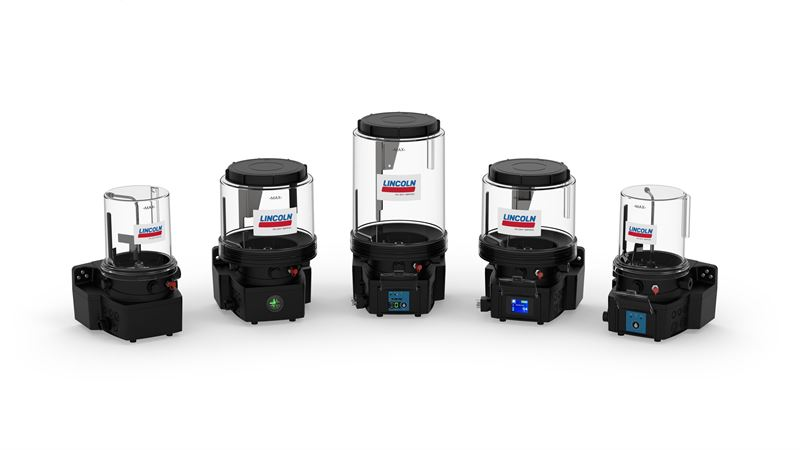
The Progressive Lubrication Pump, or PLP, is the first product family built around SKF’s new lubrication platform. It combines the pump, lubricant-level monitoring, control options, and connectivity within a design intended to serve both fixed machinery and mobile equipment.
SKF is offering the platform with 2-, 4-, and 8-litre reservoir options and several control configurations. The objective is to use the same underlying pump architecture across installations with different lubrication demands and levels of automation.
Automatic lubrication performs a mechanically simple function with potentially expensive consequences when it fails. Bearings, pins, bushes, gears, and other moving interfaces depend on a lubricant film to separate surfaces and control friction and wear.
Manual greasing can perform that task adequately, but it relies on maintenance intervals matching the machine’s real operating duty and on technicians being able to reach every lubrication point safely and consistently.
A progressive system instead uses a central pump and metering network to distribute measured quantities of lubricant around the machine while it is operating or at programmed intervals.
The advantage is consistency rather than merely removing a manual task. Too little lubricant can increase friction, temperature, and wear, while over-lubrication creates its own problems through wasted grease, seal damage, heat, and contamination.
The pump therefore sits inside a larger engineered system. Distributors, pipework, fittings, controls, lubricant quality, and each delivery point all have to remain functional for the machine to receive the intended quantity.
SKF says PLP has been designed around faster commissioning and improved service access. Those details become important when automatic lubrication is fitted across a large fleet or production operation because equipment intended to reduce maintenance cannot justify itself if the lubrication system becomes difficult to maintain.
Reservoir monitoring gives operators visibility of grease level before the supply is exhausted, while connectivity allows status information to be brought into a broader machine or maintenance system.
That can reduce one of the more mundane causes of automatic-lubrication failure: a perfectly functional pump running with insufficient lubricant because no one realised the reservoir was approaching empty.
Control variants also provide a route between relatively simple timed operation and more integrated machine monitoring without requiring an entirely different pump design for every application.
Christophe Laurans, Head of Automatic Lubrication Systems at SKF, said: “Every hour of unplanned downtime matters. PLP helps customers improve equipment reliability, simplify maintenance, and keep their operations running efficiently.”
The new platform is intended to provide a common base for future functions as well. That may matter almost as much as the launch specification because lubrication equipment often remains fitted to machinery for many years.
A machine builder or fleet operator therefore has to consider not only current capability but also spare parts, replacement controls, documentation, connectivity, and whether the platform is likely to remain serviceable throughout the life of the equipment.
Standardising around a common architecture can reduce the number of unrelated pumps and control systems that maintenance departments have to hold in stock or train employees to support.
The benefit becomes more obvious in mixed fleets. Construction plant, mining machinery, agricultural equipment, conveyors, machine tools, and process equipment may all contain similar lubrication points while operating under very different environmental and control requirements.
Mobile equipment has to tolerate vibration, dust, water, impact, and temperature variation. A pump installed on fixed production machinery may face a cleaner environment but require tighter integration with machine control and more detailed fault monitoring.
A modular platform attempts to cover those differences through reservoir, control, and monitoring choices while retaining the same underlying mechanical family.
The launch also reflects a wider change in maintenance hardware. Components that were previously largely passive are increasingly being given sensors and communications so that their condition can be incorporated into plant-level maintenance systems.
Lubrication is a particularly useful example because the lubricant itself is inexpensive compared with the equipment it protects. A missed lubrication point can damage a bearing, shaft, or housing and lead to production losses many times greater than the cost of the original maintenance task.
Automatic systems do add their own complexity. Pumps, lines, distributors, wiring, and controls all require inspection, which means the business case is strongest where equipment criticality, access difficulties, duty cycle, or the number of lubrication points justify the additional hardware.
SKF’s PLP does not alter the fundamental mechanics of progressive lubrication. Its development is instead concentrated around installation, service access, monitoring, modularity, and the ability to support a range of machine-control requirements from one platform.
That is a familiar direction in industrial equipment: the mechanical task changes relatively little while the engineering emphasis shifts towards making the component easier to configure, diagnose, and maintain.
PLP will be the first test of whether SKF can use that common architecture to simplify its automatic-lubrication offer without merely moving complexity from the pump itself into another layer of electronics and software.