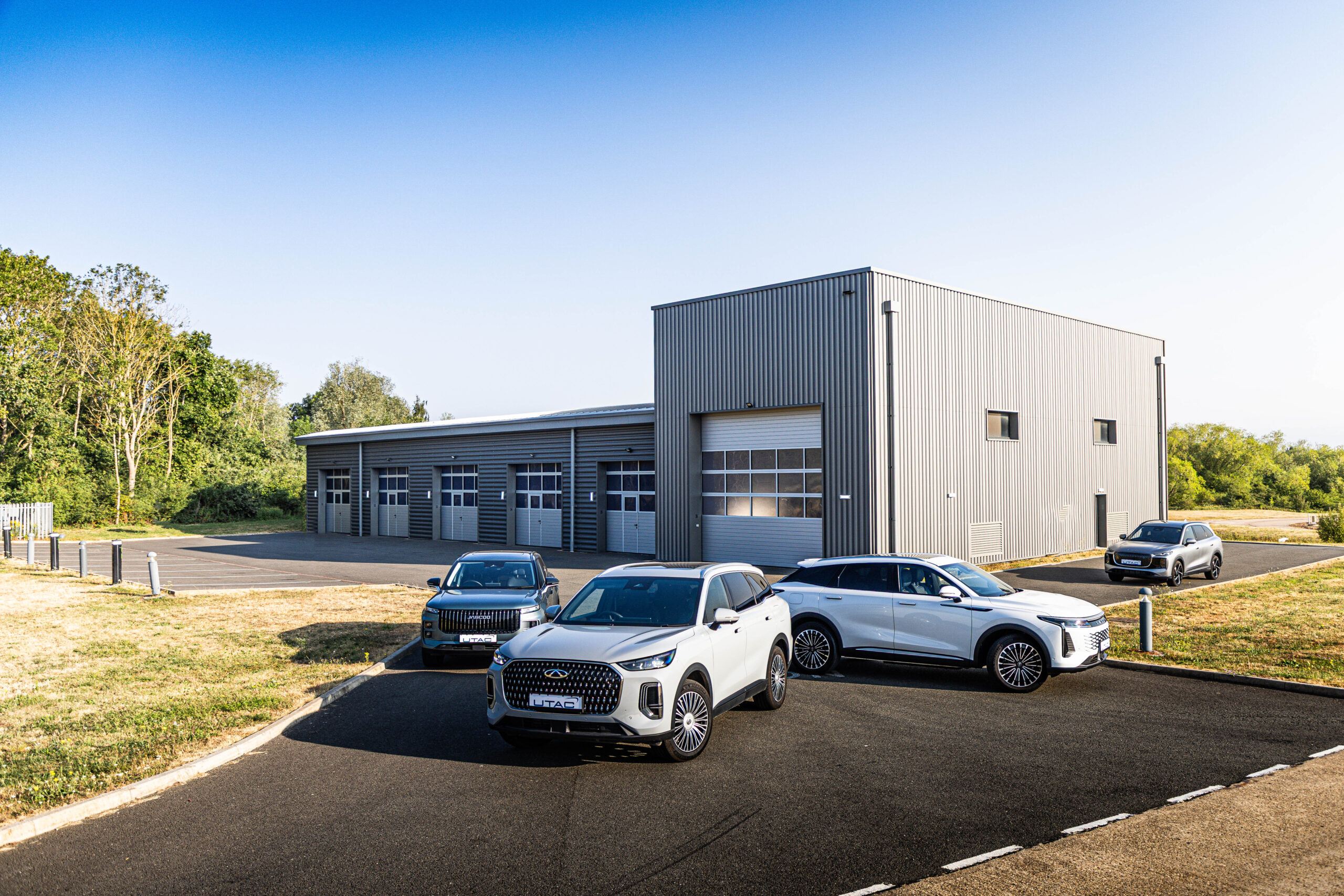
Chery Automobile will establish a UK R&D Centre of Excellence at UTAC Millbrook in Bedfordshire, creating a permanent engineering base for vehicle development and validation in the British market.
The centre is due to open in late autumn 2026 and will be integrated into Chery Automobile’s global R&D network. Initial work will focus on chassis dynamics and Advanced Driver Assistance Systems tuning and calibration for UK-specification vehicles, with longer-term ambitions extending into autonomous driving and artificial intelligence.
Millbrook gives Chery access to more than 70km of purpose-built test tracks, including the Hill Route, Alpine Circuit, durability surfaces, and noise, vibration, and harshness roads. The site also provides battery laboratories, powertrain test facilities, semi-anechoic chambers, and ADAS and autonomous-vehicle testing capability, allowing calibration, durability, systems validation, and homologation work to be concentrated at one location.
Chery said the UK centre is intended to bring customer feedback closer to the engineering process. British roads combine narrow lanes, roundabouts, dense traffic, sharp corners, and varied surfaces, while local customers have shown a preference for responsive steering and suspension settings. Those conditions create a specific calibration workload rather than a simple exercise in transferring specifications developed for another market.
Gary Lan, CEO of Chery International UK and vice president of Chery International’s Right-Hand-Drive Division, said: “UTAC Millbrook allows us to turn UK customer insight into product development, from ride and steering to active safety systems. It is another step in our long-term investment in the UK, and its work will become part of Chery Automobile’s wider global R&D activities.”
The facility will support a growing UK brand portfolio spanning OMODA&JAECOO, Chery, and the forthcoming LEPAS marque. More brands and vehicle types increase the amount of local engineering required across chassis hardware, tyres, powertrains, software, driver-assistance functions, and customer-facing characteristics, particularly where a global platform has to serve both left- and right-hand-drive markets.
Chery has not disclosed the investment value or initial headcount. It has, however, stated an ambition to recruit local engineering talent and create highly skilled jobs across a wider range of disciplines as the operation develops. The commitment therefore begins with a defined engineering remit and physical location rather than a headline employment figure.
The company’s relationship with UTAC predates the new centre. Chery Automobile established a homologation-services joint venture with UTAC Group in 2024 and also uses UTAC’s Linas-Montlhéry facility in France for active safety, passive safety, and homologation. Millbrook extends that relationship into a permanent UK development presence rather than project-by-project testing alone.
The expansion arrives as Chery increases sales and exports rapidly. Chery Group sold 276,820 vehicles globally in July, including 129,067 new-energy vehicles, while Chery International exports reached 202,533 units, up 70.1% year on year. Export deliveries from January to July reached 1.146 million vehicles, and cumulative global sales passed 20 million during July.
UK registration data add a local reason for investing in engineering capacity. Chinese brands accounted for around 15% of new UK car registrations during the first half of 2026, compared with about 10% across 2025. Chery’s JAECOO and OMODA brands are among the leading Chinese marques in Britain, exposing the group’s vehicles to a much larger population of customers and operating conditions than during the initial market-entry phase.
Chery is also exploring UK vehicle production with Nissan at Sunderland. That manufacturing discussion is separate from the Millbrook centre, but both developments push activity closer to the end market. Engineering localisation can shorten the loop between customer feedback, calibration changes, test execution, and sign-off, while any future assembly arrangement would create a second UK industrial interface around production and supply.
European governments are already competing for Chinese automotive investment while debating local content, employment, ownership, and technology-transfer conditions. A proving-ground engineering centre is smaller than an assembly plant, yet it embeds product-development work in the market and creates a technical relationship that is harder to replicate through imports alone.
Kirsty Andrew, vice president of UTAC UK, described the project as “a significant commitment to engineering and vehicle development in the UK”. She said the stand-alone centre would give Chery direct access to UTAC’s engineering expertise and test environments while supporting a long-term relationship between the two organisations.
Chery has not yet identified the first vehicles that will operate from the centre. The late-autumn opening nevertheless establishes a clear next step: UK-specific chassis and ADAS work will move into a permanent local engineering operation, with autonomous-driving and AI development intended to follow as the site’s capability expands.