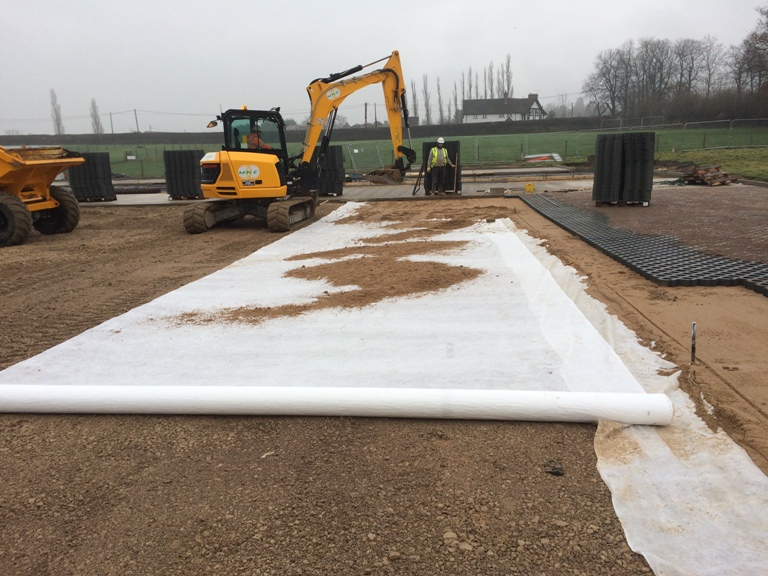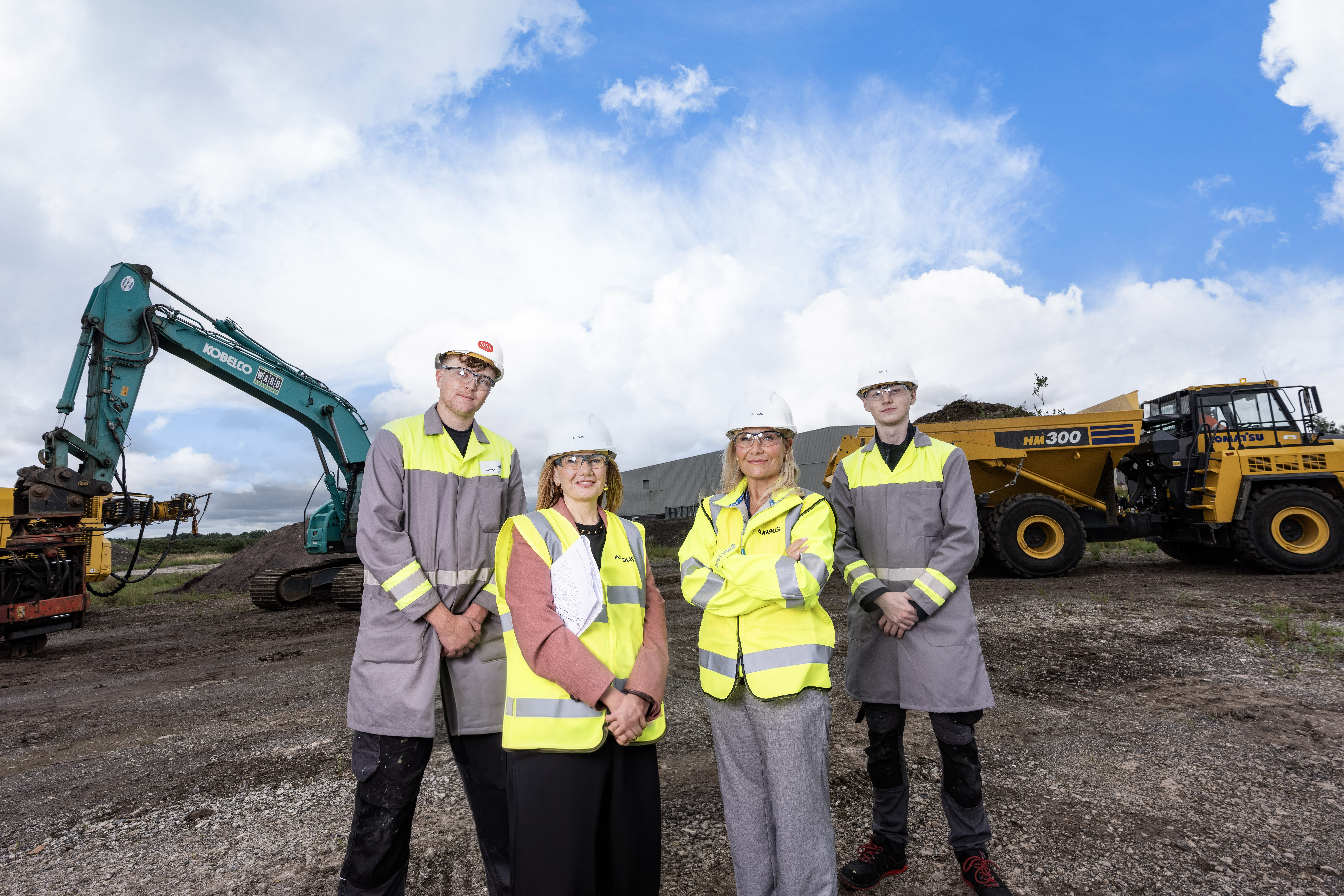
Airbus has started construction of a 6,221m² extension to its Belfast wing facility, adding manufacturing space and advanced-composites capability as the A220 programme prepares for higher production rates.
The extension is scheduled for completion in the first half of 2028. It will house a third autoclave alongside specialised wing tooling and cranage, supporting Airbus’s planned increase in A220 output to 13 aircraft per month by 2028.
Belfast is the exclusive global manufacturer of A220 wings, placing the Northern Ireland operation directly on the programme’s production-rate critical path. The site uses Airbus’s patented Resin Transfer Infusion process for the aircraft’s composite wings, producing a structure the company says is around 10% lighter than a traditional aluminium equivalent.
Anthony Rouse, head of the Airbus Belfast plant and site, said: “Enhancing our wing facilities is a direct investment in the future of A220 wing production here in Belfast, building the capacity required to meet the growing demand for this aircraft.” Airbus is also bringing 40 new apprentices into the operation in September, linking the capital programme with additional skilled labour.
The third autoclave is a central part of the expansion because composite-wing manufacture depends on controlled cure capacity as well as floor area. Autoclaves apply heat and pressure to composite material during curing, sitting within a production chain that also includes material preparation, infusion, tooling, inspection, machining, assembly, and quality assurance.
Increasing aircraft rate therefore requires balance across several manufacturing stages. Extra cure capacity provides limited benefit if tooling, inspection, machining, logistics, or final assembly become the next constraint. Airbus’s accompanying site programme includes new high-voltage electrical substations, a security-gate entrance, an office block, expanded parking for 650 vehicles, and upgraded IT systems.
Those infrastructure additions support the less visible demands created by higher output. Electrical load, material movement, data traffic, workforce access, maintenance, and production planning all increase as a site moves from one stable rate to another. Aerospace plants also have relatively little tolerance for uncontrolled variation because dimensional or quality problems can move quickly into downstream assembly.
The Belfast expansion follows the site’s delivery of its 500th A220-300 wingset earlier this summer. That milestone came after Airbus assumed control of the former Spirit AeroSystems wing operation, bringing a strategically important supplier inside the aircraft manufacturer’s own industrial system.
Direct ownership gives Airbus greater control over investment timing, process engineering, quality systems, and production planning at a site whose output has to align with final assembly in Mirabel, Canada, and Mobile, Alabama. The shift does not remove supply-chain risk elsewhere on the aircraft, but it reduces the organisational distance between wing production and the programme team setting monthly rate requirements.
The A220 has accumulated more than 1,000 firm orders and passed 500 aircraft deliveries, providing the backlog behind the planned ramp-up. Aircraft production remains vulnerable to the slowest element in a distributed supply chain, however. Engines, aerostructures, systems, interiors, skilled labour, logistics, and final assembly must all rise together before a nominal monthly target becomes repeatable output.
Belfast’s composite expertise is difficult to duplicate quickly. Large structural composite work requires controlled materials, stable process parameters, specialist tooling, non-destructive inspection, repair capability, and experienced technicians who can recognise small deviations before they become expensive defects. Much of that capability is accumulated through repeated production rather than installed with a single capital asset.
The 40 apprentices due to join in September are therefore part of the capacity equation rather than a separate skills initiative. New equipment still needs operators, maintenance teams, manufacturing engineers, quality specialists, and production support, while experienced employees have to transfer process knowledge without disrupting current output.
Airbus is targeting the same year for completion of the extension and achievement of 13 A220 aircraft per month. The programme leaves roughly two years to complete the building work, install and qualify the autoclave and associated tooling, integrate supporting infrastructure, train additional personnel, and raise wing output without undermining the quality requirements of an already active production line.
The new Belfast footprint is consequently more than a property expansion. It adds cure capacity, tooling, utilities, and labour around a single-source wing operation that must support a larger global aircraft programme. The useful measure will be how quickly those assets convert into consistent wingsets at the required rate rather than how much new floor area is available when construction ends.