Cambridge Aerospace has raised $300 million in a Series C funding round that values the two-year-old British defence company at $3.4 billion, providing additional capital to expand manufacturing capacity for its Skyhammer and Starhammer interceptor systems.
Cambridge Aerospace has now raised more than $630 million since its formation in 2024. The latest round was led by DFJ Growth, with other participating investors including Lux Capital, Accel, Lakestar, Elad Gil & Co, Never Lift and Ora Global.
The capital arrives as Cambridge Aerospace pushes its low-cost Skyhammer interceptor into substantially higher production. The company is targeting output of 2,500 Skyhammer units a month by the end of March 2027, while its rocket-powered Starhammer system, intended for higher-speed threats, is expected to reach the market during 2027.
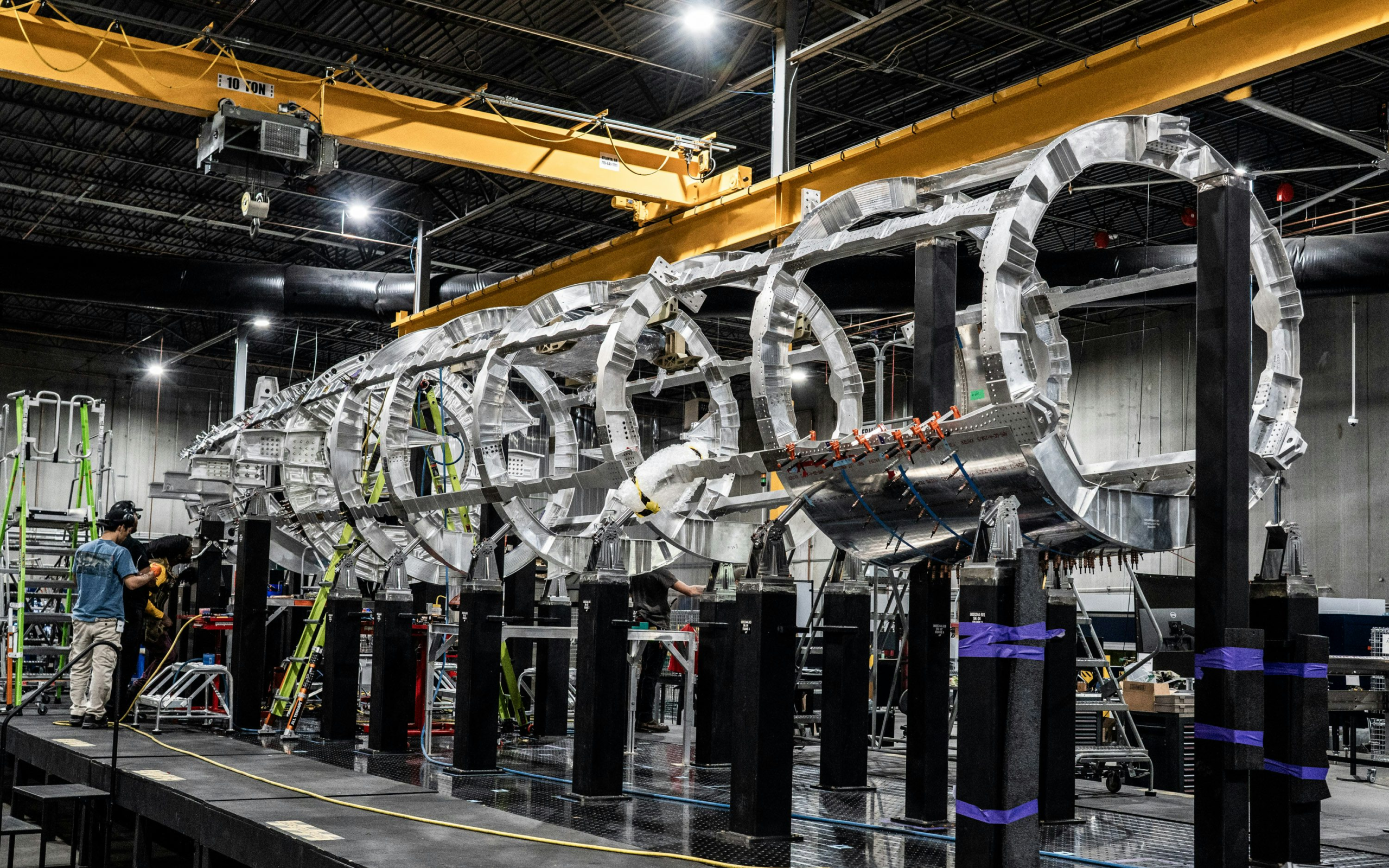
Production at that rate presents a different engineering problem from developing and flight-testing an interceptor. Thousands of units a month require controlled component supply, repeatable assembly, software configuration management, acceptance testing and production equipment capable of maintaining output without allowing quality variation to accumulate.
Cambridge Aerospace employs around 250 people, primarily in the UK, with operations also extending into Germany, Poland, Norway, Ukraine and Australia. The company has already secured UK Ministry of Defence business for Skyhammer, meaning manufacturing expansion is being undertaken against active procurement rather than solely in anticipation of future demand.
Skyhammer is positioned around the demand for lower-cost interception of drones and cruise-missile-class threats. The economics are increasingly important as armed forces confront targets that can be produced in quantities large enough to make repeated use of traditional high-cost air-defence missiles difficult to sustain.
Lower interceptor cost does not reduce the need for production control. Propulsion, guidance electronics, airframe assemblies, connectors, software and launch interfaces all have to remain sufficiently consistent that each unit behaves predictably after transport, storage and deployment. A cheaper weapon that requires excessive inspection or produces unreliable batches simply moves cost elsewhere in the system.
Cambridge Aerospace has sought to control more of that manufacturing chain internally, including the development of its Nightstar solid rocket motors. A new rocket-motor factory is planned in Norfolk, creating additional domestic propulsion capacity at a time when solid rocket motors remain a constrained part of several Western missile supply chains.
Propulsion manufacture adds substantial process and safety requirements. Materials have to be prepared and handled within controlled conditions, motor cases and interfaces require consistent manufacture, and completed units must meet demanding performance and storage requirements. Scaling production therefore requires specialised infrastructure rather than simply adding another assembly line to the interceptor factory.
The company also uses additive manufacturing and AI-assisted development methods as part of an engineering approach intended to reduce iteration time and production cost. Those tools can shorten development cycles, but once hardware enters repeatable manufacture the emphasis moves towards process capability, documentation and control over design changes.
Previous Skyhammer testing has already pushed attention towards that industrial stage. Recent programme activity has highlighted production repeatability, seeker behaviour, launch readiness and quality control as the system advances beyond early demonstrations. Increasing output to the newly stated target makes those issues more consequential.
Inspection capacity may prove as important as assembly capacity. Interceptor production requires evidence that propulsion, electronics, control surfaces and complete systems meet acceptance requirements, and an end-of-line test process that takes too long can constrain factory throughput even when upstream production equipment has spare capacity.
The same applies to suppliers. Motors, electronics, sensors, structural materials and specialist components have to arrive at a rate consistent with finished-product output. Bringing selected systems in-house can reduce one type of dependence, but vertical integration also transfers the capital cost, manufacturing risk and quality responsibility directly onto Cambridge Aerospace.
International manufacturing relationships add another dimension. The company has been developing cooperation with Kawasaki Heavy Industries around Japanese capability, while its wider European and Australian presence gives it access to customers and industrial partners outside the UK. Maintaining common configuration and production standards becomes more difficult as activity spreads across jurisdictions and supply bases.
The $3.4 billion valuation places substantial expectations on a company founded less than two years ago. Investor demand for defence technology has risen quickly, but valuation does not manufacture hardware, qualify suppliers or clear test bottlenecks. Cambridge Aerospace now has another $300 million to build production capacity; meeting a 2,500-unit monthly target will provide a more demanding measure of how far the company has industrialised.