Anglian Water is progressing construction of an approximately 8.3km potable-water transfer pipeline between Stoke Ferry and Didlington in Norfolk, adding another route through which supply can be moved across the regional network.
The @one Alliance scheme is designed to provide transfer capability of up to 1.5 million litres per day. Construction combines open-cut installation with horizontal directional drilling, allowing the new polyethylene main to pass beneath roads and watercourses where continuous surface excavation would create greater disruption.
The pipeline has a 225mm outside diameter and is being integrated with existing potable-water assets at several points along the route. Its purpose is to increase operational flexibility rather than create a new raw-water source, giving Anglian Water more ability to redistribute supply when demand rises or another part of the system comes under pressure.
That type of flexibility becomes more valuable as water-resource margins tighten. Additional treatment or abstraction capacity in one part of a network has limited practical use if existing mains cannot move enough water to the area where it is required, making transfer infrastructure a physical constraint on resilience as well as an asset in its own right.
Construction began in May 2026 after enabling work that included archaeological trial trenching, boreholes, and trial holes along the proposed alignment. Those investigations were used to establish ground conditions and inform the final construction method before large-scale pipe installation began.
The route runs mainly through rural land, creating a familiar set of linear-infrastructure interfaces: agricultural operations, highways, drainage channels, watercourses, land access, traffic management, and reinstatement all have to be coordinated as the pipeline advances section by section.
Open-cut construction is being used where the route can be excavated with manageable disruption. Horizontal directional drilling is being used at more constrained crossings, where the pipe is pulled through a drilled bore between entry and exit points rather than placing an open trench across the full width of a road or watercourse.
HDD reduces surface disturbance but introduces a different engineering load case. Bore geometry, soil conditions, drilling-fluid management, pull forces, pipe strength, and available working area have to be considered before a section can be installed, particularly when long welded pipe strings are moved through the ground in one operation.
The design specifies SDR21 high-performance polyethylene for open-cut sections and heavier SDR11 pipe for directional-drilled sections, where installation loads are greater. A shorter 125mm section is also planned within the existing network at Oxborough, alongside connections into larger strategic and local mains elsewhere on the scheme.
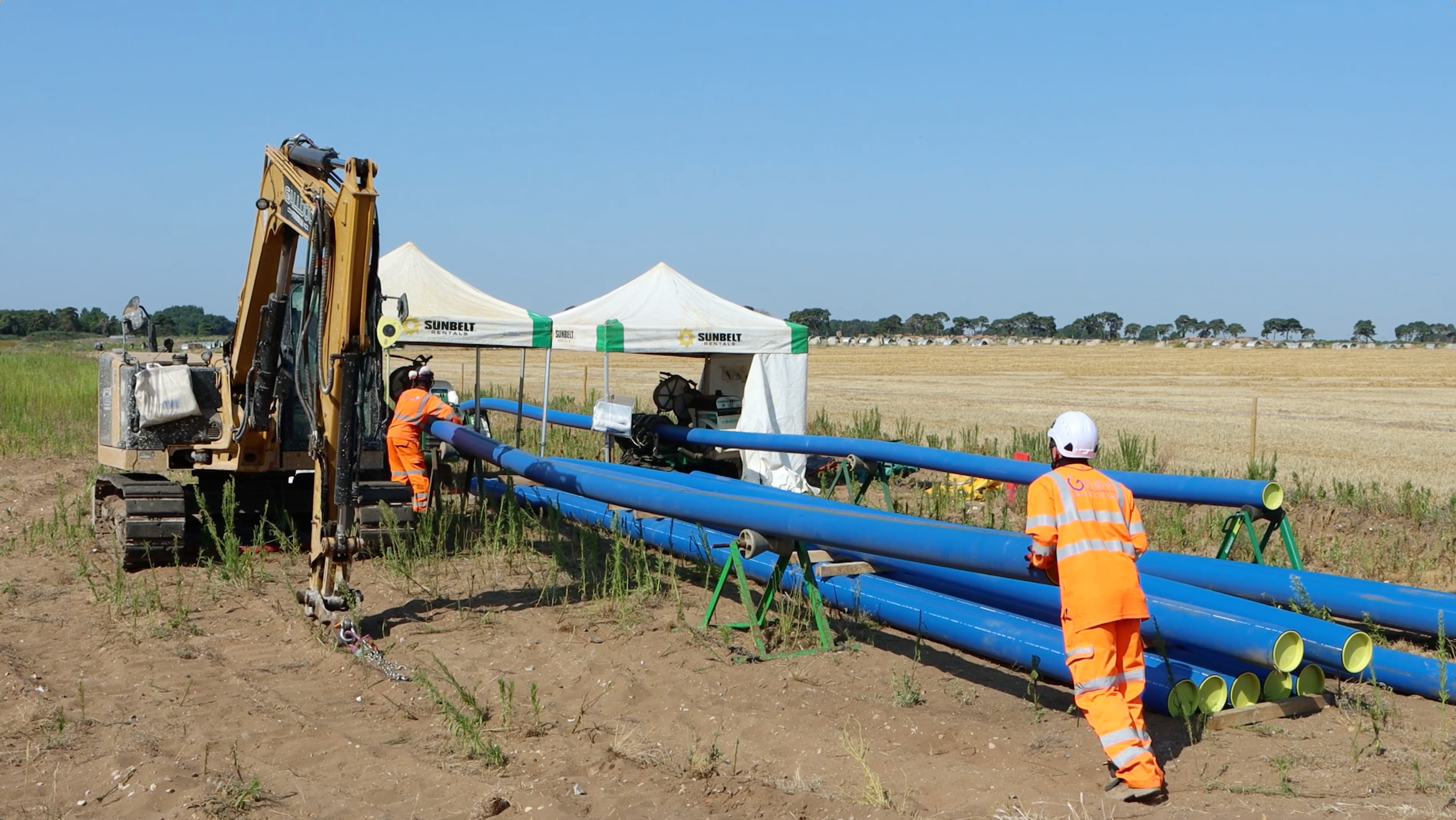
Pipe fusion is another critical part of delivery because the installed main depends on consistent joints along several kilometres of polyethylene. Each joint has to be prepared, fused, cooled, handled, and subsequently pressure tested without introducing contamination or damage that could compromise the integrity of the completed main.
At Gibbet Lane, the project also requires a connection into an existing 24-inch strategic main using under-pressure drilling. That allows a new connection to be formed without taking the strategic main completely out of service, adding another live-network interface to the construction sequence.
The wider hydraulic arrangement includes connections to smaller mains at Gooderstone Road and Watermill Lane. It also includes a district-metering flow meter, non-return protection, and modifications to an existing pressure-reducing-valve controller at Foulden.
Those controls determine how useful the new transfer main becomes once buried. Operators need to measure flow, prevent unwanted reverse movement, manage pressure at existing interfaces, and commission new connections without destabilising the surrounding network, particularly while other parts of the system remain in normal service.
The programme is being phased so completed sections can move through welding, installation, pressure testing, backfilling, and reinstatement while work continues elsewhere. Temporary compounds and access routes are required across the rural alignment, while traffic management and road closures are being used at individual crossing locations.
Once commissioned, the main will provide another operating route for balancing supply during periods of higher demand or reduced local resource availability. The scheme increases flexibility within the existing network without depending solely on additional abstraction, while flow monitoring and pressure control give operators the information and control needed to use that capacity deliberately.
The construction programme still has to bring the remaining crossings, network connections, testing, and reinstatement through to completion. Until those interfaces are commissioned, the new pipe is simply installed capacity; its value emerges when the utility can move water through it reliably under the conditions that created the resilience requirement in the first place.
Most of that infrastructure will disappear beneath fields, roads, and watercourses once reinstatement is complete. Its performance will be measured elsewhere — in the network’s ability to move another 1.5 million litres a day when local supply and demand no longer line up neatly.