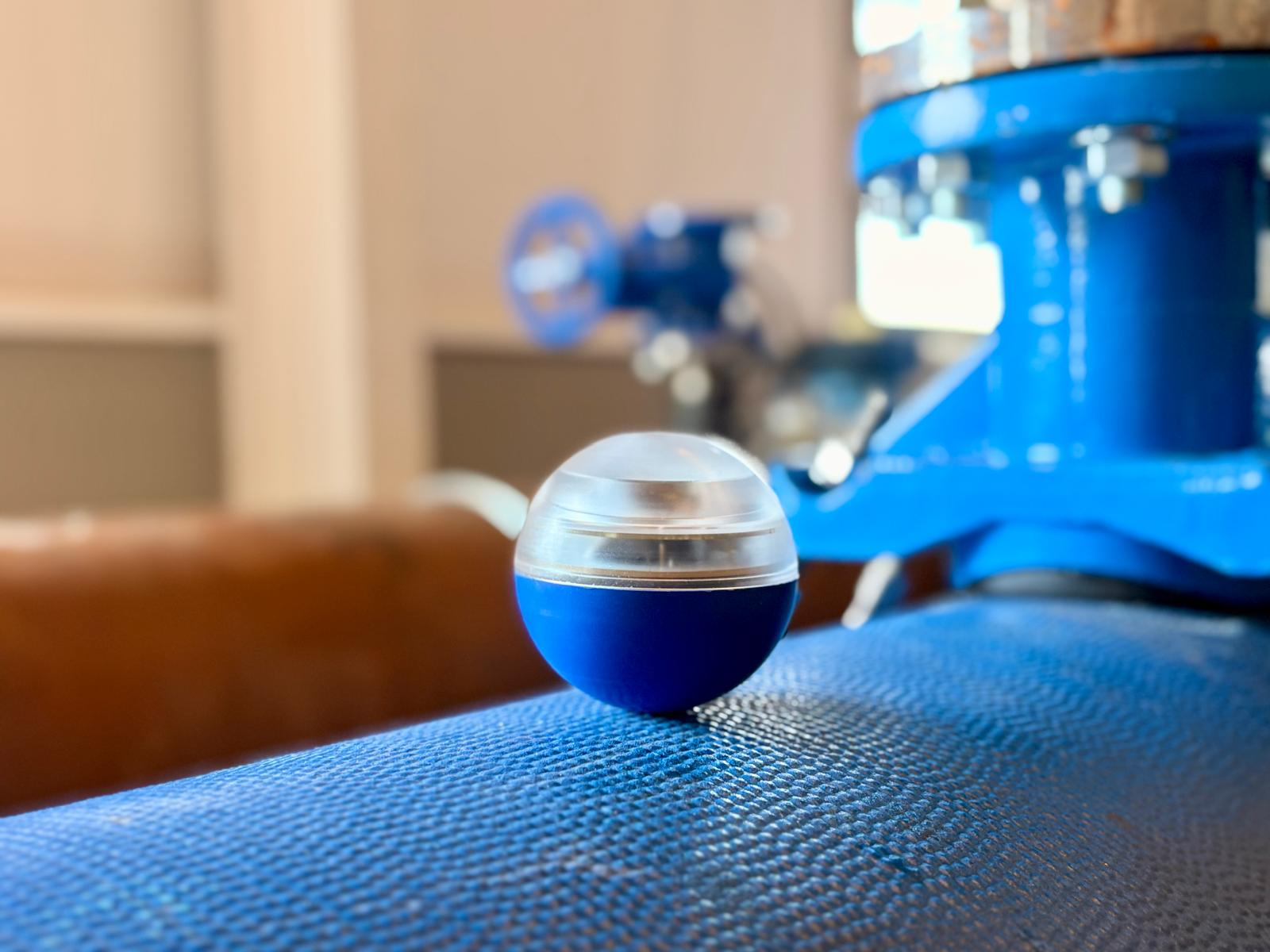
Aganova has introduced a redesigned generation of its Nautilus in-line water-pipeline inspection platform, expanding the system beyond leak location so data collected during a live inspection can also support condition assessment, maintenance planning and infrastructure investment.
The new platform combines revised hardware and software with rechargeable power, wireless charging, remote-management functions and expanded data analysis. It is designed for large-diameter water mains that remain in operation while the free-swimming inspection device moves through the pipeline.
Aganova is describing the wider analytical service as Smart Condition Assessment. Where a utility commissions both leak detection and condition assessment, field data can be acquired during the same inspection run and then processed separately for the two different objectives.
The distinction is deliberate. The company is not presenting condition assessment as an incidental feature added to a leak report. Each service retains its own analytical process and deliverables, while common data acquisition reduces the need to deploy inspection equipment repeatedly through the same main.
For large transmission pipelines, avoiding unnecessary interventions can be valuable. Taking a major water artery out of service may require complex isolation work, alternative supply arrangements and carefully controlled operating windows, particularly where redundancy in the network is limited.
Nautilus is intended to gather information while the pipeline remains under normal pressure. The platform travels with the flow and has historically been used to identify acoustic signatures associated with water escaping from the pipe.
The new approach attempts to extract more asset information from that deployment. Condition indicators can be used alongside other engineering evidence to help operators decide where closer investigation, rehabilitation or maintenance should be prioritised.
That addresses a broader asset-management problem. Large water mains are often decades old, but age on its own is a weak indicator of remaining life. Two sections installed at the same time can deteriorate differently because of soil conditions, pressure cycles, material quality, construction methods and operating history.
Replacing infrastructure purely according to age can therefore consume capital on assets that remain serviceable. Waiting for visible failures creates the opposite risk, with emergency repairs, water losses, disruption and damage occurring before investment is directed to the weak section.
Condition assessment is intended to provide evidence between those extremes. Utilities can use measured indicators to rank assets and determine where additional investigation is justified rather than treating an entire pipeline as equally deteriorated.
Aganova has developed the new Nautilus using experience accumulated across more than 4,500 kilometres of water-network inspections worldwide. That operating history is relevant because a free-swimming device has to function across wide variations in pipe diameter, flow, material and internal condition.
Those variations are difficult to reproduce completely in laboratory testing. Real deployments expose inspection equipment to changes in velocity, fittings, deposits, geometry and recovery arrangements that can influence whether data is captured consistently.
The new hardware architecture is intended to make field deployment easier. Rechargeable power with wireless charging reduces battery handling, while wireless connectivity and remote-management functions are designed to give operating teams faster access to system status and inspection data.
Improved analysis becomes the more important part after retrieval. Additional condition information has value only if engineers understand what the measured signals indicate and how confidently they can be linked with actual deterioration.
Aganova therefore has to demonstrate correlation between analytical indicators and the physical condition later confirmed through excavation, repair or complementary inspection. A useful screening technology does not have to replace every established assessment method, but it has to identify where further work should be concentrated with sufficient reliability to affect investment decisions.
Different pipe materials also fail in different ways. Prestressed concrete, metallic and other large-diameter mains can experience distinct structural and corrosion mechanisms, making a single universal condition metric unlikely to capture every asset risk.
The value of Smart Condition Assessment is consequently in combining field data with a utility’s broader engineering knowledge rather than converting one inspection run into an automatic replacement plan.
Chief executive Marcos Barrera said the aim is to extract greater value from each inspection by helping operators anticipate problems and prioritise maintenance. Head of product and technology Daniel Mediano said the redesigned platform captures and processes information more efficiently to support both operational and strategic decisions.
The launch arrives as utilities face simultaneous pressure from ageing infrastructure, leakage reduction and constrained capital budgets. Better information does not remove the cost of renewing major pipelines, but it can change which sections receive that investment first.
Aganova’s earlier Smart Condition Assessment work has already been presented to utilities and engineering companies as a route towards more predictive asset management. The new Nautilus puts revised hardware behind that model and makes the same field deployment capable of supporting a broader analytical programme.
The industrial test will be whether the additional information changes real maintenance decisions. More than 4,500 kilometres of inspection experience has informed the redesign; the next evidence will come from how accurately the new generation distinguishes infrastructure that can remain in service from sections where intervention should move forward.