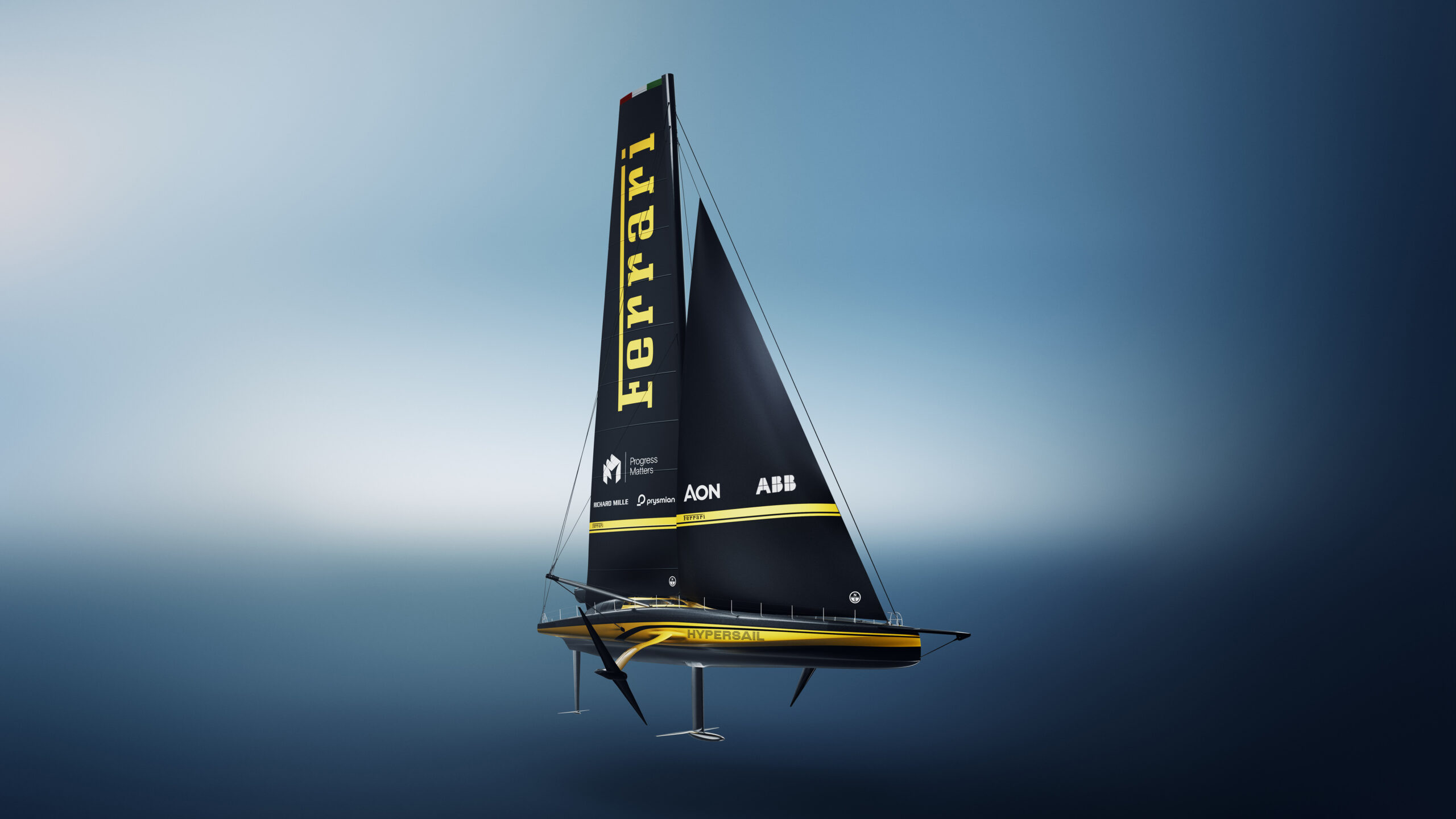
ABB has become Electrification Partner to Ferrari Hypersail, bringing its direct-current engineering to a 100-foot ocean-going foiling yacht whose electrical system is designed to operate as a self-sufficient renewable-powered microgrid.
The vessel will combine 48V and 800V DC systems to generate, store, distribute, and manage electricity for navigation, foil controls, safety systems, electronics, and propulsion. ABB will support the project with expertise in DC integration, energy management, intelligent power distribution, monitoring, storage, and marine electrical systems.
Ferrari Hypersail is intended to remain self-sufficient for weeks at a time in offshore conditions, giving the electrical architecture a rather more demanding role than supplying auxiliary equipment on a conventional yacht. Critical systems have to remain powered while generation varies, stored energy is finite, and the platform is subjected to salt spray, pressure, motion, temperature variation, and limited opportunities for external support.
The combination makes the project relevant beyond marine sport. Renewable generation, battery storage, high-power loads, multiple voltage levels, and the need to maintain essential functions are increasingly common features of industrial microgrids, data centres, electric transport, and energy infrastructure.
Direct-current distribution is central to ABB’s involvement. Solar arrays and batteries are inherently DC technologies, while a growing range of industrial electronics and high-power loads ultimately operate from DC internally even when connected to an AC network.
Conventional electrical architectures may therefore convert power several times as it moves between generation, storage, distribution, and the final load. Every conversion stage requires equipment, occupies space, generates heat, introduces losses, and adds another component whose behaviour has to be considered during a fault.
Ferrari Hypersail uses a dual-voltage architecture rather than attempting to operate every device at one level. Lower-voltage 48V systems serve one group of functions while the 800V network supports higher-power requirements.
Higher DC voltages allow a given power level to be transmitted at lower current, reducing resistive losses and potentially the conductor cross-section required. The engineering challenge moves into insulation, switching, protection, isolation, connector design, fault detection, and safe maintenance.
Those considerations are becoming increasingly relevant as power demand rises elsewhere. High-density data centres are investigating 800V DC distribution as artificial-intelligence computing pushes rack loads upwards, while renewable generation, grid storage, electric propulsion, and rapid charging all increase the quantity of high-power DC equipment connected to industrial systems.
ABB brings more than 25 years of DC development experience to the partnership and says its technology portfolio includes more than 700 patents in the field. It is already developing high-voltage DC power architectures for other sectors, so the yacht provides another operating environment in which control, distribution, monitoring, and resilience can be tested.
Marine service is particularly unforgiving. Corrosion, vibration, moisture, restricted cooling, mechanical shock, and difficult maintenance access can expose weaknesses that are less obvious in a stationary installation.
Foiling adds another layer because the vessel relies heavily on active control. Navigation, foil control, safety functions, and other essential systems have to retain dependable power while sharing a finite energy budget with propulsion and other electrical loads.
That requires prioritisation rather than simply installing sufficient generating capacity for a nominal load. Renewable generation changes with conditions, batteries move through different states of charge, and transient loads can arrive without regard for the available generation at that moment.
An intelligent microgrid therefore has to decide where power is needed, manage storage, maintain voltage stability, and preserve essential services when supply and demand stop matching neatly.
ABB says the project will help its engineers gather lessons relevant to shipping, data centres, renewable-energy infrastructure, and industrial microgrids. The transfer should not be interpreted too literally: a lightweight racing yacht is not a factory, and equipment optimised for offshore performance would not simply be installed unchanged in a stationary industrial system.
The transferable part is the electrical architecture and operating evidence. Real-world data can expose transient demand, power-conversion behaviour, thermal limits, battery response, fault conditions, and control interactions that are difficult to reproduce completely in laboratory testing.
The project also provides an unusually severe demonstration of the relationship between energy efficiency and resilience. Reducing losses preserves stored energy, but simplifying conversion stages and managing loads intelligently can also reduce the number of potential failure points between generation and critical equipment.
Ferrari Hypersail will inevitably attract attention because of the name on the hull and the ambition of the sailing project. For ABB, the more durable value sits below deck: a compact, high-power DC network being asked to remain self-sufficient in conditions where electrical inefficiency and poor fault management are given very little room to remain theoretical problems.