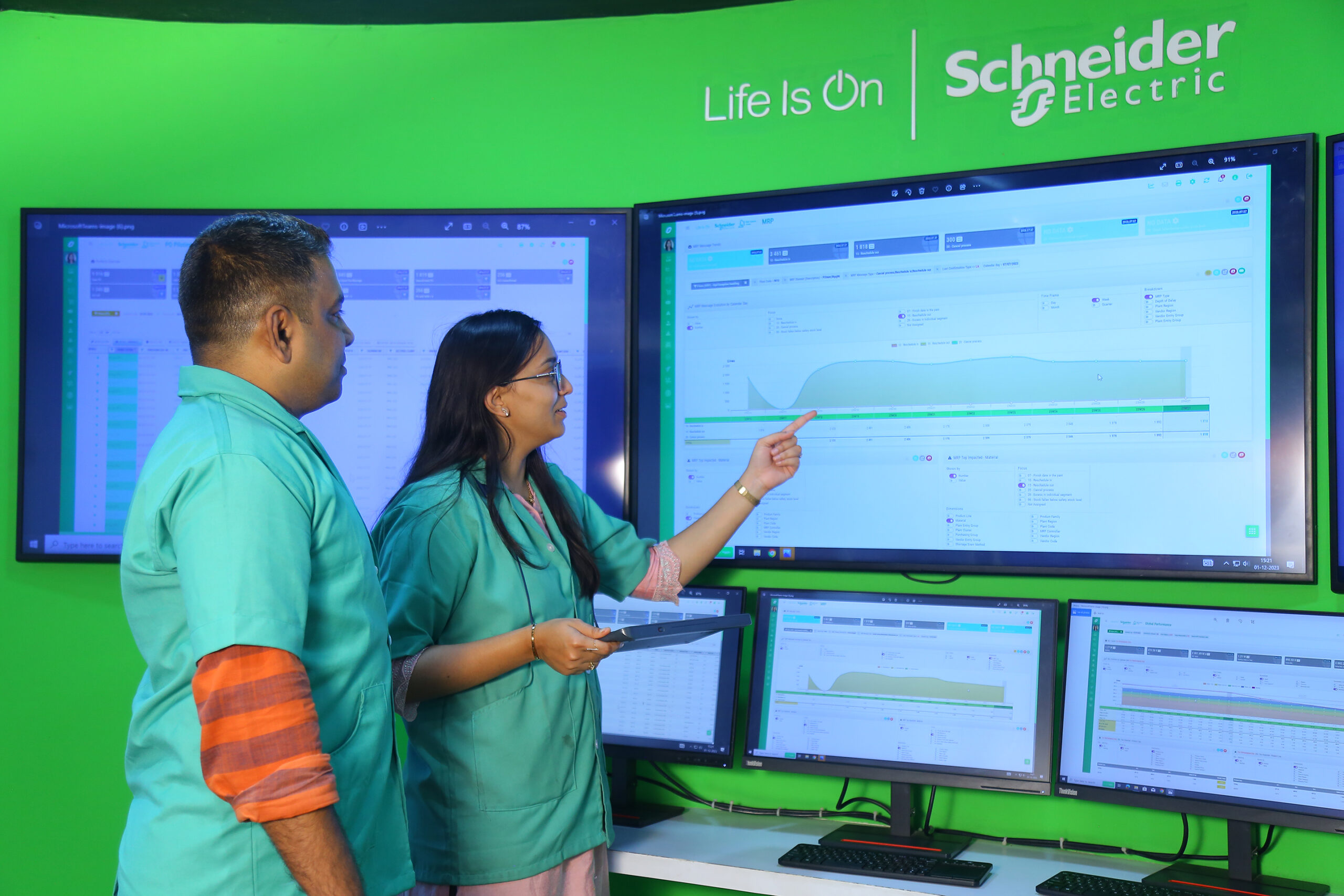
Schneider Electric and Boston Consulting Group (BCG) have entered into an exploratory collaboration to demonstrate artificial intelligence, automation and connected production technologies to manufacturers in India.
The agreement, confirmed on 19 November, will combine Schneider Electric’s industrial facilities and manufacturing technology with BCG’s operational transformation expertise. Its initial activities will involve Schneider Electric’s existing production environments, including the company’s Industry 4.0 Lighthouse Factory in Hyderabad.
The companies intend to develop a Model Smart Factory approach through which manufacturers can examine digital technologies operating in a production environment and assess their suitability for their own operations.
The arrangement is an Exploration Agreement rather than a confirmed programme of installations at customer factories. No investment value, number of participating manufacturers or timetable for completed deployments has been disclosed.
The technologies identified for demonstration include connected operations, industrial artificial intelligence, machine connectivity, predictive maintenance, energy management and software-defined automation.
Schneider Electric will provide access to relevant manufacturing infrastructure and operating experience, while BCG will contribute expertise in evaluating production processes and potential opportunities for digital and operational changes.
Manufacturing systems often contain equipment supplied by several companies and commissioned at different times. Controllers, drives, sensors and management software may use different communication arrangements, creating integration work when information needs to be collected across an entire production process.
Machine connectivity provides a means of transferring suitable operating data from equipment into systems used for monitoring, analysis or production management. The resulting information can include machine status, process measurements, production counts, energy use and maintenance-related conditions.
The value of these measurements depends on their accuracy and the context in which they were collected. A machine running under load, for example, may exhibit different power consumption and operating characteristics from the same machine when idle.
Data used for industrial analysis must therefore be associated with the relevant operating state, equipment and production activity. Without that context, differences in measurements can be mistaken for changes in process performance rather than ordinary variations in operating conditions.
Predictive maintenance is one proposed application. Information from machinery may be analysed to identify changes in condition associated with developing faults, allowing maintenance teams to investigate equipment before a failure interrupts production.
Implementing such a system requires knowledge of the equipment and the failure mechanisms being monitored. A model must distinguish between normal changes in operating behaviour and conditions that justify maintenance action.
The consequences of incorrect results also need to be assessed. An unnecessary alert can lead to avoidable inspection or equipment downtime, while a missed fault may allow machinery to deteriorate further before maintenance personnel intervene.
Industrial AI systems may support these evaluations, but their practical performance depends on the availability of appropriate data, the method used to develop the model and its validation against the operating equipment.
The Hyderabad demonstration environment is intended to allow manufacturers to examine applications within an established factory rather than relying solely on presentations or software simulations. Its effectiveness as a reference will depend on how closely the demonstrated processes correspond to the requirements of participating businesses.
A technology that functions in one production facility may need different interfaces, sensors or control arrangements elsewhere. Machine age, existing automation, process characteristics and site operating procedures influence the amount of engineering work required during implementation.
Energy management is another area covered by the collaboration. Monitoring electricity consumption across machinery, utilities and production areas can help a manufacturer understand when and where energy is used.
Connecting consumption information with operating conditions can reveal whether equipment is consuming power during non-productive periods or whether changes to production scheduling could influence demand.
Such opportunities must be evaluated against manufacturing constraints. A process may require continuous operation to maintain product quality, while the availability of machines, labour and materials can restrict the extent to which production schedules can be altered.
Software-defined automation is also included in the demonstration programme. The approach involves using software architectures that reduce some of the dependence between automation applications and particular hardware platforms.
Industrial implementation still requires suitable real-time performance, equipment compatibility and appropriate safeguards. Control functions responsible for moving machinery or regulating industrial processes cannot be treated as interchangeable with ordinary business software.
Changes to automation systems must be assessed against the physical equipment and operating requirements involved. A revised control application may need testing and commissioning before it can be introduced into production, even where its underlying software architecture allows greater flexibility.
Schneider Electric and BCG intend to combine technology demonstrations with an assessment of the operational needs of participating manufacturers. The goal is to help businesses identify applications that could be evaluated further, rather than prescribe a single implementation model for every factory.
Deepak Sharma, zone president for Greater India and managing director and chief executive of Schneider Electric India, has connected the initiative to the need for practical demonstrations of advanced industrial technology.
Sharad Verma, managing director and senior partner at BCG, has likewise identified the assessment of measurable operating outcomes as central to the proposed collaboration.
The partners have not published comparative data showing that the new arrangement has delivered specific improvements in energy consumption, productivity, maintenance costs or production quality. Individual projects would require suitable measurements before such outcomes could be established.
Participating manufacturers will retain discretion over technology and supplier decisions. The exploration agreement does not require them to purchase Schneider Electric systems or appoint BCG to implement subsequent projects.
The initial development is the agreement to use existing industrial facilities as a reference for evaluating connected manufacturing technologies. Further details will be needed to establish the companies participating, the applications selected and whether demonstrations lead to independently measurable production improvements.