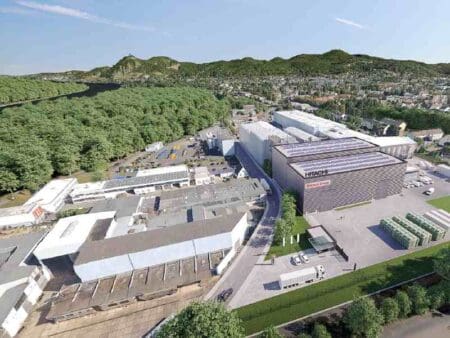
Hitachi Energy has inaugurated expanded transformer manufacturing facilities in Bad Honnef, Germany, bringing the site’s production space to 15,000 square metres. The completed project adds a production hall and machinery while modernising existing facilities for large power transformers. It forms part of the manufacturer’s response to electricity network reinforcement and growing demand for equipment used in transmission and distribution.
The 12 November inauguration marked completion of an expansion first announced in February 2024. The factory has manufactured electrical equipment since 1906 and remains a European production base for large power transformers. Attendees included North Rhine-Westphalia’s Minister-President Hendrik Wüst and senior Hitachi Energy executives. The event marks a new manufacturing expansion milestone for an established project, rather than a newly announced investment decision.
Hitachi Energy began the modernisation in 2024 with an initial commitment exceeding €30m. Chief executive Andreas Schierenbeck said that financial commitment had since more than doubled, but the company’s inauguration release did not state a precise final capital value. A separate statement from the city of Bad Honnef describes investment of more than €60m and approximately 100 new jobs; those local figures are attributed to the municipality rather than presented as an additional company announcement.
Large power transformers are essential equipment in electrical transmission and distribution. A transformer changes voltage between circuits through electromagnetic induction, enabling electricity to move over long distances at higher voltage and lower current for a given amount of power. Lower current reduces resistive losses in conductors. At the receiving end of a network, other transformers reduce voltage for distribution and industrial use. These functions make large transformers central to network expansion, new connections and replacement of ageing grid assets.
Producing a large power transformer requires magnetic cores, high-voltage windings, insulation, cooling equipment and mechanically secure connections to be assembled under controlled conditions. Dimensional checks, insulation integrity and electrical performance all affect whether a unit can meet the specification for its designated network connection. Completed transformers must pass the manufacturer’s prescribed tests before transport and site installation. Hitachi Energy has not identified individual machines installed in the new hall, so a particular assembly or test process should not be attributed to that investment without further evidence.
A larger hall can give production teams space for heavy assemblies, safe lifting routes and work that needs extended access around a transformer tank. Its benefit still depends on the availability of components, qualified staff and test facilities. A bottleneck in specialised materials or final testing can constrain delivered units even when assembly space has increased. The 15,000m² figure measures production floorspace; the company has not disclosed how many additional transformers will leave the plant each year.
Network operators across Europe are planning reinforcements to accommodate renewable generation, electrified industrial demand, charging infrastructure and new data centres. These developments often require transformers at different voltage levels and with project-specific specifications. Ordering and delivering a large transformer can also affect the timetable of a substation or grid connection, because installation and energisation depend on other works, electrical testing and the availability of suitable equipment.
Transformer manufacturing depends on supply of electrical steel, conductor material, insulation, bushings, instrumentation, cooling components and fabricated structures. Once a unit is built, its dimensions and weight may require specialised road or rail transport and coordinated installation at the destination substation. Expanding one factory does not automatically expand each upstream supplier or shorten every project lead time, particularly when the network operator needs a transformer built for a particular configuration.
Bad Honnef’s expansion sits within Hitachi Energy’s global manufacturing investment programme, which the company says exceeds $9bn across factories, people and technology. That global amount covers a much wider set of initiatives and should not be attributed to the German site. The company’s stated aim is to strengthen transformer production capacity worldwide as electrification increases pressure on delivery schedules. The programme reflects the capital-intensive nature of grid equipment manufacturing and the time required to establish specialist production facilities.
The Bad Honnef expansion also anchors skilled manufacturing activity in North Rhine-Westphalia. The city says the project has created around 100 additional jobs and brought the site’s workforce to approximately 430. That provides a concrete local employment measure alongside the company’s investment description, although the inauguration material provides no quantified rise in annual transformer output. The manufacturing and testing capabilities will ultimately be assessed against customer specifications and delivery schedules.
With the expanded hall now inaugurated, the next milestones are production ramp-up and shipment of tested transformers to customer projects. Hitachi Energy has not published a timetable for reaching a particular unit output, nor should its wider global manufacturing investment programme be treated as expenditure at Bad Honnef. The new space represents an additional industrial resource whose actual contribution will depend on component supply, testing capacity and reliable execution of transformer orders.