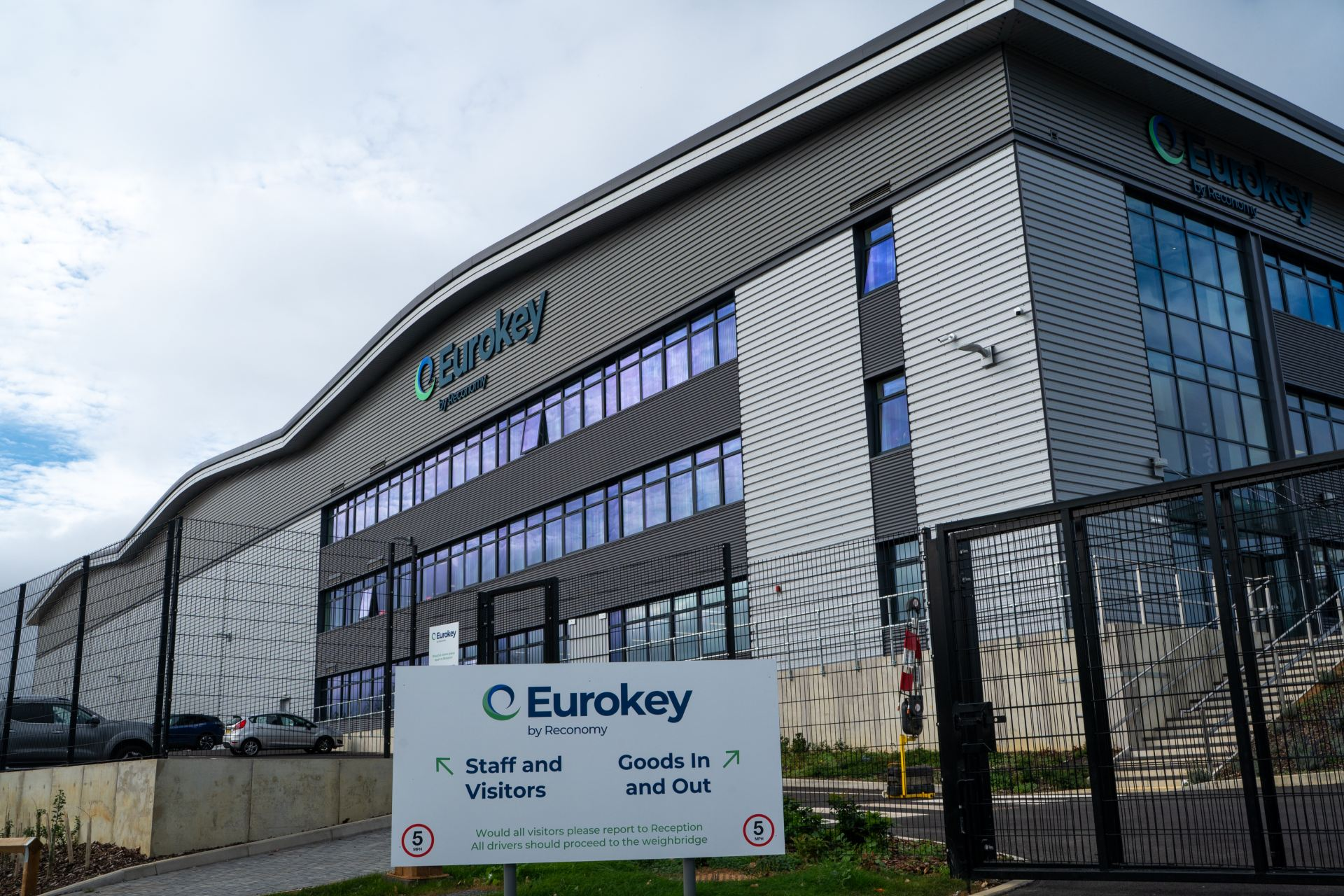
Reconomy has opened a £20m plastics recycling plant in Corby, Northamptonshire, creating a new domestic outlet for packaging recovered from supermarket supply chains. Operated by its Eurokey business, the 138,000 sq ft facility has been designed to recycle up to 38,000 tonnes of plastic material annually and has created more than 30 local jobs. Its official opening on 13 November follows an investment programme first outlined in March, when construction was nearing completion.
The Corby operation forms the second processing stage of a system that begins at Eurokey’s nearby Kettering facility. Plastic packaging used to protect and transport products before they reach supermarket shelves is collected from retailers and grocers, then separated into suitable material streams at Kettering. Those streams are transferred to Corby for washing, cleaning and conversion into pellets. The resulting material is supplied to UK packaging manufacturers, which can incorporate it into new packaging for the businesses that originally supplied the recovered material.
At Kettering, separating incompatible polymers and removing unsuitable material helps limit contamination before the sorted streams reach Corby. The new plant then washes and reprocesses those streams into pellets. Residual labels, dirt and mixed polymers can affect pellet consistency and the performance of newly manufactured packaging, so the effectiveness of collection and sorting influences how much incoming material becomes saleable output. Reconomy has not disclosed the detailed equipment configuration, expected processing yields or the polymer grades assigned to the new lines.
The 38,000-tonne figure is the plant’s rated annual processing capacity; the company has not yet reported actual production at that level. Actual output will depend on the supply and quality of material entering the system, production performance and demand for the resulting grades. The site nevertheless adds an industrial-scale reprocessing step to a collection and sorting network that Eurokey has developed around commercial packaging streams, keeping more of that processing chain within the UK.
Keeping sorting and reprocessing at facilities less than ten miles apart reduces the distance travelled by material between those two stages. Reconomy expects the arrangement to provide supermarket customers with a domestic alternative to exporting the recovered packaging for recycling. The total transport and emissions outcome will depend on collection routes, processing yields and where pellets are ultimately converted into new packaging; the company has not supplied a measured whole-system carbon saving.
UK plastics reprocessors are contending with energy and operating costs while competing with imported recycled resin and virgin polymers. The selling price of recycled pellets depends partly on feedstock quality, polymer type and customer specifications; a buyer cannot substitute any recycled grade into an existing packaging line without assessing the material’s processing and performance characteristics. Eurokey’s established supermarket collection network offers a potential route to supply and demand for the Corby output, although the company has not quantified firm purchase commitments for the plant’s annual capacity.
UK government waste statistics recorded an overall plastic packaging recycling rate of 51% for 2024, but the measure includes material exported for recycling and cannot be read as the proportion processed domestically. Reconomy also points to closures among UK plastics recycling businesses since 2023 as evidence of pressure on domestic capacity. Its supplied total of 19 closed sites has not been independently reconciled against a published underlying dataset and is not presented here as an established national count.
The Plastic Packaging Tax, introduced in April 2022, generally applies when plastic packaging manufactured in or imported into the UK contains less than 30% recycled plastic by weight, subject to its exemptions and reporting requirements. That threshold has created a commercial incentive to source recycled resin, while requirements for product quality and traceable recycled content still govern whether a manufacturer can use a particular material. Domestic production does not, by itself, establish price parity with virgin plastic or prove that every pellet leaving Corby will qualify for a particular packaging application.
Guy Wakeley, Chief Executive of Reconomy, described the opening as “a major milestone for our business and the UK’s plastics recycling industry”, adding that the plant would help increase domestic capacity and reduce dependence on virgin plastic. Zubair Bajwa, Operations Director at Eurokey, said the investment strengthened the company’s ability to serve supermarket and retailer customers after more than three decades in the sector. Both comments accompanied the 13 November opening.
Corby’s ability to sustain its rated annual throughput will be tested by the volumes of suitably sorted material supplied from Kettering, washing and reprocessing yields, equipment availability and customers’ acceptance of the finished pellets. Packaging applications differ in mechanical strength, appearance, processing behaviour and, where relevant, food-contact requirements. Reconomy has not named the manufacturers taking the recycled resin or given a timetable for reaching the full 38,000-tonne processing capacity, so the opening should not be confused with a completed production ramp-up.
With Corby operating as the reprocessing stage of Eurokey’s existing collection and sorting network, the company now has an additional UK route for converting supermarket transport packaging into packaging feedstock. The next measurable milestones will be the actual volumes processed, pellet quality and amount returned into new packaging, rather than the plant’s design capacity alone.