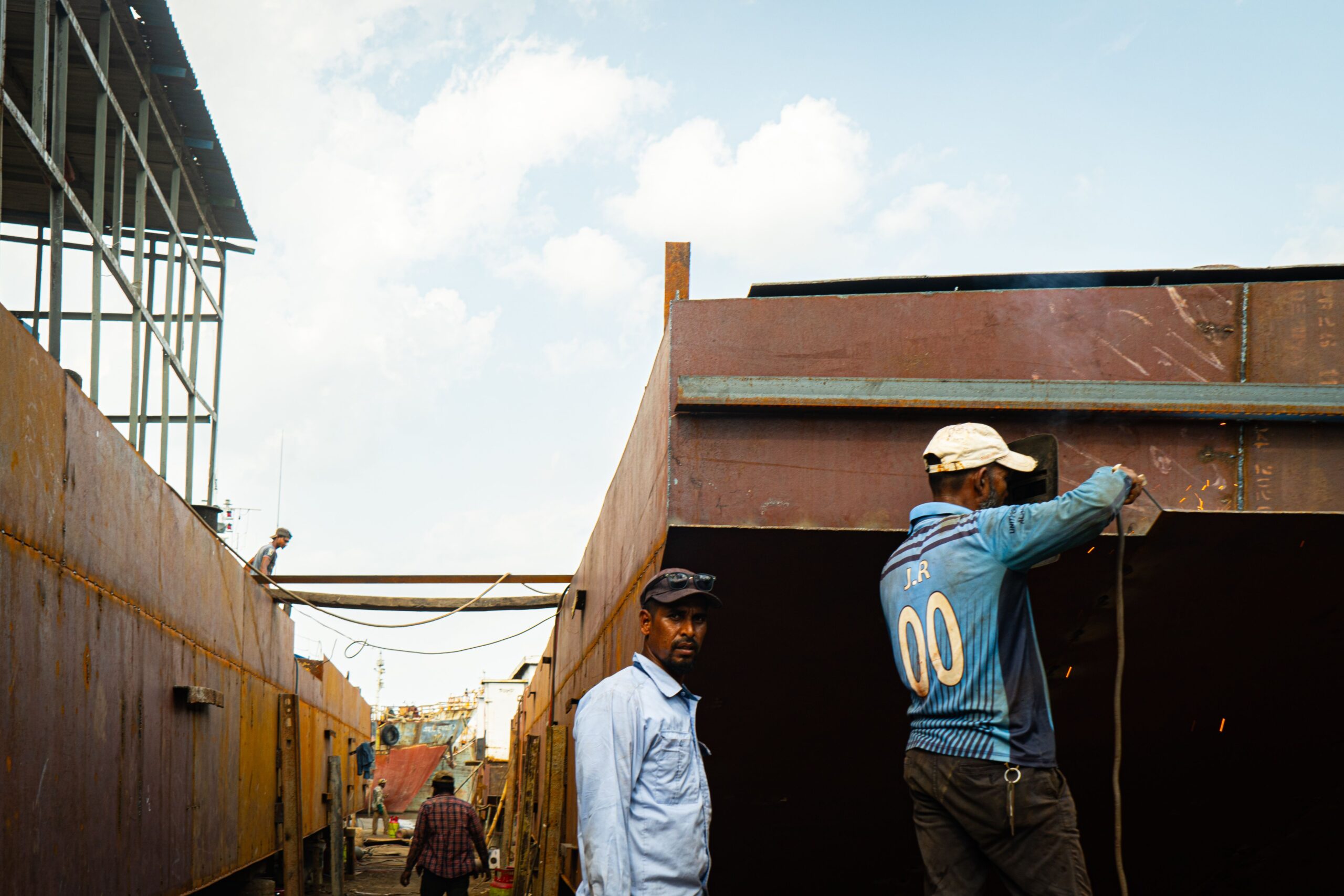
Navantia UK has opened a new fabrication hall at the Harland & Wolff shipyard in Belfast, adding 5,000 square metres of production space to support construction of three Fleet Solid Support ships for the Royal Fleet Auxiliary. The extension incorporates robotic plasma cutting, a mechanised panel line and additional cranes as the yard prepares for large-scale ship fabrication and final assembly.
The facility, named Resurgent Hall, is a central element of a £157 million investment programme covering Navantia’s four UK shipyards. Around £100 million of that programme is being directed to Belfast, where the hall is intended to support more than 900 skilled jobs and apprenticeships associated with the shipbuilding operation.
Its equipment is directed at the early stages of steel ship construction, where plate must be cut, prepared and assembled into panels before larger modules can be built. Robotic plasma cutting uses an electrically generated plasma arc to separate metal along programmed paths, allowing repeated components to be produced from digital cutting instructions. A mechanised panel line then provides a more controlled production route for combining cut parts into larger structures.
Once steel plate has been cut, the rate of panel production depends on positioning, fit-up, welding and inspection as well as machine cutting speed. A mechanised line can reduce variation between repeated assemblies, but that benefit depends on dimensional control, a reliable supply of plate and enough trained staff to operate and inspect the work. Those stages determine how consistently finished panels can move to larger block assembly.
New cranes support the movement of substantial plate and fabricated assemblies through the production area. Lifting systems must be matched to the loads, travel paths and work sequences of the hall, because handling operations connect the individual fabrication stations. Navantia has also begun refurbishing Belfast’s Samson and Goliath cranes, extending the modernisation programme beyond the new enclosed production space.
Navantia UK is the prime contractor for the Ministry of Defence’s £1.6 billion Fleet Solid Support programme. The three vessels, named RFA Resurgent, RFA Reliant and RFA Resourceful, are intended to replenish Royal Navy task groups at sea. Belfast will undertake fabrication and final assembly, making the newly opened capacity directly relevant to the programme’s production schedule.
The hull blocks emerging from Belfast’s fabrication stages will eventually have to accommodate propulsion equipment, electrical services, cargo-handling systems and other shipboard machinery. Dimensional accuracy in early steelwork limits the changes required when outfitters install those systems, especially where cable runs and pipework must pass through structural openings. Fabrication schedules also have to align with suppliers delivering components that must be fitted before blocks are closed.
The Ministry of Defence says work on the three ships remains on schedule and within budget, with entry into service expected in the early 2030s. The facility opening is an industrial capacity milestone within that longer project, rather than completion of the vessels themselves. The pace of steel fabrication, block assembly, outfitting, testing and acceptance will determine how the available capacity translates into delivered ships.
Navantia acquired the Harland & Wolff sites at Belfast, Appledore, Methil and Arnish in January 2025. Across its UK operations, it now reports more than 1,300 jobs and over 340 apprentices, alongside a commitment to create 750 apprenticeships by 2030. Those workforce figures cover the wider business and should be distinguished from the Belfast jobs supported by the new facility.
To produce repeatable ship structures, the new machines must be integrated into qualified work instructions, inspection procedures and maintenance schedules. Robotic cutting requires consistent plate preparation and calibrated process settings; the panel line must hold the dimensions needed for subsequent block construction. Measurement records and traceability connect the machines to the yard’s quality system, with experienced fabricators and apprentices working to the same production controls.
Shipbuilding expansion requires a broad industrial supply chain, extending from steel and fabrication consumables to electrical equipment, industrial gases, lifting machinery and specialist marine components. The new production line increases the yard’s physical ability to handle ship structures, while procurement and skills development will determine whether that capacity can be sustained across successive construction phases.
Ministry of Defence expenditure in Northern Ireland reached £464 million in 2025/26, up 63% in real terms from the previous year. That total includes defence contracts beyond shipbuilding, while the new hall represents a specific investment in Belfast’s fabrication capability and the supply chain supporting the three Fleet Solid Support ships.
Resurgent Hall provides additional fabrication capacity for the Fleet Solid Support programme at Belfast. The next physical milestones will be the production of hull sections, their integration into larger blocks and the movement into shipwide outfitting, commissioning and trials. The Ministry of Defence continues to target entry into service for the three ships in the early 2030s.