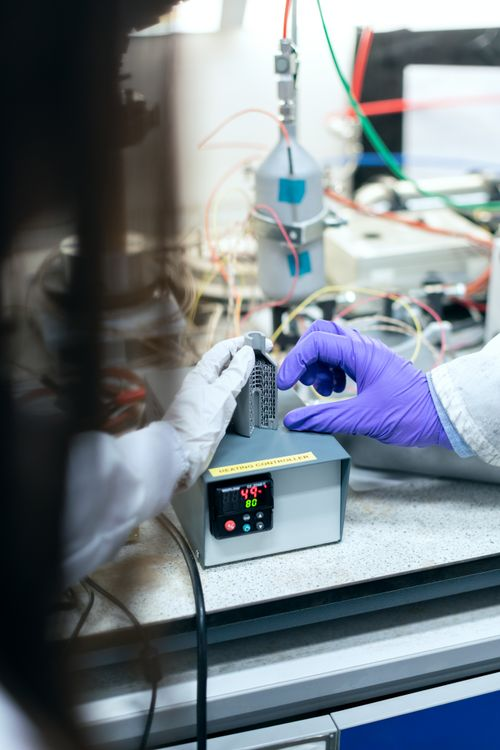
LUT University in Finland has operated a laboratory alkaline water electrolysis system at 1,000 volts using stacks supplied by Stargate Hydrogen and power electronics from ABB. By connecting multiple stacks electrically in series, the researchers demonstrated a configuration that could reduce the current required in industrial hydrogen production systems. Their next work will concentrate on stray currents and the cost of translating the electrical arrangement into larger installations.
Industrial alkaline electrolysers typically operate at around 200 to 400 volts, according to LUT. Raising the system voltage allows the same electrical power to be delivered at a lower current. Because resistive losses in conductors depend on current, the change could reduce the electrical loading of cables, busbars and power conversion equipment. The overall saving depends on the efficiency and equipment requirements of the complete installation, including components needed to operate safely at a higher voltage.
An alkaline electrolyser produces hydrogen and oxygen by passing an electric current through water in an electrochemical system containing a conductive electrolyte. Each cell operates at approximately two volts. Reaching 1,000 volts therefore requires a large number of cells connected in series, with the LUT configuration representing nearly 500 cells across its connected stacks. The current flows through the intended electrical circuit while the electrolyte also circulates within the equipment to support the production process.
That circulation creates the main electrical complication. Conductive electrolyte can provide unintended paths between cells at different potentials, allowing stray currents to bypass parts of the intended circuit. Energy lost through these paths reduces the advantage of the higher-voltage arrangement. The researchers are investigating ways to limit stray currents without impairing hydrogen production, making electrolyte and electrical-system design part of the same optimisation problem.
ABB co-funded the study and supplied the power electronics used in the demonstration. Stargate Hydrogen, an Estonian manufacturer, supplied the electrolysis stacks. The research examines whether power conversion technology already employed in solar, wind and battery applications can operate effectively with a series-connected alkaline electrolyser. It changes the electrical architecture around the production process rather than replacing the underlying electrolysis chemistry.
Jero Ahola, professor of energy efficiency at LUT, estimates that electricity supply and power electronics account for about one-quarter of the investment cost of a hydrogen production plant. He outlined an illustrative calculation in which reducing that portion of expenditure by half could lower total plant investment by approximately 10 to 15 per cent. The estimate describes the possible effect of a future equipment-cost reduction; it is not a measured saving achieved by the laboratory system.
Reducing current has implications for the sizing and cost of equipment carrying electricity to the stacks. At the same time, designers must account for insulation, protection and control at the higher operating voltage. The relative cost of these elements, alongside power conversion losses and the behaviour of the electrolyte, will shape a practical commercial design. A voltage increase by itself therefore does not establish the total capital cost or energy consumption of a production plant.
The operating pattern also affects investment economics. An electrolyser supplied predominantly by wind or solar generation may run fewer hours in a year than one operating continuously from a stable electricity source. When annual hydrogen output falls, the original equipment expenditure is spread across fewer kilograms of production. Equipment that can operate flexibly as electrical supply varies may consequently have a different cost profile from a plant designed around constant output.
LUT’s next research phase will use digital modelling, simulation and optimisation to test different series-connected designs and identify methods of controlling the stray current through the circulating electrolyte. The work must consider how electrical losses change across operating conditions and whether a configuration demonstrated in the laboratory can retain its advantages at greater scale. Laboratory measurements and the models will inform decisions about stack connections, electrical components and system configuration.
Earlier stages of the university’s alkaline electrolysis research have been described in scientific publications and doctoral dissertations. A peer-reviewed article covering this particular 1,000-volt system has yet to be published. That places the result at the system demonstration stage while the detailed loss measurements and economic assessment remain part of the continuing programme.
The demonstrated electrical voltage gives LUT and its industrial partners a basis for testing how electrolysis stacks and high-voltage power conversion equipment can be integrated. Work on the electrolyte paths, control arrangements and capital cost will determine which aspects of the design can be carried into larger hydrogen production installations.