
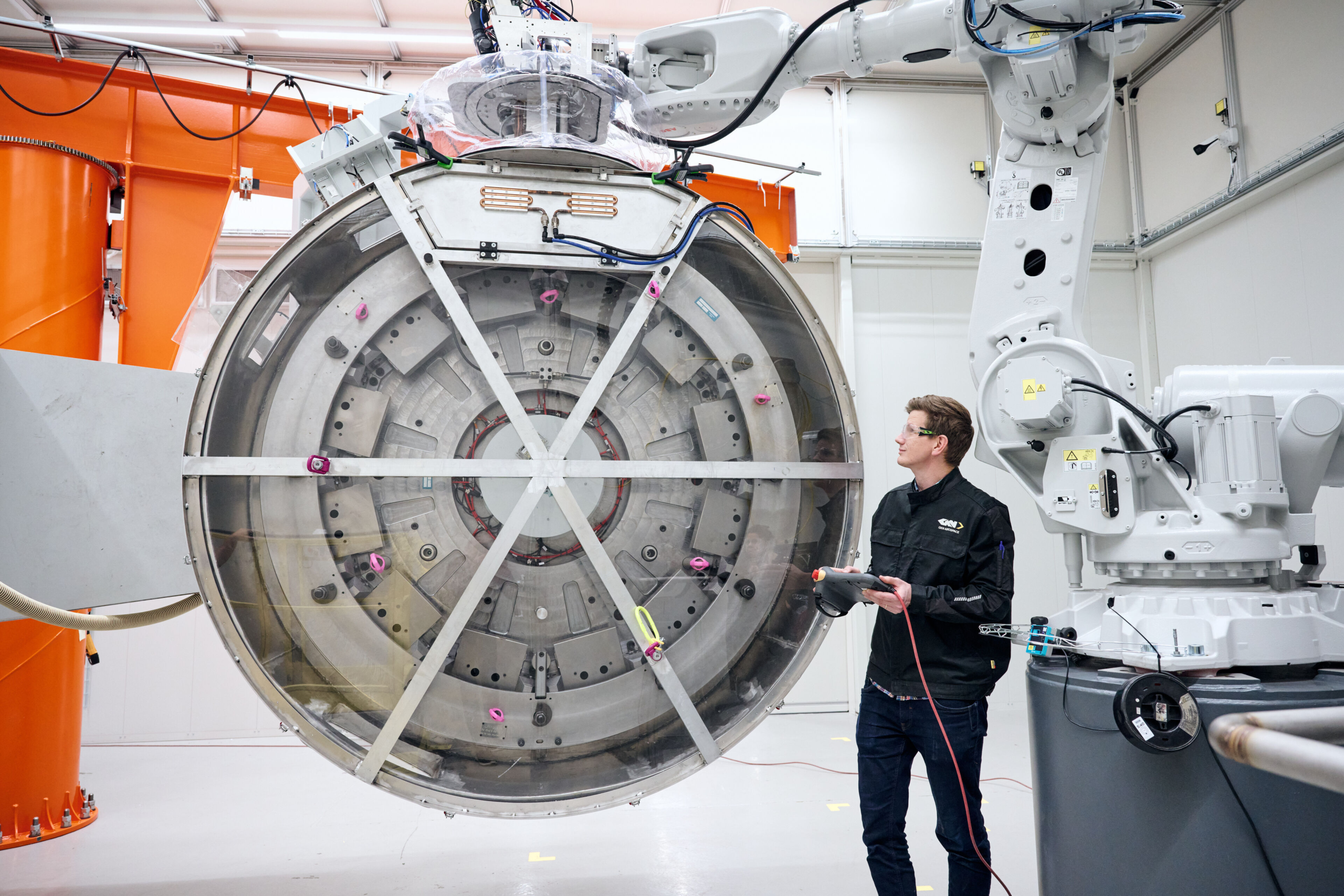
GKN Aerospace has become the first company to obtain Nadcap accreditation for laser wire directed energy deposition, a metal additive manufacturing process being developed for aerospace and defence components. The company’s L-DED-w operation underwent an independent audit covering process controls, personnel qualifications, equipment, raw materials and traceability. The accreditation supports wider use of the manufacturing route, although individual future aircraft parts will still require their own engineering approval and production qualification.
Laser wire directed energy deposition uses a concentrated laser heat source to create a melt pool while metallic wire is fed into the deposition area. Successive passes build material on a prepared substrate or form the geometry of a near-net-shape component. The process differs from powder-bed fusion, where thin layers of metal powder are selectively melted across a build platform. Wire-fed deposition can be attractive where a relatively large metal form is needed before final machining and inspection.
Laser power, wire-feed rate, travel speed and the thermal history of neighbouring passes influence bead formation, dimensional accuracy and metal microstructure. As successive layers heat and cool, residual stresses and distortion may develop, while changes to wire specification or machine settings can alter the deposited material. Manufacturers control these variables through documented procedures, equipment checks and inspection records so a repeatable build can be linked to its production conditions.
Nadcap brings manufacturers and aerospace customers into a shared special-process accreditation system, using common requirements and independent audits to assess production control. GKN’s audit examined operating procedures, personnel qualifications, equipment, material control and traceability. These controls allow successive builds to be compared and provide evidence for investigating deviations when a component fails an acceptance requirement.
Traceability for a deposited component begins with incoming wire, its material certification and the equipment setup. Manufacturing records then capture approved parameters and subsequent heat treatment, machining and inspection where those operations are required. Linking each stage to a specific part helps engineers investigate nonconformances and identify other material made under the same conditions. Local thermal conditions during additive manufacture make these records especially valuable, since the finished properties depend on the deposition history as well as the original alloy.
GKN has previously developed and delivered certified additively manufactured parts that are already flying. The new Nadcap accreditation applies specifically to its L-DED-w process and establishes audited manufacturing controls for future applications. Each component programme still proceeds through its own engineering, inspection and customer qualification requirements before production and flight use. The company has identified the accreditation as a step towards wider adoption of laser wire deposition across aerospace and defence.
Depositing metal close to a component’s intended geometry can reduce the amount of expensive alloy removed during machining. Forged or billet parts sometimes require substantial stock removal to form their final features, whereas wire deposition can build a near-net-shape preform before precision finishing. Material consumption, deposition efficiency, machining time and inspection requirements together determine the economics for a particular geometry and production volume.
Deposited parts may undergo heat treatment, machining, non-destructive examination and dimensional verification before entering service. Each operation has its own acceptance criteria and must be incorporated into the qualified manufacturing route. Representative testing must establish the metal’s integrity and mechanical properties under the loads, temperature changes and fatigue cycles expected in use. Where deposited material is bonded to an existing substrate, the interface and its local properties also require evaluation.
Aerospace configuration control extends from design through manufacture and service. Changes to laser equipment, wire specification or a build strategy must be assessed against the validated operating envelope before the altered process is used. Recorded deposition parameters and inspection results help establish which adjustments fall within the approved procedure. The independent Nadcap audit provides customers with an additional basis for assessing this control system and its traceability.
Manufacturers can apply metal deposition to new components and, under separately approved procedures, certain repair or modification activities. Heat treatment, surface finishing and non-destructive examination must be chosen for the specified hardware and service conditions. GKN’s next industrial steps will involve matching the audited L-DED-w process to individual customer requirements, then demonstrating repeatable results for the relevant parts and production quantities.
The scope of future production will be defined through component-specific approvals, stable manufacturing parameters and delivery of qualified hardware. As more applications move from development to production, the audited records will allow GKN and its aerospace customers to assess deposition quality and consistency across successive builds.


