Oriole Resources has lodged an exploitation licence application for the Wapouzé marble deposit in north-eastern Cameroon, proposing a quarry and crushing operation supplying calcium-rich stone to cement manufacturers. Its internal preliminary economic assessment models 500,000 tonnes of product a year over 24 years, drawing initially on two prospective pits. No exploitation licence has yet been granted, no cement buyer has signed a binding offtake agreement, and the modelled production rate is not a demonstrated plant capability.
Oriole holds an 85% interest in Wapouzé. The proposed first phase would extract 12.3 million tonnes, equivalent to approximately 38% of its existing 32.2-million-tonne inferred Mineral Resource. The initial concept concentrates on two pit areas rather than developing every part of the resource at once. A formal licence decision, detailed engineering, financing and a commercial supply arrangement are still needed before quarrying could begin.
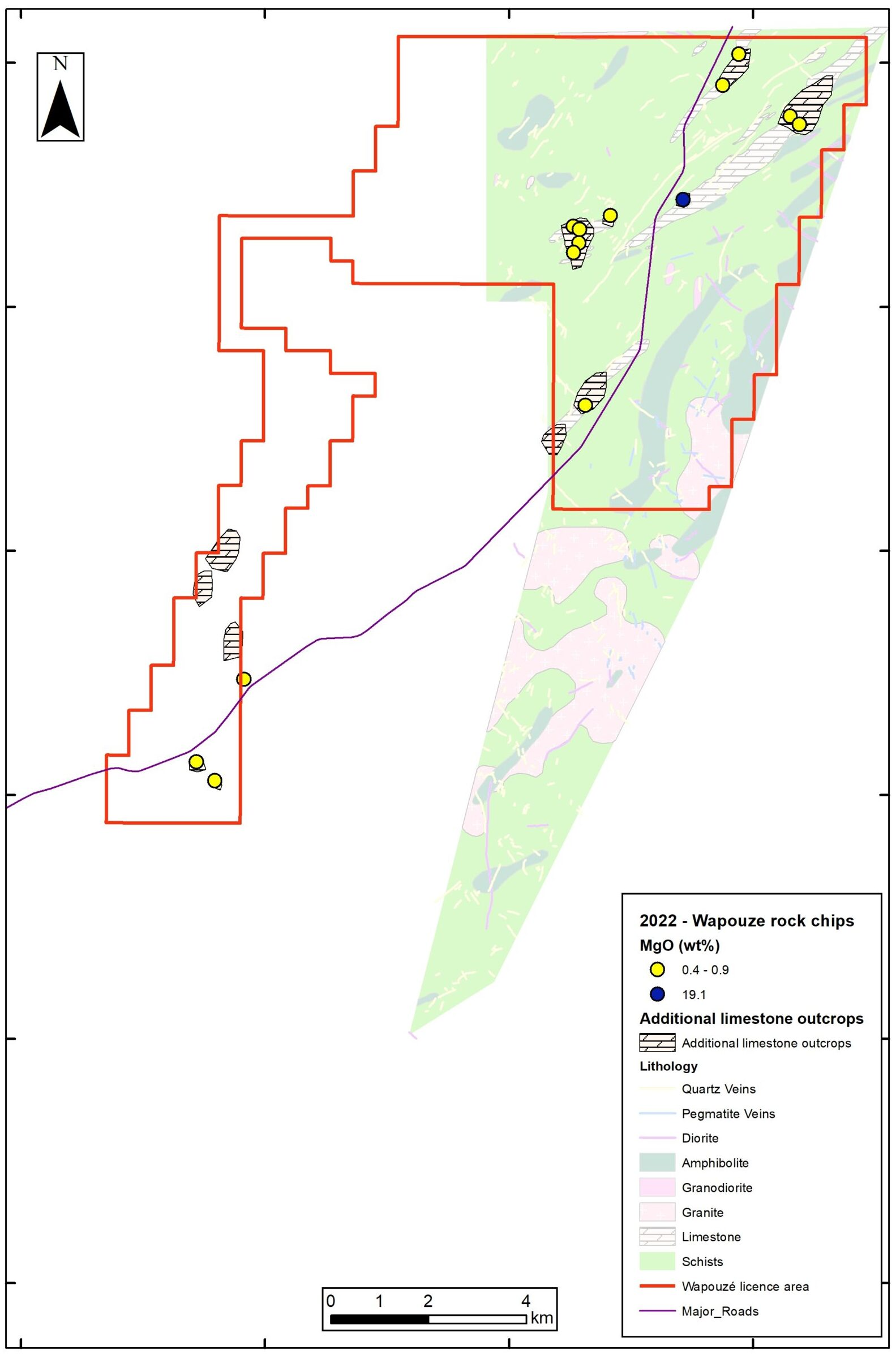
The project moved forward after a maiden Mineral Resource Estimate was announced on 7 October. Prepared under the JORC reporting framework, the inferred estimate covers metamorphosed limestone, commonly described as marble, with average grades of 50.33% calcium oxide, 1.13% magnesium oxide and 6.06% silicon dioxide. These figures describe estimated in-ground material quality, not the specification or recovery rate of a product delivered from an operating processing plant.
A cement works requires limestone or comparable calcium-carbonate feed with a chemistry that can be blended into a controlled kiln raw mix. During calcination, carbonate breaks down and releases carbon dioxide; the remaining calcium-bearing material reacts with silica, alumina and iron compounds at high temperature to form clinker minerals. A quarry’s average in-ground calcium oxide equivalent is therefore only one part of the specification. Variations in magnesium and silica content, moisture and particle sizing also affect processing and blending requirements at the receiving plant.
Oriole proposes crushing and blending quarry material to produce a homogeneous product. In practice, feed consistency depends on the varying composition of mined rock, selective extraction, stockpile management, crushing stages and quality control sampling. The company has not provided a final process flowsheet, equipment selection, crushing capacity or verified customer acceptance specification. Its proposed operating rate can only be assessed against actual quarry design and plant utilisation once those details have been developed.
The licence application has been submitted to Cameroon’s Ministry of Mines, Industry and Technological Development. An environmental and social impact assessment, prepared by a locally accredited consultancy, was separately submitted to the Ministry of Environment, Nature Protection and Sustainable Development on 22 October. The submission of those documents does not establish that either the exploitation licence or environmental permissions have been granted. Conditions attached to any approvals may affect the final project design.
Oriole’s internal preliminary economic assessment considers about 12.3 million tonnes of stone from the first two pit areas, corresponding to roughly 38% of the reported inferred resource. At a nominal 500,000 tonnes a year, that supports an indicative operating horizon of about 24 years before detailed allowances for losses, dilution and processing recovery. The company says further quarry design and economic work are required even to bring the assessment to formal scoping-study standard. These figures are conceptual inputs for planning, not a mineral reserve or an approved mine plan.
The October licence filing follows a broader estimate of 32.2 million tonnes reported in six mineralised domains, with four conceptual pit shells. A separate Exploration Target of 5.5–14 million tonnes sits outside the declared Mineral Resource. Such a target represents exploration potential with insufficient supporting data for resource classification, and should not be added to the 32.2-million-tonne figure as if it were a proven recoverable inventory. The project has not announced an Ore Reserve.
Oriole is discussing potential commercial arrangements with businesses interested in Cameroon’s cement industry, which currently uses imported clinker and local raw materials in differing proportions. The company envisages supplying the proposed crushed marble product to a cement producer, but has not published a customer identity, contract price, transport plan or assured demand. Haul distance, road capacity, crushing costs and chemistry-related blending requirements will influence whether production at the modelled rate is commercially viable. No start date for quarry construction has been announced.
The company has also identified possible alternative uses for particularly high-calcium rock, including chemical lime applications, but the present economic concept is centred on material suitable for cement production. It does not establish that the whole resource meets higher-grade industrial chemical specifications. The projected plant would require consistent sampling and product segregation if different material grades were eventually sold into separate markets.
The company has filed its exploitation licence application with the mining ministry and submitted a separate environmental and social assessment to the environmental ministry. Regulatory consideration, formal study work, financing, process design and customer contracting remain outstanding. The existing 32.2-million-tonne inferred resource supports further appraisal, but neither that estimate nor the separate exploration target constitutes an ore reserve; Wapouzé has not yet reached an approved production stage.