Isembard has opened a £750,000 precision manufacturing factory in Milton Keynes, with two CNC machines already producing components for the advanced engineering supply chain. The new facility operates under the company's franchise model and is intended to expand in stages as it builds its production workforce and machinery capacity.
Muhammad Altalib and Guglielmo Salvatore Pellegrino own and operate the site at Caxton Court, Garamonde Drive, Wymbush. The 2,100 sq ft factory was established in just over three weeks and has begun dispatching parts, some of which are intended for space applications. Its opening is a separate development from Isembard's larger Southwark factory announced in September.
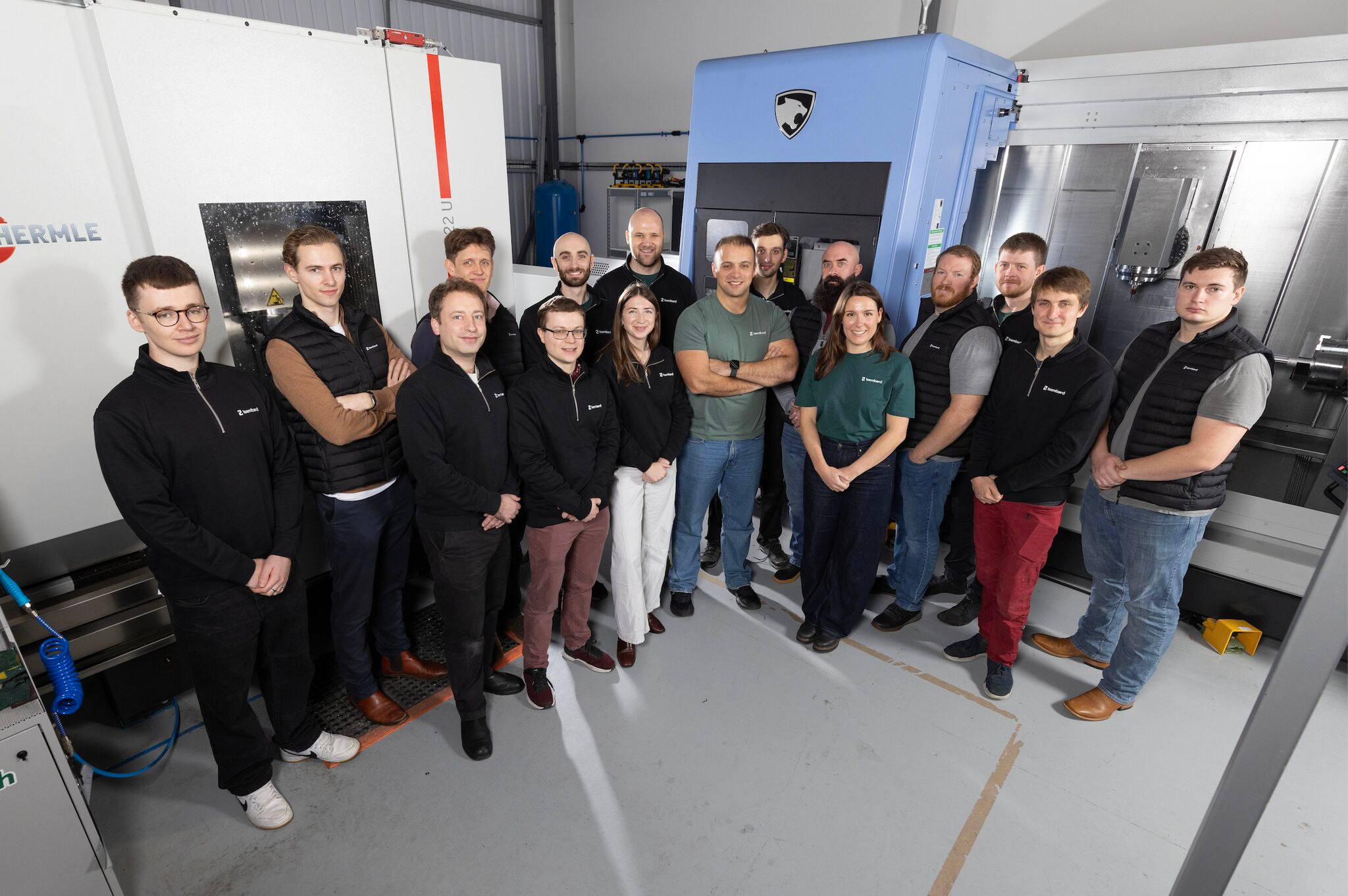
The local operation is starting with two computer numerical control (CNC) machine tools. Isembard provides its franchisees with access to technology, training, branding, customer opportunities and accreditation support, while the franchise owners are responsible for operating the factory. Production management uses MasonOS, the company's digital system for coordinating manufacturing work.
Isembard describes machining accuracy at the new location in terms of a fraction of the thickness of a sheet of paper. This is a broad description of precision, not a published tolerance specification for every component or machining process. Capability depends on the machine, tool, workpiece material, setup, measurement method and the geometry being manufactured.
A CNC machining centre produces parts by controlling relative movement between a cutting tool and a workpiece, removing material along a programmed path. The result depends on more than the programmed geometry. Tool condition, cutting forces, workholding rigidity, temperature and the accuracy of the initial setup can influence the dimensions and surface condition of the finished part.
The two installed machines give the operators capacity to make machined components, but the announcement does not identify their makes, axes, spindle arrangements or operating hours. Those details would be needed to establish which particular jobs the factory can manufacture without outside processing or additional equipment.
Isembard's wider network serves aerospace, defence and robotics customers, and names Anduril, Babcock and Tekever among its customer relationships. Those relationships are at network level; there is no confirmation that this particular factory has received orders directly from each of those customers.
The factory is already recruiting machinists and programmers, and its operators aim to grow to seven employees over the next year. The same plan envisages ten CNC machines and approximately 10,000 sq ft of premises. These are targets for future expansion, rather than current staffing, equipment or occupied space.
Pellegrino, a biomedical engineer who previously founded digital orthodontics business Tie Cast, is general manager at the new location. Altalib previously founded technology business Seedlink and worked in venture capital. Both are now operating an industrial business in which production scheduling, quality and delivery performance must be maintained alongside commercial development.
Under the franchise arrangement, MasonOS supplies a common software layer across otherwise separately operated manufacturing locations. Coordinating work digitally can assist with quoting, scheduling and recording production activity, but the existence of a shared platform does not establish that components can be transferred between factories without verifying equipment capability, process instructions and quality requirements.
Before machining starts, a manufacturer must examine the customer drawing and determine how to make and inspect the component. Material selection, tooling, workholding, machine access and dimensional inspection all affect the route through production. Parts for demanding end uses may also require documented traceability and controls appropriate to the contractual specification.
A network of smaller factories can place capacity closer to customers while distributing some of the cost and operational responsibility among local owners. It must also handle variation between sites: available machine envelopes, staffing, inspection facilities and experience may differ, even when administrative processes use the same software.
The Milton Keynes location gives the franchise access to a regional engineering market covering motorsport, aerospace, robotics and specialist machinery. Its proximity to those sectors is a geographical advantage, but it does not itself demonstrate a confirmed order book or a specified production rate.
Isembard intends its model to support additional UK manufacturing sites and opened a separate large operation in Southwark in September. The Milton Keynes factory differs in its franchise ownership, initial two-machine footprint and locally managed workforce. Maintaining a consistent production and quality system across these different facilities will be essential as the network expands.
Expanding the new site from two to ten machines would increase its nominal equipment capacity, but the eventual output will depend on the mix of components, machining cycle times, labour availability, tool change requirements, inspection and the reliability of customer demand. Production capability will also need to be maintained as new operators and equipment are introduced.
The immediate result is a working precision machining facility with two installed CNC machines and parts already being dispatched. Recruitment and the proposed move into larger premises remain subsequent steps, with no reported deadline for a particular throughput or revenue level at Milton Keynes.