GE Aerospace is investing £30 million in its engine maintenance, repair and overhaul operation at Prestwick, Scotland, under a £57 million programme supported by the Ayrshire Growth Deal. A new 55,000 sq ft building and changes to site logistics are intended to increase overhaul capacity, with the expanded facilities targeted to be fully operational in the first quarter of 2028.
The £27 million Ayrshire Growth Deal contribution comprises £18 million from the UK Government, £8 million from the Scottish Government, and £1 million from South Ayrshire Council. Scottish Enterprise has separately identified a further £6 million of planned investment, additional to the £57 million partnership total. The company has yet to receive that prospective contribution.
The Caledonian facility at Prestwick specialises in aircraft engine maintenance rather than final assembly of new engines. Its existing work includes overhaul of GE’s GEnx commercial engine family, with published service information identifying the GEnx-1B and GEnx-2B among the variants supported. The investment consequently addresses capacity in the installed fleet’s maintenance cycle, where airlines depend on serviceable engines returning from workshops on predictable schedules.
During overhaul, an engine is taken out of service and disassembled sufficiently for its condition to be established against the relevant maintenance programme. Components may undergo inspection, non-destructive testing, repair or replacement before reassembly and return-to-service checks. Different modules follow different routes through a workshop, and findings can change the work scope after an engine has arrived. Parts availability, approved repair procedures, engineering resources and test arrangements all affect the eventual turnaround.
A reconfigured workshop can reduce internal movement and waiting time without altering the certified repairs themselves. Engines and modules have to pass between receiving, inspection, specialist processing, stores, assembly and dispatch areas, while heavy components require suitable lifting and handling equipment. Poorly arranged interfaces between those activities create avoidable movements or queues. GE says its Prestwick scheme will improve layout, access and logistics as well as provide additional physical space, although it has not published a target for annual shop visits or turnaround reduction.
The proposed 55,000 sq ft extension is the most visible element of the work, but the number of additional overhaul positions and the equipment mix have not been disclosed. Integrating new premises with an operating engine shop also requires construction access and equipment changes to be planned around ongoing service commitments. GE says the redevelopment follows more than two years of work with public partners and is being delivered on an accelerated programme; operational commissioning is still ahead.
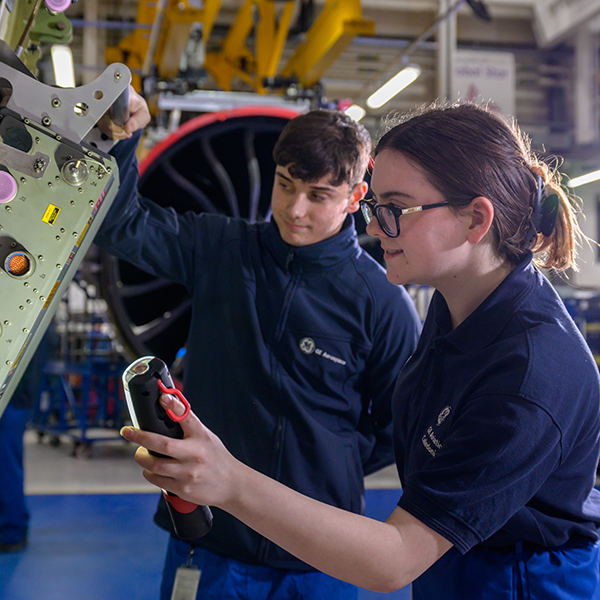
Around 150 people are expected to be recruited over five years rather than at the point construction begins. Engine overhaul demands technicians, inspectors, quality personnel, production planners and specialists in component repair and tooling. Training and authorisation for particular maintenance tasks take time, which means the site’s ability to use new workshop space will depend partly on developing the qualified workforce alongside it.
GE is also providing £75,000 to Ayrshire College for training equipment and a course intended to introduce students to aerospace careers. Approximately 150 apprentices and full-time students are expected to benefit. The college programme is separate from the proposed recruitment of around 150 workers at Prestwick, and participation in the course carries no reported employment commitment.
Prestwick forms part of GE Aerospace’s wider UK manufacturing and aftermarket network, which supplies and services aircraft engines across different stages of their operating lives. A maintenance facility’s effective capacity cannot be read directly from its floor area, because individual engines vary in work scope and the availability of specialist processes. Growth in installed engine fleets and the time spent in overhaul both influence demand for workshop slots, while customers need reliable release dates to plan aircraft operations.
Additional workshop space must be supported by timely movement of engines, repaired components and replacement parts through the overhaul route. An inspection can generate work requiring a separate repair process or additional material, with resulting changes to labour and test schedules. The enlarged facility can accommodate more activity only as those processes, equipment and qualified staffing are brought into operation.
New handling arrangements and equipment will need to be installed and qualified within the maintenance organisation’s existing quality system. Actual shop-visit throughput and turnaround will also depend on the condition and mix of arriving engines, access to approved repairs and the timely return of components. The redevelopment supplies physical capacity whose operating performance will have to be measured after commissioning.
Publicly funded enabling work, private investment in the MRO facility and the college training contribution are being coordinated around an established aerospace employer in Ayrshire. The milestones are nonetheless on different timetables: new physical capacity is targeted for the first quarter of 2028, while the recruitment programme extends over five years. Subsequent reporting of operating capacity and engine turnaround will show how the investment changes the site’s practical workload.