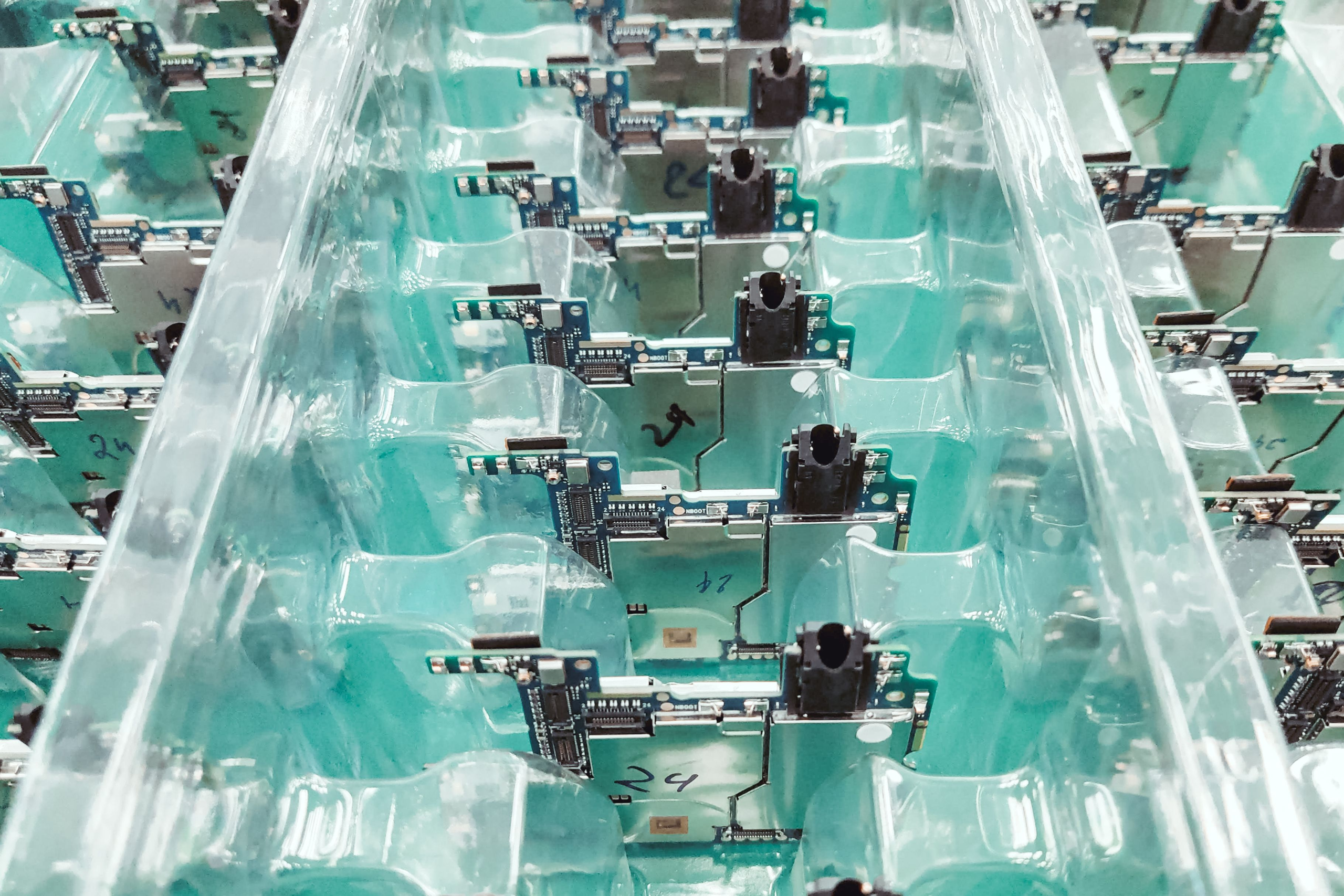
Texas Instruments has introduced a high-speed analogue-to-digital converter designed to record very brief disturbances on the electrical supply rails used by AI computing systems. The ADC34DSO75 combines four 14-bit sampling channels, a maximum rate of three gigasamples per second per channel and on-chip event capture, enabling remote diagnostic equipment to retain selected waveform data rather than continuously transmit every measurement.
TI demonstrated the ADC34DSO75 at the Open Compute Project Global Summit on 12 October. The hardware had already appeared in documentation and an earlier technical demonstration, while the summit presentation brought its event-capture design into a wider power-system context. A transient in a densely loaded rack may begin and disappear before ordinary management telemetry can report it, leaving engineers without the waveform needed for diagnosis.
The ADC34DSO75 has four independent channels with programmable event detection. According to TI’s technical documentation, trigger modes can respond to upper or lower voltage thresholds, changes relative to an established baseline, signal slope or an external trigger signal. The channels can also cross-trigger, allowing an event observed at one measurement point to prompt capture elsewhere. These functions help preserve related waveforms when diagnosing which part of an electrical system experienced a disturbance first.
The device retains selected events in internal memory instead of streaming every measurement indefinitely. TI specifies 256KiB of capture memory on each chip, distributed across the four channels with up to 32,720 samples per channel. Programmable pre-event and post-event windows preserve the waveform before a threshold crossing and the subsequent electrical response, allowing engineers to examine the development of a disturbance.
Each recorded event can include the triggering mode, the voltage at detection and a timestamp derived from an internal counter. That information supports comparison between related disturbances, although correlating events across a larger installation still depends on the system’s synchronisation, wiring and instrumentation design. TI provides serial interfaces for configuring the device and retrieving captured data, and it identifies arrangements for synchronising multiple devices where more measurement points are required.
Sampling speed alone is not a guarantee of a useful diagnosis. Analogue bandwidth, input coupling, sensor selection, electrical noise, calibration and the measurement point all determine which transient features reach the converter. TI specifies buffered analogue inputs and a 3GHz full-power input bandwidth, while each channel consumes about 1.6W at its highest sampling rate. A practical instrument must account for that power demand and the signal-conditioning components around the device.
Persistent remote telemetry becomes more useful when measurements can be triggered and retained without an engineer bringing a portable oscilloscope to the affected rack. Power events may occur intermittently or only when a particular computing workload changes the electrical demand. Local capture can preserve evidence even if the symptoms have disappeared before maintenance staff arrive. Nevertheless, a recorded disturbance does not establish its root cause without correlating electrical behaviour with operating conditions, equipment logs and the protection system.
AI power distribution increasingly combines large aggregate rack loads with low-voltage, high-current supplies near processors. Fast current changes and the electrical response of conversion stages can produce disturbances whose duration is too short for ordinary slow-rate health reporting. The design of connectors, decoupling networks and control loops influences how those events propagate. Distinguishing a fault from a permissible transient requires limits tied to the relevant equipment, rather than assuming that every short voltage excursion represents impending failure.
TI’s separate LMI800PS isolated hot-swap controller addresses the connection and protection of loads on ±400V and 800V DC power paths. Its function is to control startup and interrupt abnormal power flow, whereas the ADC34DSO75 captures selected waveforms that can inform fault analysis. The devices address different stages of electrical reliability; designing a combined monitoring and protection system would require separate electrical validation.
The LMK6B bulk acoustic wave oscillator, also shown at the summit, addresses clock timing variation in high-speed communications. TI cites jitter of 9.6 femtoseconds at 625MHz. Its signal-integrity function is separate from the power monitoring of the ADC34DSO75 and the switching protection provided by the LMI800PS controller.
TI currently labels the ADC34DSO75 as a preview product, with published specifications rather than demonstrated fleet-wide deployment results. Engineers seeking to use its event-capture function will need to characterise the analogue signal path, apply safe electrical isolation where necessary and correlate captured waveforms with equipment logs. The summit announcement did not disclose an operating hyperscale installation or a measured reduction in downtime, leaving field performance to be established through future system integration and testing.