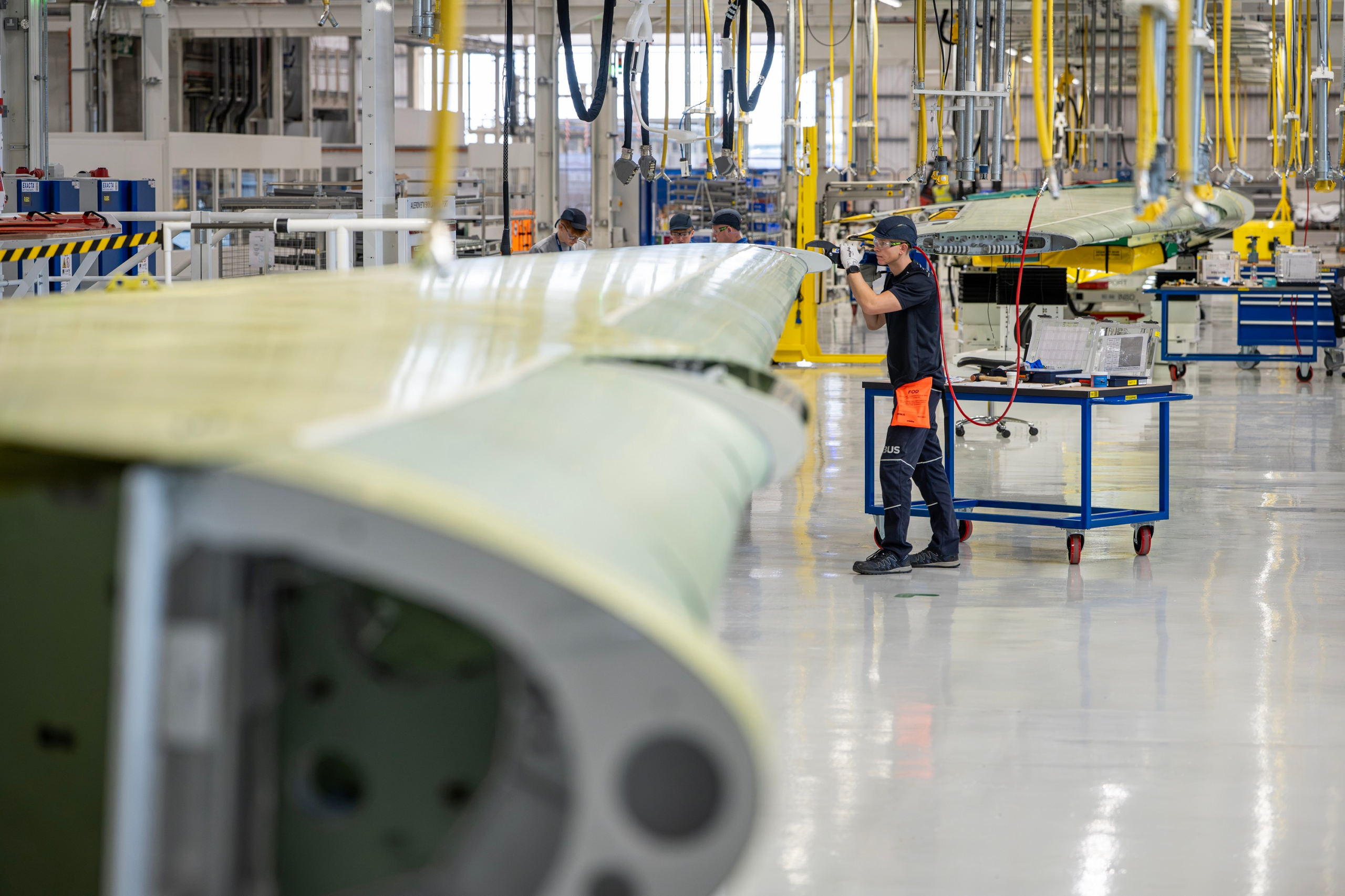
Airbus is investing £150 million to convert the former A380 wing production hall at Broughton into a new A321 manufacturing line, adding six production jigs, an equipping line, and paint facilities as the group increases output of its largest A320 Family variant.
The conversion is due to be completed by the end of 2026, with the first wing already moving through the refurbished facility. Airbus expects all six jigs to be operational by year-end and says the wider programme will support around 480 new jobs at Broughton during 2026, including approximately 250 roles associated directly with the converted factory.
The investment reflects the changing composition of Airbus’s single-aisle order book. Around 70% of the roughly 7,500 A320 Family aircraft in backlog are A321 variants, increasing the pressure on wing manufacturing to keep pace with higher output across the group’s final assembly network.
Jerome Blandin, Head of Airbus Wing, said: “We aren’t just talking about a ramp-up; we’re putting the infrastructure in place to support it.”
Broughton is Airbus’s global centre of excellence for commercial aircraft wing manufacture, with every A320 Family wing assembled at the Flintshire site before shipment to final assembly lines elsewhere. Increasing aircraft output therefore requires capacity to rise at Broughton alongside the downstream assembly system rather than concentrating investment solely at plants where completed aircraft leave the line.
The company is repurposing manufacturing space built for the A380 rather than constructing an entirely separate wing factory. The hall is being re-equipped around the A321 workload, giving Airbus access to an established aerospace production environment while changing the tooling, material flow, and workstation layout to support the current programme.
Wing manufacture is one of the more capital-intensive stages of commercial aircraft production. Large structural assemblies require dedicated jigs, precision drilling and fastening, systems installation, surface treatment, inspection, and traceability, with comparatively little scope to absorb uncontrolled variation as monthly output rises.
Production rate also depends on balance between processes. Adding another assembly jig has limited value if inspection, equipping, paint, logistics, or skilled labour become the next constraint, which explains why the Broughton programme extends beyond the primary wing tooling.
The conversion is part of a broader Airbus manufacturing expansion in the UK. The company is also increasing capacity at its Belfast operation, where a 6,221m² extension is being built for A220 wing production. That programme includes a third autoclave and additional specialist tooling as Airbus targets higher A220 rates.
The two investments serve different aircraft families and manufacturing processes, but both concentrate spending at sites positioned directly on the production-rate critical path. Final assembly capacity can only translate into additional aircraft when large aerostructures arrive at the required volume and quality.
Broughton’s role is particularly difficult to duplicate quickly. Large wing assembly depends on specialised tooling, experienced production teams, quality systems, and a surrounding supplier and maintenance base that has developed around repeated aircraft programmes rather than a single capital project.
The A321’s growing share of the order book also changes the workload within the factory. Production planning, jig utilisation, equipping, surface treatment, material supply, and logistics increasingly have to reflect a mix dominated by the larger variant rather than a more even spread across the A320 Family.
Airbus is pursuing a monthly A320 Family production rate of 75 aircraft. Reaching that level requires engines, structures, systems, interiors, skilled labour, and final assembly capacity to increase in step, leaving the overall programme exposed to whichever part of the industrial chain moves slowest.
The Broughton conversion gives Airbus additional wing capacity at one of those critical points. With the first A321 wing already in the hall, the project has moved beyond construction planning into production ramp-up, where new tooling and additional labour now have to reach stable output without disrupting wings already moving through the site.