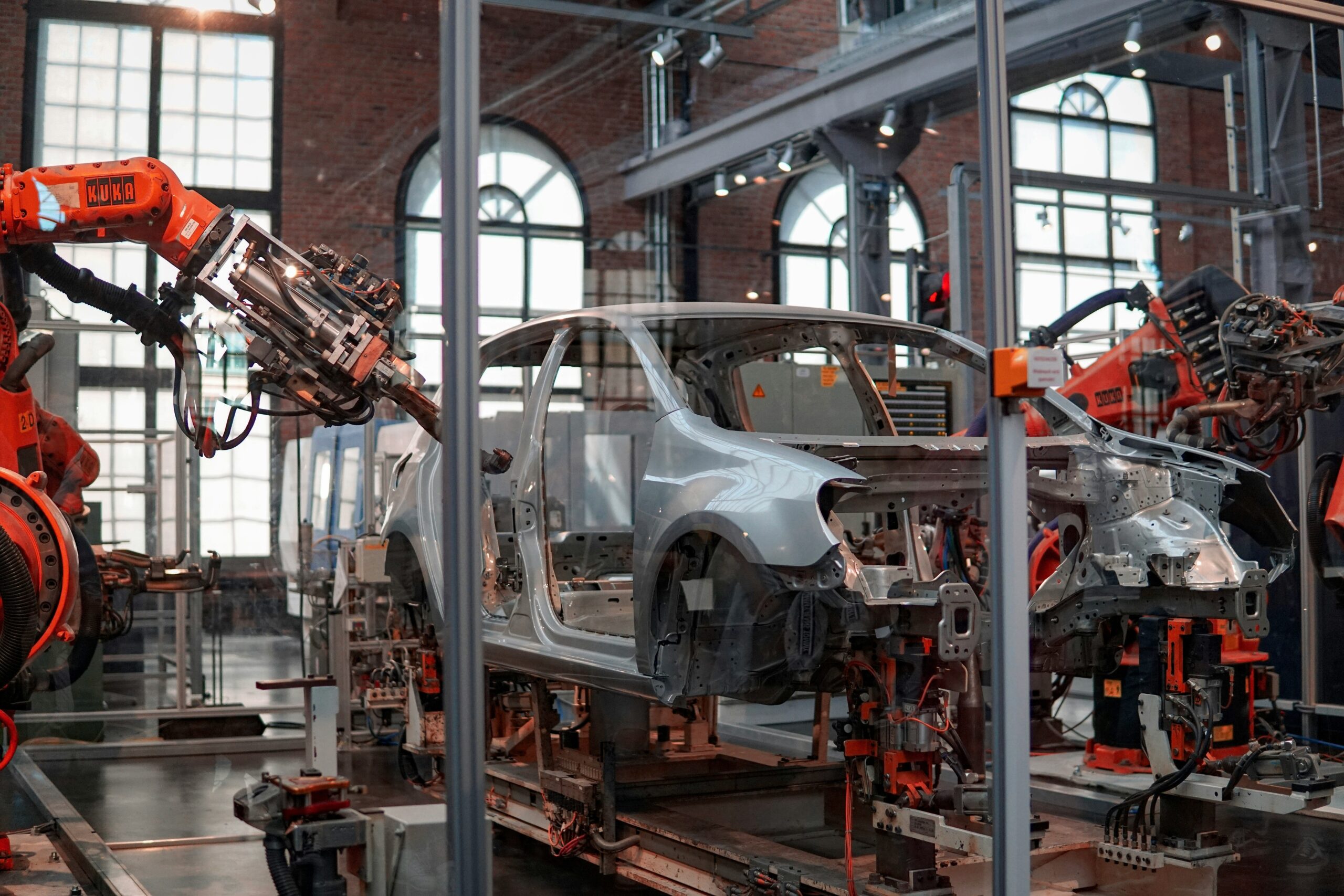
GAC has begun local assembly of its S7 hybrid SUV in Kazakhstan through manufacturing partner ALLUR Group, turning an earlier localisation agreement into operating vehicle production at ALLUR’s Kostanay plant.
The S7 is being produced using a knocked-down, or KD, assembly model under an agreement signed by GAC International and ALLUR in Guangzhou during February. GAC subsequently announced the industrial partnership in April as part of a wider strategy to move from vehicle exports towards local production, sales, and service in Kazakhstan and neighbouring markets.
KD manufacturing involves shipping vehicles in component or partially assembled form for completion at a plant in the destination market rather than importing finished cars. The industrial depth of those programmes varies considerably, from comparatively limited final assembly to operations incorporating welding, painting, powertrain installation, testing, and progressively more locally sourced components.
GAC has not disclosed a detailed local-content percentage for the S7, so the current development should be treated as a local assembly milestone rather than evidence of a fully localised automotive supply chain. The distinction matters because the amount of manufacturing value retained in the host market depends heavily on which processes and components eventually move into domestic production.
Even at an early KD stage, however, the arrangement changes the relationship between the manufacturer and Kazakhstan. ALLUR is now carrying out part of the production process rather than acting simply as an importer or distributor, creating requirements around manufacturing quality, inventory, technical documentation, workforce training, and production scheduling.
ALLUR gives GAC access to an established vehicle manufacturing base rather than requiring an entirely new factory. The Kazakhstan company has annual production capacity of more than 125,000 passenger and commercial vehicles and already works with several international automotive brands.
Using that infrastructure allows GAC to introduce local assembly without first carrying the cost and programme risk associated with constructing a dedicated plant. Shared manufacturing still requires model-specific tooling, quality procedures, parts handling, software, diagnostics, and production training, but much of the basic factory infrastructure and workforce already exists.
The S7 creates additional requirements because it is a hybrid rather than a conventional combustion-only vehicle. Production and final inspection have to account for high-voltage electrical systems, battery management, power electronics, thermal systems, software, and electrical safety alongside familiar body, chassis, trim, and mechanical operations.
That raises the importance of training and process control as locally assembled volumes increase. Automotive quality systems depend on thousands of individual parts arriving in the correct version and sequence, with torque records, software configuration, inspection data, and traceability retained across the finished vehicle.
KD production also changes the logistics model. Instead of sending completed vehicles from China, GAC has to deliver component kits and subassemblies in a sequence aligned with Kostanay’s factory schedule, while maintaining sufficient inventory to protect output without filling warehouses with expensive parts.
A single missing component can prevent completion of a vehicle containing thousands of correctly delivered items. Supplier visibility, customs handling, packaging, inventory accuracy, and production planning therefore become increasingly important as the operation moves beyond launch quantities.
The partnership is intended to cover more than one model. GAC and ALLUR have described plans spanning internal-combustion, hybrid, and battery-electric vehicles, potentially increasing the variety of components, tooling, diagnostic equipment, software versions, and workforce skills that the plant must manage.
Further localisation would deepen the industrial impact. Vehicle manufacturing can create substantially more domestic value when seats, glass, tyres, wiring, interior parts, body components, batteries, or other systems are sourced locally, but suppliers generally require enough stable production volume to justify dedicated tooling and quality approval.
That means localisation normally develops in stages. Initial assembly establishes demand, manufacturing discipline, and logistics; greater local content follows only where volumes and economics support investment by suppliers further down the chain.
Kazakhstan has become an increasingly important market for Chinese vehicle manufacturers. GAC says the combined market share of Chinese brands rose from 3.8% in 2020 to 38.5% in 2025, creating a commercial incentive to move beyond an export-only model as sales become large enough to support local industrial partnerships.
GAC sees the country as a base for wider Central Asian and CIS expansion. The company already operates overseas production facilities in Malaysia, Thailand, Indonesia, Nigeria, and Austria and has been developing additional localisation projects elsewhere.
International manufacturing brings advantages in market access and transport costs, but it also makes product control more demanding. Engineering changes, software versions, quality standards, supplier substitutions, service information, and regulatory requirements have to remain synchronised across factories serving different regions.
For ALLUR, the GAC programme adds another model family to an existing multi-brand factory. For GAC, the S7 is the first physical evidence that its Kazakhstan strategy has moved beyond distribution and agreements into manufacturing operations.
The next measure will be how much of the vehicle moves with it. Local assembly is a clear industrial step, but deeper localisation will determine whether the programme develops into a broader Kazakhstan automotive supply chain or remains principally an efficient method of completing imported component kits closer to the customer.