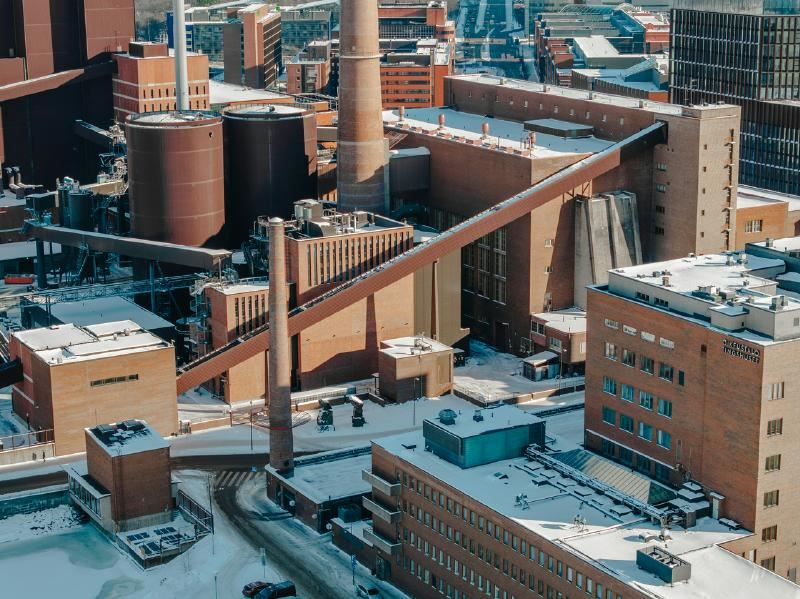
Valmet will supply a flue-gas condensing plant for Helen’s Salmisaari K6 pellet heating plant in Helsinki, adding a heat-recovery stage intended to extract more useful energy from the same quantity of biomass fuel.
The new equipment will be integrated with the existing K6 unit and will complete heat recovery across the K6 and K7 heating plant complex, both of which were previously supplied by Valmet. Start-up is scheduled for the second half of 2027.
Flue-gas condensation recovers energy that would otherwise leave through the stack. Water vapour produced during combustion is cooled until it condenses, releasing latent heat that can then be transferred back into the process and ultimately into the district heating network.
The underlying principle is straightforward, but useful performance depends on how low the exhaust temperature can be reduced and whether the recovered heat can be absorbed effectively elsewhere in the system. Fuel moisture, flue-gas chemistry, heat exchanger design, corrosion control, water treatment, and network return temperatures all influence the amount of energy available.
At Salmisaari, Valmet and Helen are using the city’s district cooling network to improve that recovery. The new condensing plant will be connected directly to the cooling system, allowing the final flue-gas temperature to be reduced to below 10°C without installing separate heat pumps specifically for the condensation process.
Heat collected through the cooling network will then be transferred into Helsinki’s district heating system using Helen’s existing heat pumps. That arrangement makes the project more than a conventional boiler-efficiency retrofit because it links generation, cooling, and heat-pump infrastructure already operating across the wider energy network.
District energy systems increasingly depend on that kind of integration. Individual boilers, heat pumps, waste-heat sources, cooling plants, storage systems, and industrial processes can all become useful thermal assets when operators have sufficient network flexibility to move heat between locations and temperature levels.
The immediate benefit at Salmisaari remains more conventional: higher fuel utilisation. Recovering energy from flue gases allows Helen to increase district heat output without increasing pellet consumption by the same amount, improving the productive value obtained from fuel that has already been transported, stored, and burned.
That can also reduce the amount of energy discharged to atmosphere. Valmet says the project will increase plant efficiency, raise heat production, and reduce emissions, although the company has not published a quantified efficiency gain or annual heat-recovery figure for the installation.
The order was recorded in Valmet’s second-quarter 2026 orders received, but its financial value has not been disclosed. The scope includes the complete flue-gas condensation plant and an associated building, rather than a single heat exchanger added to the existing boiler house.
Integration with the operating K6 plant will require pumps, pipework, controls, instrumentation, heat exchangers, condensate handling, and protection systems to work around equipment that remains part of Helsinki’s heating infrastructure. The engineering task therefore includes maintaining plant availability while another process stage is added to an existing energy asset.
Valmet’s previous involvement with both K6 and K7 should reduce some of that interface risk. As supplier of the existing process systems, the company already has detailed knowledge of the plant configuration, control philosophy, operating conditions, and maintenance requirements into which the new equipment has to fit.
The project also illustrates why efficiency investment remains relevant even while energy systems are changing rapidly. New generation attracts most of the attention around decarbonisation, but operators have large installed fleets of boilers, heat networks, industrial plants, and energy centres whose fuel consumption and emissions can be altered through relatively targeted engineering work.
Where an asset is expected to continue operating for years, improving the amount of useful energy recovered from each unit of fuel can provide a more immediate reduction in resource use than waiting for wholesale replacement. The economics depend on operating hours, fuel cost, heat demand, and the capital required for the retrofit, but the thermodynamic opportunity exists whenever recoverable heat is still leaving the process.
District heating makes that opportunity particularly attractive because recovered energy has an established route to customers. A factory with intermittent waste heat may struggle to find a reliable local user, whereas a city-scale heat network aggregates demand across thousands of buildings and can combine several heat sources.
Helen is using that network increasingly flexibly as it works towards a stated net-zero target for 2040. The Salmisaari retrofit supports that transition by increasing the contribution obtained from an existing renewable-fuel asset rather than simply adding another generation technology alongside it.
The engineering value will become measurable when the plant enters service in 2027. Lower exhaust temperatures, higher useful heat output, reliable condensate management, and smooth integration with the district cooling and heating circuits will matter rather more than the size of the new building. Recovering energy already paid for remains one of industry’s less glamorous, and more persistent, efficiency opportunities.