PFISTERER is increasing manufacturing and qualification capacity for high-voltage connection equipment as grid investment drives stronger demand for components used across transmission, distribution, subsea links, substations, and renewable-energy infrastructure.
The German electrical-engineering group is expanding cable-connection manufacturing at sites in Germany and the United States while construction proceeds on a dedicated HVDC qualification centre at its Winterbach headquarters. It is also preparing a larger production and logistics expansion at Kadaň in the Czech Republic, the group’s biggest manufacturing site for insulators and cable accessories.
The investment programme accompanies stronger first-half trading. PFISTERER reported revenue of €256.7 million, up 20.2% year on year, while adjusted EBITDA increased to €52.4 million from €39.5 million. Its order backlog stood at €340.3 million at the end of June, compared with €312.5 million a year earlier, and already extends into 2027.
The figures provide a commercial backdrop for a capacity programme driven by physical constraints in power infrastructure. Transmission expansion, renewable generation, interconnectors, replacement of ageing assets, industrial electrification, and data-centre demand all require more than cable and transformers. Joints, terminations, insulators, connectors, and other interfaces have to be manufactured and qualified at the same pace.
Those components work at points where electrical, mechanical, thermal, and environmental stresses converge. Failure at a connection can remove a much larger asset from service, which makes repeatable manufacturing and qualification disproportionately important compared with the component’s physical size.
The new Winterbach HVDC qualification centre is scheduled for commissioning during the first half of 2027. High-voltage direct-current technology is increasingly used for long-distance and subsea transmission, particularly where large renewable-generation resources have to be connected across considerable distances.
Connection systems for HVDC applications require dedicated validation because direct-current electric fields behave differently from alternating-current systems, particularly within insulation. PFISTERER received a patent during the first half for a pluggable HVDC connection design intended to manage space-charge behaviour through a redesigned stress-control element and specially developed insulation materials.
The combination of new product IP and additional qualification infrastructure is industrially significant. Developing a connector is only the first stage; the manufacturer must also demonstrate that it performs under the electrical, thermal, mechanical, and environmental conditions required by cable-system suppliers and network operators before it can enter major projects.
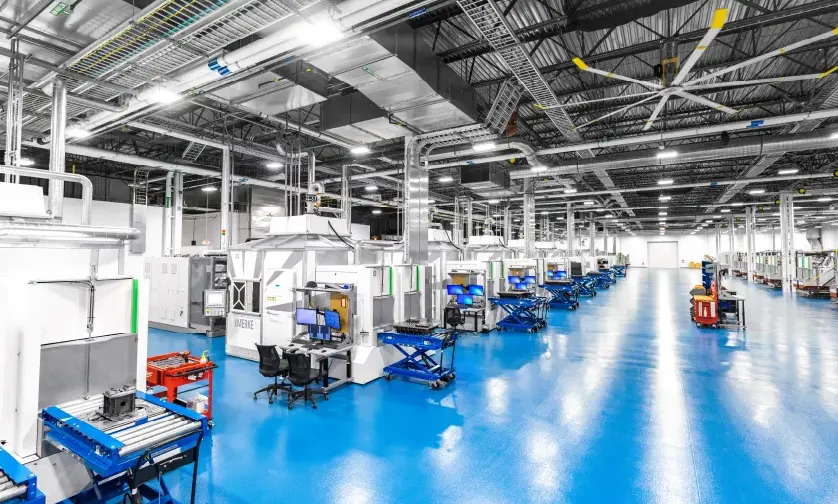
PFISTERER is expanding conventional cable-connection production at the same time. Additional capacity is being added in Germany and the United States, while the Czech operation provides room for a larger manufacturing increase over the coming years.
At Kadaň, the company acquired around 46,000m² of additional industrial land in August, following almost 50,000m² acquired in the previous year. Existing buildings on the latest site add approximately 5,000m² of usable production and logistics space, while the wider landholding creates room for further factory development.
The Czech plant already manufactures insulators and cable accessories for international customers, meaning the expansion surrounds an established operation rather than creating an entirely new supply base. Existing labour, processes, quality systems, utilities, and logistics can therefore provide the foundation for additional capacity as new buildings and equipment are introduced.
Johannes Linden, spokesperson and member of PFISTERER’s executive board, said the group was “expanding capacity, investing in technology and strengthening our international presence”. The company’s first-half figures show Europe and Africa providing the largest contribution to revenue and earnings growth, with regional revenue increasing to €140.3 million.
The capacity programme also reflects a broader problem in grid investment. Major projects can receive planning approval and financing while still facing long lead times for specialised hardware. Transformers are the most visible example, but switchgear, cable systems, connectors, insulators, protection equipment, and engineered accessories can all constrain delivery when manufacturing and test capacity become saturated.
Qualification adds another bottleneck because high-voltage equipment cannot simply be substituted with an untested alternative when a schedule tightens. Utilities and system suppliers need evidence that the proposed configuration has been designed, manufactured, and tested for the relevant voltage, current, cable type, installation environment, and expected life.
PFISTERER is therefore investing at both ends of that constraint: production capacity to manufacture more connection equipment and test capacity to qualify technology for new HVDC applications. The company has not yet disclosed a complete capital programme or final timetable for all of the planned Czech expansion, so owning the additional land should not be confused with having all of the future factory capacity already operational.
The order backlog gives PFISTERER workload while those investments are implemented. The harder measure will arrive as the new capacity becomes available: whether additional production space, cable-connection lines, and HVDC qualification infrastructure shorten delivery constraints and convert strong grid demand into qualified equipment rather than simply adding more orders to an already extended book.